Water is sitting on the porch roof two days after the rain stopped. Or the flat section over your addition has started to bubble, and there’s a stain on the ceiling underneath it. Flat roofing problems tend to sneak up like that, and most homeowners aren’t sure whether they need a patch or a whole new roof.
It’s normal to feel unsure. Flat roofs work differently than the sloped shingle roof on the rest of the house, the materials have names like TPO and EPDM that nobody explains, and quotes can vary wildly. You deserve a plain explanation of what’s wrong and what will actually fix it.
APC Roofing repairs and installs flat and low-slope roofs on homes and light commercial buildings across Central Florida, the Daytona Beach area, the Kansas City metro and Springfield, Missouri. We’ve been in business since 2017, we’re GAF Certified, licensed and insured, and the inspection is free. Call 866-995-0704.
Where you’ll find flat roofing on a home
Your house may have a low-slope section even if your main roof is shingle or tile. Common spots are porches and patio covers, carports, garages, room additions, sunrooms and Florida rooms, and the connecting roof between two parts of a house. Some mid-century homes are flat-roofed throughout. On the commercial side, small offices, shops and strip centers often have low-slope roofs from edge to edge.
A flat roof isn’t really flat
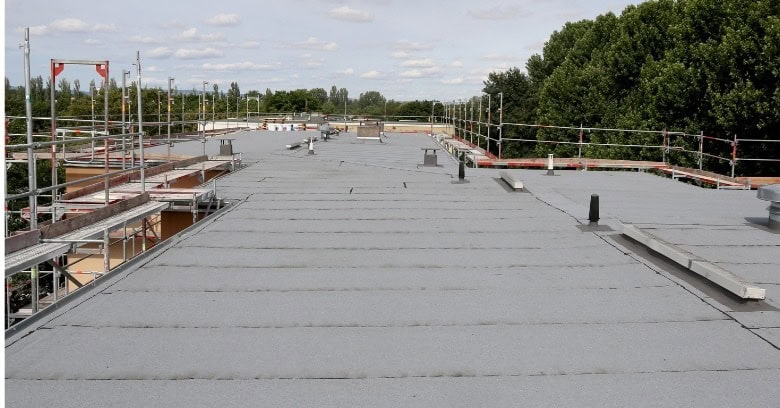
Your “flat” roof is built with a slight slope, usually at least a quarter inch of fall per foot, so water runs toward a drain, a scupper at the edge or a gutter. That small slope is the most important thing about the roof. Shingles can’t be used at that pitch, because water would push back up under them. Flat roofs use continuous membranes instead, with sealed seams.
When your roof’s slope is wrong, water ponds. A common rule of thumb is that water still standing 48 hours after a rain is ponding, and it’s a problem. Standing water works at seams, speeds up aging, grows algae and adds weight, roughly five pounds per square foot for every inch of depth. A coat of sealant won’t fix ponding, because ponding is a drainage problem. The fix is building slope back in, often with tapered insulation, or adding a drain where the water collects.
How climate changes the job
Where you live changes what your flat roof faces.
In Central Florida and the Daytona Beach area, the big tests are heavy afternoon downpours and hurricane season. Your flat roof has to clear a lot of water fast, so drains, scuppers and gutters need to be sized for the hardest rain, not the average. The sun never lets up, either. Reflective membranes help keep the roof surface, and the room under it, cooler.
In the Kansas City metro and around Springfield, the tests are hail, wind, snow and freeze-thaw. Water that ponds and then freezes expands at seams and pulls them apart. Snow and ice can block drains. A membrane that stays flexible in the cold, and good seam work, matter most here.
Flat roofing materials, in plain terms
Most flat roofs today use one of these:
- TPO, a white single-ply membrane with heat-welded seams. It reflects sunlight, which makes it a popular choice in Florida. Read more about TPO roofing.
- EPDM, a black or white rubber membrane joined with tape or adhesive. It stays flexible through cold winters. Read more about EPDM roofing.
- Modified bitumen, an asphalt-based sheet in rolls, often used on homes and small buildings.
- Built-up roofing, layers of felt and asphalt, usually topped with gravel. You’ll see it on older commercial buildings.
On a single-ply quote, ask what thickness the membrane is (it’s measured in mils) and get it in writing. Two quotes for “TPO” can describe very different roofs.
Repair or replace?
Most flat roof leaks start at seams, around pipes and vents, at the edges where the membrane meets a wall or trim, or at a clogged drain. If the rest of your roof is sound, a targeted repair can buy you years. Our flat roof repair page covers that in more detail.
Replacement makes sense when water has soaked the insulation or decking across a large area, the membrane is cracked and brittle in many places, or the roof ponds badly and needs to be rebuilt with proper slope. If that’s where you are, our flat roof installation page explains what’s involved.
How it works
- Book your free inspection. Call 866-995-0704 or request a free estimate online.
- Get a clear, honest assessment and estimate. We’ll check the membrane, seams, edges and drainage, look for trapped moisture and show you photos. You’ll get a written estimate and a straight answer on repair versus replacement. Financing is available for homeowners through Aqua Finance, Fortifi, Hearth and Home Run Finance.
- The work gets done and the site gets cleaned up. You’ll know the timeline before we start.
On a flat roof, small leaks don’t stay small for long. Water spreads through the insulation under the membrane, and every rain makes the repair a little bigger.
Flat roofing questions
Is some standing water on a flat roof normal?
A few small puddles that dry within a day or two usually aren’t a concern. Water that’s still there after 48 hours, or a puddle that keeps getting bigger, points to a drainage problem that should be fixed.
What’s the best flat roofing material for my home?
It depends on your climate, the size of the roof and how much it gets walked on. In Florida, a reflective TPO roof is a common choice. In Kansas City and Springfield, EPDM’s cold-weather flexibility is a plus. You’ll get the trade-offs for your roof explained before you choose.
Can you put a flat roof on a porch or addition?
Yes. Porches, additions, carports and Florida rooms are some of the most common flat roofs out there, and you’ll find them on a lot of homes.
Can a flat roof be repaired instead of replaced?
Often. If the insulation underneath is dry and the problems are limited to seams, flashing or a few spots, a repair can keep the roof going.
A flat roof that drains and stays dry
The goal is a roof that sheds water the way it should, a dry ceiling underneath and no surprise bill. Call 866-995-0704 or book your free inspection online, and we’ll tell you exactly what your flat roof needs.