The flat roof over your garage or back addition has been patched so many times it looks like a quilt, and it still leaks after a spring snow. You’re starting to think it’s time for a new one, but you’ve heard flat roofs always leak eventually and you’re not sure what to put up there instead. Good flat roofing in Country Club, Denver comes down to two things: the right membrane and a roof that actually drains.
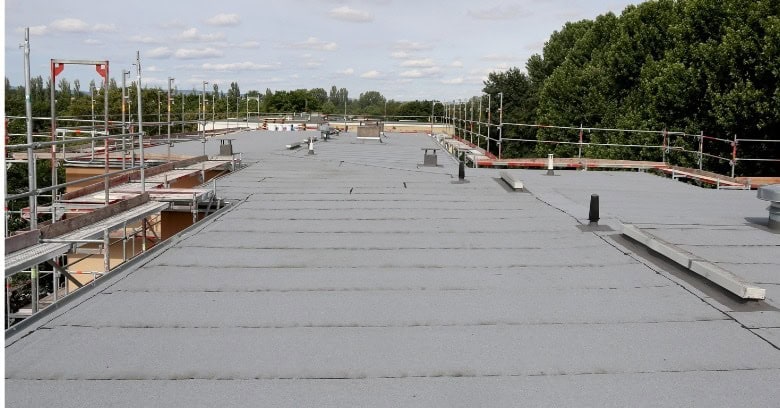
It’s hard to know what you’re buying with a flat roof. You can’t see it from the ground, the materials have unfamiliar names, and two contractors can describe the same job very differently. You should get a plain explanation of the options and the reasons behind the recommendation.
APC Roofing is a GAF Certified contractor, licensed and insured, and the inspection is free. Call 720-902-6940 to have a roofer look at your low-slope roof.
Why flat sections need a different kind of roof
Shingles work by overlapping, so water runs from one onto the next. That only works when the roof is steep enough. On a roof with very little pitch, wind and standing water push water back up under the overlaps. So flat and low-slope roofs get a membrane instead: a continuous waterproof sheet with sealed seams.
On most homes, the flat part is a section rather than the whole roof. It covers a porch, a garage, a rear addition, a sunroom or a dormer, and it ties into a pitched main roof. Some modern homes are mostly flat. The principles are the same either way.
Low-slope membrane options
There are three common choices for residential flat roofing in Denver.
TPO is a white single-ply sheet with heat-welded seams. The white surface reflects the strong high-altitude sun, which keeps the roof and the room underneath cooler. See more on TPO roofing in Denver.
EPDM is a black rubber sheet with seams that are primed and taped. It stays flexible in the cold and is easy to patch. The dark surface absorbs heat, which helps snow melt off but works the material harder in summer. See more on EPDM roofing in Denver.
Modified bitumen is asphalt reinforced with polymers, laid in rolls and often installed in two layers. It’s tough and handles foot traffic well, which helps if you walk out onto the roof.
The best choice depends on what’s under the roof, how much sun it gets, whether you walk on it and what it ties into. We’ll explain the trade-offs for your roof.
How a low-slope roof is installed
A new flat roof is more than a new sheet on top. Here’s what a full low-slope roof installation usually involves:
- Tear-off and deck check. The old roofing comes off so the deck can be checked. Soft or rotted decking gets replaced.
- Building in slope. Tapered insulation boards can tilt a dead-flat deck toward the drain, scupper or gutter. A small ridge called a cricket can split the flow around a chimney or wall.
- Insulation and cover board. Insulation keeps the room below comfortable, and a hard cover board gives the membrane a firm base that stands up better to hail.
- The membrane. It’s fastened or adhered according to the system, with every seam welded or sealed.
- Flashing at walls and edges. The membrane runs up walls and under siding, and metal edging holds the perimeter down against wind.
- The tie-in. Where the flat roof meets the pitched roof, the membrane goes up under the shingles so water from above lands on top of it.
Membrane work needs dry weather, so the schedule has to follow the forecast.
Drainage: the part that decides how long it lasts
Water that sits on a flat roof finds every weak seam, and it adds weight. In Denver winters, it also freezes and thaws over and over. A properly built low-slope roof sheds water within a day or two of a storm. If you’ve got water still sitting there days later, the slope, the drain or the deck needs attention, and a new membrane alone won’t fix it.
Scuppers and gutters on the low edge need to be big enough for a summer downpour and placed so meltwater doesn’t refreeze in them.
Lay a new roof over the old one, or start fresh?
A recover, where a new membrane goes over the existing roof, can work if there’s only one existing layer and it’s dry underneath. If there are already two layers, or the old roof is holding moisture, it all needs to come off. Starting fresh also lets you fix the deck and build in slope, which a recover can’t do.
Signs your flat roof is due
- Water still standing two or more days after rain or snowmelt
- Seams that are lifting, open or split
- Cracks, blisters or a surface that feels brittle
- Repeat leaks in the room below, especially after snow
- A soft or spongy spot when you walk on it
One or two of these can often be repaired. Our page on flat roof repair in Denver covers that side. When several show up at once, replacement usually makes more sense.
How it works
- Book your free inspection. Call 720-902-6940 or request a free estimate online.
- Get a clear, honest assessment and estimate. We check the drainage, the seams, the edges and the tie-in, test for moisture where there’s a leak and give you photos and a written estimate. Financing is available through Aqua Finance, Fortifi, Hearth and Home Run Finance.
- Your roof gets done and the site gets cleaned up. You’ll get a realistic schedule with your estimate.
A flat roof that leaks a little each storm can soak the insulation and deck underneath before you see a stain. Replacing it before that happens keeps the job simpler.
Flat roofing in Country Club: homeowner questions
Is a flat roof the same as a low-slope roof?
Close. Most “flat” roofs are low-slope roofs with a slight pitch toward a drain or gutter. A truly flat roof doesn’t drain well and usually needs slope built in.
Can I walk on my flat roof or use it as a deck?
You can walk on most membranes for occasional access. If you plan to use it regularly, walkway pads or a tougher membrane like modified bitumen hold up better. Turning it into a full deck takes a system built for that.
Which lasts longer in Denver, TPO or EPDM?
Both hold up well here when they’re installed correctly. Drainage, seams and flashing affect how long a flat roof lasts more than the membrane choice does.
Why does my flat roof leak after snow but not rain?
Melting snow drains slowly and can refreeze at the edges, so water sits against seams and the tie-in for days. That points to drainage or flashing problems more than the membrane.
Book a flat roof inspection in Country Club, Denver
Call 720-902-6940 or request your free inspection online. You can also see everything we do in Country Club.
The goal is a roof over your garage or addition that drains, stays dry through the winter and lets you forget it’s up there. Trust matters.