The snow on your back porch roof melted three days ago, and there’s still a sheet of water sitting up there. Or a brown ring has shown up on the ceiling of the room under the addition, right where the flat part meets the main roof. If you’re looking for help with flat roofing in Cherry Creek, you probably want to know two things: where the water is getting in, and whether this is a patch or a whole new roof.
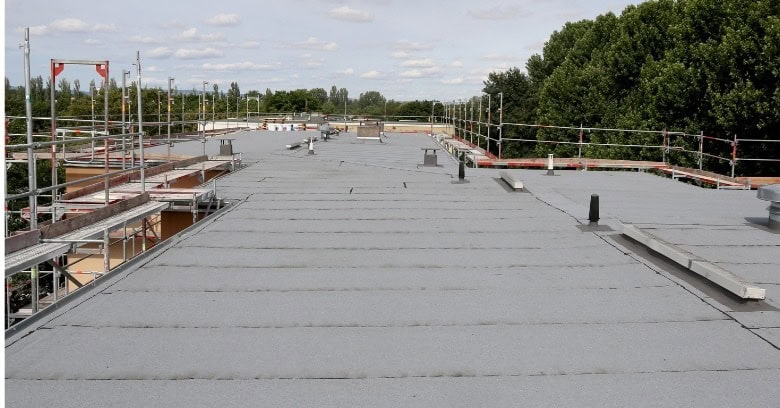
Flat sections are hard to judge from the ground. You can’t see the seams or the drain, and the leak inside often shows up feet away from the spot that failed. That’s a frustrating place to be, especially when you don’t know who to trust with the answer.
APC Roofing is a GAF Certified contractor, licensed and insured, and your inspection and estimate are free. Call 720-902-6940 and a roofer will walk the flat section, check the drains and the edges, and tell you plainly what’s going on.
Where flat roofing shows up on Cherry Creek homes
Most homes don’t have one big flat roof. They have a pitched main roof in shingle or tile, plus a low-slope section somewhere: over a back porch, an attached garage, a sunroom, a rear addition or a dormer. Some modern homes do have mostly flat roofs, and those follow the same rules on a bigger scale.
Shingles need a slope of at least 2 inches of rise per foot. On anything flatter, wind pushes water up under the overlaps. So the flat part of your house gets a membrane instead: one continuous waterproof sheet. The membrane itself rarely fails in the middle. The trouble usually starts at the seams, the edges, the drains and the spot where the flat roof tucks under the shingles.
What Denver weather does to a flat roof
A flat roof in Denver has a harder job than its size suggests.
Snow sits. A pitched roof sheds snow. A flat one holds it, and when it melts during the day and refreezes at night, the meltwater can back up at a frozen drain or scupper. Water that can’t drain finds the weakest seam.
Hail hits it square. On a pitched roof, hail glances off at an angle. On a flat roof it lands straight down. A hard summer hailstorm can bruise or puncture a membrane that’s gone brittle with age, and those small holes are easy to miss without walking the whole surface.
The sun is strong at altitude. At a mile up, Denver gets stronger UV than lower-elevation cities, and it dries out and cracks roofing materials faster. A light-colored membrane like white TPO reflects much of it back. A black EPDM roof absorbs more heat, which helps snow melt but works the material harder over the years.
Temperatures swing. Big swings between a cold morning and a sunny afternoon are normal along the Front Range. The membrane expands and shrinks every day, which strains seams and the metal edges that hold it down.
The details that decide whether it leaks
Drainage. A good flat roof isn’t truly flat. It slopes slightly toward a drain, scupper or gutter, often about a quarter inch per foot. Water still standing two days after a storm usually points to a sagging deck or a clogged outlet, and a new membrane alone won’t fix either one. Tapered insulation or an added drain may be part of the answer.
Seams. On TPO, the seams are heat-welded into one piece, and a roofer runs a probe along every weld to find gaps. On EPDM, seams are primed and taped, and a seam that was installed dirty or damp will lift at the edge over time.
The tie-in. Where your flat roof meets a shingled slope, the membrane should run up under the shingles so water from above lands on top of it. If it was done backward, rain gets driven behind the edge. A wet stripe on a porch ceiling right along the house is a classic sign.
Edges and penetrations. Metal edging clamps the membrane down so wind can’t peel it back. Plumbing vents get a fitted boot, and anything odd-shaped gets a sealed pocket that needs topping up as the sealant shrinks.
Repair or replace your flat roof?
A leaking flat roof often has one small point of entry: a puncture, a lifted seam, a cracked boot. A matching patch, welded or taped in place, can fix it for a lot less than a new roof. That’s often the right call on a membrane that’s otherwise in good shape.
Replacement makes more sense when seams are failing across the whole roof, the membrane has gone hard and split, or the insulation underneath is soaked. Wet insulation is the big one. It stops insulating, it adds weight and it keeps rotting the deck under a sealed membrane. A moisture meter or a small core sample tells you how far the water has spread, even when the surface looks fine.
You’ll get the answer with photos, and the decision is yours. You can read more about flat roof repair in Denver, or see how TPO roofing in Denver compares as a replacement option.
How it works
- Book your free inspection. Call 720-902-6940 or request a free estimate online.
- Get a clear, honest assessment and estimate. We check the drains, walk every seam, look at the edges, the tie-in and the penetrations, and test for moisture if there’s an active leak. You get photos and a written estimate. Financing is available through Aqua Finance, Fortifi, Hearth and Home Run Finance.
- Your roof gets done and the site gets cleaned up. Membrane work needs dry weather, so the job is scheduled around the forecast, and any open area is sealed watertight before the crew leaves for the day.
A small puncture left open through a wet spring can soak the insulation below it. Catching it early usually keeps the fix small.
Flat roofing questions from Cherry Creek homeowners
Can you put a new membrane over my old flat roof?
Sometimes. Building codes generally allow a recover over one existing roof, and only if the insulation underneath is dry. If there are already two layers, or moisture is trapped below, a full tear-off is the right way to go.
Which is better for a Denver home, TPO or EPDM?
Both work well here. White TPO reflects more of the high-altitude sun and has welded seams. Black EPDM handles cold well and is easy to patch. The right pick depends on your deck, your drains and what sits on the roof, and you’ll hear the reasoning behind the recommendation.
Why is my porch ceiling leaking when the flat roof looks fine?
The leak is often at the tie-in where the flat roof meets the main roof, or at a seam or edge a few feet from the stain. Water travels along the deck before it drips.
Does hail damage flat roofs?
It can, especially older membranes that have lost their flexibility. Hail punctures can be small, so the whole surface needs to be walked after a storm. If you file a claim, you file it with your insurer and pay your deductible; we document the damage and work with your adjuster.
Get your flat roof checked in Cherry Creek
Call 720-902-6940 or book your free inspection online. You can also see everything we do on our Cherry Creek roofing page.
The goal is a flat roof that drains, a dry ceiling under the porch, and no surprise bill. Your satisfaction is our reputation.