The main roof on your house handled the last storm fine. The flat section over the sunroom didn’t. Maybe there’s a soft spot in the ceiling, maybe snow sat up there for two weeks last winter and the corner hasn’t looked right since. Flat roofing in Blue Springs works differently from the shingle roof above it, and it needs someone who treats it that way.
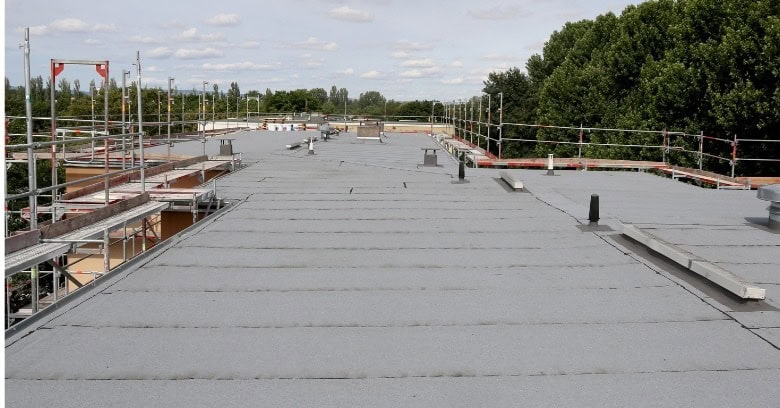
Low-slope sections are easy to forget because you can’t see them from the yard. They also tend to be the first part of a house to leak. Not knowing what’s going on up there, or whether it’s a quick fix or a whole new roof, is a stressful place to be.
APC Roofing repairs and installs flat and low-slope roofs on homes and light commercial buildings in Blue Springs and across the Kansas City area. You’ll get photos of what’s up there and a plain answer about what it needs. We’re GAF Certified, licensed and insured, in business since 2017, and the inspection is free. Call 913-398-5020 and we’ll take a look.
What counts as a flat roof
Almost no roof is truly flat. A “flat” roof has a slight pitch, often a quarter inch per foot or so, just enough to move water to a drain, scupper or gutter. Anything too shallow for shingles to shed water falls into this group.
On Blue Springs homes, you’ll usually find low-slope sections over:
- Sunrooms, porches and enclosed patios
- Attached garages and carports
- Room additions and the short connecting roofs between two parts of a house
- Dormers and bay window tops
Small commercial buildings, shops and detached garages often have flat roofs across the whole building, and we work on those too.
Your options for a low-slope roof
The right membrane depends on how the roof drains, how much sun it gets and how it connects to the rest of your house. These are the common choices for homes and small buildings:
TPO, a white single-ply membrane with heat-welded seams. It reflects summer sun, which helps the room underneath stay cooler. See TPO roofing in Blue Springs.
EPDM, a rubber membrane that stays flexible in cold weather and is easy to patch later. See EPDM roofing in Blue Springs.
Modified bitumen and built-up roofs, the asphalt-based systems found on many older homes and buildings. Some still have years left. Others are ready to be replaced, often with a single-ply membrane.
What a Blue Springs winter does to a flat roof
Kansas City-area winters are where flat roofs show their age. On a pitched roof, snow slides or melts and runs off. On a flat roof, it sits. When the sun warms it during the day, meltwater runs toward the drain, then freezes again overnight. Ice can block the scupper or downspout, and the next round of meltwater has nowhere to go but into any open seam.
Spring brings the next round. Severe storms bring hail that can bruise or puncture a membrane, and heavy rain fills any low spot on the roof. In July, heat dries out older membranes and sealants and can make a dark roof very hot.
The weak spots stay the same through every season: where the flat section meets a wall, where it tucks under the shingle roof above it, and where pipes or vents come through. Most flat roof leaks on homes start at one of those transitions.
Repair or replace your flat roof
A leaking flat roof doesn’t always need to be replaced. If the problem is a few failed seams, a bad flashing or a puncture, and the material underneath is dry, a repair is usually the right call. Our flat roof repair in Blue Springs page explains how leaks get traced and fixed.
When the membrane is cracked or shrinking all over, the insulation or deck is wet, or water ponds in several places after every rain, a new roof makes more sense. Our flat roof installation in Blue Springs page walks through how a replacement is done and how drainage can be improved along the way.
Things you can check yourself
You don’t need to climb onto the roof to spot early trouble. From a window, a deck or inside the house, watch for:
- Water still standing on the roof two days after rain
- Ice that builds up at the drain or scupper in winter
- Stains or soft spots on the ceiling of the room below
- Edges of the membrane that look lifted, wrinkled or pulled away from a wall
- Moss, plants or debris collecting in one area
If you see any of these, it’s worth having someone take a closer look before the next storm.
How it works
- Book your free inspection. Call 913-398-5020 or request a free estimate online.
- Get a clear, honest assessment and estimate. We check the membrane, seams, edges, drains and every spot where the flat roof meets the rest of the house, and you get photos and a written estimate.
- The work gets done and the site gets cleaned up. Old material and debris leave with the crew.
If you’d like to spread out the cost of a new roof, financing is available through Aqua Finance, Fortifi, Hearth and Home Run Finance.
A small flat roof leak can soak the ceiling boards and framing over a sunroom for months before it shows. Catching it early keeps the repair small.
Flat roofing questions from Blue Springs homeowners
Should I shovel snow off my flat roof?
Usually not. Shovels and ice picks can puncture the membrane. If snow is unusually deep or you see ice blocking the drain, call a roofer rather than climbing up yourself.
Can I put a deck or patio furniture on my flat roof?
Not directly on the membrane. A rooftop deck needs to be built so it doesn’t puncture the roof and can be lifted for repairs. Talk to us before adding weight or foot traffic.
Does a flat roof need gutters?
Many do. Low-slope sections over porches and additions often drain to a gutter at the edge. If yours overflows every storm, the gutter or downspout may be too small for the water it’s catching.
Do you work on flat roofs for businesses?
Yes. We repair and install TPO, EPDM and other low-slope systems on light commercial buildings as well as homes.
Flat roofing in Blue Springs starts with a free inspection
You shouldn’t have to wonder what’s happening on the part of your roof you can’t see. Call 913-398-5020 or start your free estimate online.
When it’s done, snowmelt runs off instead of sitting in the corner, the sunroom ceiling stays dry and you know the flat part of your house is ready for whatever a Missouri winter brings.