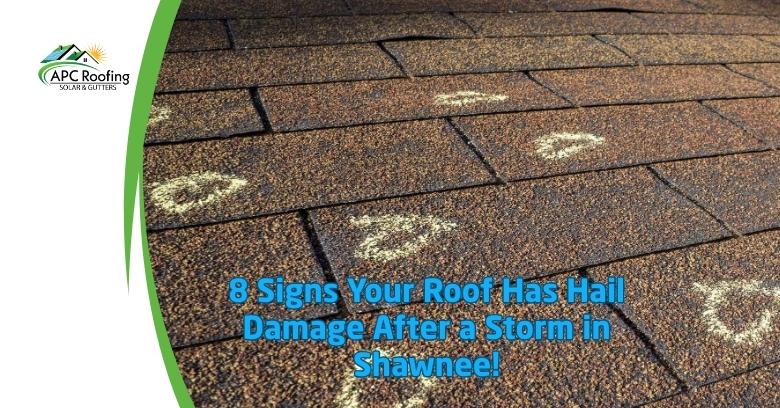
Searching for Hail Damage Roof Repair for a House in Kansas City Metro Area?
APC Roofing examines a slope in the calm after a rough spell, recording what the recent weather left behind.
Call 913-398-5020 to arrange a visit from a roofer.
A Roof Shaped by Moving Air: Not Spread Out Evenly
The eaves, the rakes and the ridge carry the heaviest load of any gust, and a wide open middle takes far less punishment. Blowing air working under a raised flap lifts the shingle set above the flap, so a lone nail beneath a shingle bears a following blast unaided.
A corner of a house sits where two paths of wind meet, so a tighter attachment pattern goes into that area during installation. A course near a structure's outside edge absorbs more force than a course out in the open field, and a closer-set fastener arrangement there is a direct answer to that pressure.
A Roof's Quiet Final Step: No Machinery Involved
Every shingle carries a strip of sealant that fastens down to the course beneath, so every shingle is anchored top and bottom. Wind can undo a bond that summer heat put together, yet a parted shingle looks the same for now.
A broken seal goes unnoticed until the wind returns, and rain then reaches nail heads left bare for the first time. Taken alone, a single loose shingle is no emergency, but a cluster of parted shingles makes a real opening.
The Number on a Package: Read With Care
A laboratory fastens new shingles to a test panel and seals every tab by hand, and moving air is then driven across the surface at a measured speed. Years of sun and cold change how a shingle performs compared with the shingle's very first months in place, and a bench rating stops matching a roof once real weather sets in for good.
A fastener placed high of the nailing band grips a smaller area than a maker intended, so a slope lets go sooner than a printed number suggests. A weathered mat behaves differently from the sample once tested at a factory, which is why an early rating belongs to day one alone.
A Bruise in a Shingle's Mat: the Part That Matters
Storms crossing the colder end of our territory carry the largest stones, while milder weather reaches every other market too. A strike drives surface granules down into the asphalt underneath, and the struck area no longer feels as firm as the surrounding shingle.
What stops rain from reaching a deck lies under the topmost grit, which is why a weak spot at that depth matters most. A struck area of a shingle runs down faster than a sound area beside a struck spot, and small failures appear here and there once hail has covered a broad stretch.
What Else Takes a Beating: Quiet Evidence After the Fact
Impact a shingle survives leaves a mark on a metal cap, and a mark like that does not heal the way flexible siding might. A boot opened by a strike lets water follow a pipe downward instead of around a pipe, and the water that follows shows up in a room below. Marks on a gutter's surface rarely stop a gutter from working, but a flattened downspout holds a run's water behind a flattened point.
A pitted vent cap sits alongside a dimpled fascia and a scuffed drip edge on one visit, so nothing made of trim is left out of a written record. Small dings in the metal and craters in the asphalt tend to come from a single storm, so marked shingles hardly ever stand next to hardware with no marks at all.
A Story in the Grit: More Than Dirt
Colored granules bedded into a shingle block sunlight from reaching the asphalt below, because an uncovered stretch dries out and cracks quickly. A storm's runoff moves dislodged grains into the trough at the eave, and a heap of sand there says a great deal about the slope above.
Bare spots widen as the sheet beneath a bare patch dries out, so a minor patch grows into a larger fault over time. A drift of grit at a downspout fell from the roof plane overhead, and the quantity found says something about how hard a storm hit.
Water Pushed Uphill by Wind: Why a Sound Roof Still Drips
An overlap performs because whatever comes from overhead obeys gravity, so an angled gust finds a route no course was designed for. A ridge vent can take in spray when wind blows straight along the peak, and nothing on the covering needs repair from an event like that.
A Branch Across a Slope: More Than a Scrape
Sudden momentum drives an entire mass through one narrow point of contact, so structural members absorb the shock directly. A board can crack even though the covering keeps a normal shape from above, and a roofer finds the break by tapping the deck and by checking from the attic.
Limbs raking a roof leave sweeping lines of exposed asphalt along the way, so the pattern left behind traces how far that motion carried. Fixing a split board means taking the covering off above the split, so the finished work covers more area than the scar first suggested.
Reading the Underside of a Deck – Quick to Check
A pinprick of brightness through the roof boards points to a hole, and the precise location can be pinpointed against a truss or the end wall. Water leaves brown tide lines across the underside of a panel, and the darkest mark generally sits closest to the actual opening.
Compressed insulation records a history of repeated soaking over time, and a room beneath that area can lose heat as a result. Rain entering at an end wall can land nowhere near an actual hole above, and the answer in that case is a baffle behind the slats, not a repair to the surface.
Down Where People Live: Reading the Stain
A brown ring on the drywall lands downhill of where rain first entered, since water can travel the framing for feet before letting go there. Peeling alongside a joint says the board underneath stayed damp for a while, and a small mark can sit directly under a much larger fault.
A drip at a fan or a light is reason to cut the breaker without delay, and live wiring beside water is left to an electrician. A dark line under a flue traces the outer face of the chase, which puts the search exactly where two different materials meet.
Thin, Exposed and Essential – What Pulls Free
The assembly at a wall junction depends on staying tucked beneath the shingle layers while nailed in place at once, and rain gets in the moment either point gives way. A squall catching the end of a course can tear the drip edge loose, so the section above starts to go the same way once that piece lets go.
Ridge caps sit in the roughest airflow on a roof and can still come away as a unit, and the seam stays unsealed the entire distance the instant that connection fails. A raised end on a vent lets rain slip in under the baffle, and the volume getting in through a gap like that is large, not a trickle.
Domes and Glass Panels – Not the Same as a Window
The frame under a skylight stands above deck level on purpose, and courses step around that rise in a set sequence. A direct knock can craze the outer pane of the unit while the inner pane stays sound, so the entire assembly gets replaced together.
A hard hit on a dome can leave a crack right at the point of impact, and a small fracture can widen with every hot afternoon that follows. Fogging inside a double-glazed skylight shows the seal around the glass has gone, and that fixture gets swapped rather than dried out.
A Rate Nothing Can Match – Watching for the Backup
A cloudburst can push more water at a trough than that trough can hold, and the surplus pours over the front lip instead of down a downspout. Twigs and needles collecting at one spot can seal off an entire stretch of drain line, which puts strain on brackets never designed to take that much moisture.
Not the Final Answer: Made to Stay Put
A patch of poly over a break can buy time until conditions allow proper work, and that covering is never the end of the job. A covering carried past the peak and pinned on each face sends water away, which curbs a sudden surge from ripping the covering free.
A sheet weighted rather than tied down can lift the moment the wind returns, so the damage from a failure can extend beyond the first weak point. Fasteners set into an undamaged course create holes that need sealing afterward, so a roofer plans exactly where every screw for that cover lands.
A Plain-Language Summary of the Damage: What a Roofer Writes Down
Photographs are taken of the whole house while conditions still match what a storm left behind, and nothing gets tidied up or moved before that record is made. Dimensions get written down beside each damaged spot on a visit, because a mark's true size is hard to judge without a reference point.
The next rain shower can change what is visible on a damaged slope, and marks seen now may look different again next week. Whatever gets requested for review comes from that same set of photographs and measurements, and that plain account is the whole of a roofer's part in the process.
When Everyone Arrives Together: Worth a Second Thought
Vehicles with out-of-area plates can work a neighborhood for days after a big storm, but not every outfit working the area is a problem. What gets signed at a doorstep is a binding agreement, not a formality, which is reason enough to ask for a copy to review overnight.
A business rooted in the area tends to stay put once a season passes, so a concern that comes up afterward has somewhere to go. Urgency coming from a salesperson rather than the condition of a roof deserves suspicion, and sleeping on a choice like that is simply good sense.
Weakness That Compounds: Back Again
Shingles that have already let go once are more likely to go again, and less force is required with each fresh round of damage. A creased shingle carries a line that later sun cannot undo, and warm weather afterward does nothing to erase that kind of damage.
Water reaching a deck a second time can carry on into insulation and drywall well beyond that point, and what began outside turns into a household project as well. Plywood swollen and dried repeatedly holds a nail less firmly with each cycle, and new material fastened there in that state will not hold securely either.
Things Worth Checking After a Storm: Outside and Indoors
- Shingles out of line on a single plane, on any elevation of a house.
- A pitted cover on a stack or a vent, with a shape that holds for a long time afterward.
- A heap of mineral grains under a spout, in amounts that keep returning.
- Light where there should be none up top, anywhere along a ridge line.
- A bubble in the finish of an upstairs ceiling, however small a mark looks at first.
- A soft spot in the wallboard near a corner, strongest on the side wind blew from.
- A cracked dome over a light shaft, or daylight showing where the unit meets the roof.
- A length of gutter holding trapped water, on the side that took the wind.
How APC Roofing Approaches Hail Damage Roof Repair in Kansas City Metro Area: Plainly Explained
A visit opens at ground level, crossing the yard and the driveway for anything that came down, and scattered wreckage gets a record made before any cleanup starts. A roofer moves across every plane that can be walked safely, and the framing gets checked from inside once the surface pass is done.
Findings come back in writing, with photographs attached to every item, and nothing in that summary gets dressed up beyond what a roofer actually saw. Every suggestion carries the thinking behind that call, and the choice of what to do next belongs entirely to the homeowner.
Hail Damage Roof Repair for Homes in Kansas City Metro Area – Inspected and Measured
Reach us at 913-398-5020 and say what you noticed outside.
Snow Over the Shingles: Built to Take More
At the colder end of our territory, a heavy fall can sit on the framing for days, and freezing and thawing in cycles makes the load denser over time. Ice built up along an eave can hold meltwater back behind that ridge of frost, and water held back that way can find a path up under the lowest courses.
At the colder end of our territory, valleys and the sides of a dormer fill well past the general depth, and one section can carry many times what the rest of the roof holds. A slab breaking loose can take a gutter down in one motion, so keeping the ground clear beneath that overhang is worth doing.
A Harder Grind for Roofing Material by the Water – Strain That Builds Fast
A house at the coastal end of our territory can face a gale from breakfast to dark, while rain rides sideways for much of that span of time. A drawn-out shove can flex every shingle tab thousands of times over a day, and failures can multiply the more that sort of weather lingers.
Driven rain can reach seams that stay dry during the rest of the year, and the attic is far from the only place moisture like that turns up. Homes at the coastal end of our territory generally go up with tighter nailing along every edge, and new work in that area follows the pattern already set locally.
A Fix That Blends In: What Homeowners Should Expect
Even identical products change tone after years spent outdoors, and the difference shows plainly in low, slanting light. Replacement shingles near a driveway can catch the eye of anyone passing, and that contrast tends to soften somewhat as the new shingles settle in.
Shingles no longer manufactured get swapped for the nearest equivalent, which is worth knowing before work begins. When much of a face has been patched, piecing the work together stops making visual sense, so a homeowner sometimes chooses to redo one full side instead of patching further.
What a Homeowner Should See Afterward – the Details That Hold Up
Replacement shingles bed in as though installed on the original day, and the reveal of each course matches the courses nearby. Each flashing piece laps the piece set lower on the slope, so sealant only backs up the main barrier, not the whole defense.
No fastener shows on the visible face of a completed area, and nothing sits crooked or cuts through the mat underneath. A snapshot taken soon after a repair is worth saving for the future, since a later inspection can see exactly what section was replaced and when.
If Hail Damage Roof Repair is why you searched in Kansas City Metro Area, get in touch with APC Roofing at 913-398-5020 to arrange for a roofer to come out. What the weather left behind gets examined closely and photographed, and any question that comes up gets answered on the spot.