Commercial property owners along Florida’s Atlantic side face a problem inland owners rarely consider, that the roof is not just fighting sun and rain; it is fighting chloride-laden air that drifts in every day of the year. A single-ply membrane that performs well in Orlando or Sanford can age noticeably faster a mile off the water and fasteners, flashings, and edge metal often fail before the roof field does. For an owner of a strip retail building on Ridgewood Avenue or a warehouse bay near Flomich Street in Holly Hill Florida, that difference shows up as repeat service calls, tenant complaints, and a shortened replacement cycle.
That is a large part of why metal roofing has become the default conversation on commercial re-roofs in this stretch of Volusia County. Properly specified metal roofs routinely outlast membrane systems by two to three decades, handle high wind uplift with tested assemblies, and can often be installed over an existing low-slope roof without a full tear-off.
This article breaks down how commercial metal roofing systems actually work in a coastal Holly Hill and Daytona Beach, Florida, setting, including the two main panel types, why the substrate and paint system matter more than the profile, what the Florida Building Code and product approval process require, relative costs and service life, retrofit strategy, common failure modes, and how hurricane season shapes the installation calendar.
The Coastal Chemistry Nobody Budgets For
Substrate Matters More Than Panel Shape
Most commercial metal roofing panels are rolled from Galvalume steel in AZ50 or AZ55 coating weights, and that is an excellent product across most of the state. The complication is cut-edge corrosion. Every sheared end, every field-cut penetration, and every trimmed valley exposes raw steel, and in salt air that edge begins to bloom long before the coated face shows wear. Holly Hill sits roughly one to two miles off the Atlantic with the Halifax River on its doorstep, so the exposure category is genuinely marine, not sort of coastal.
Aluminum panels are the usual answer within that salt-spray band. Aluminum does not suffer cut-edge corrosion the same way, which is why experienced roofing companies specify it on buildings close to the water, even though it costs more and moves roughly forty percent more than steel with temperature change. Further inland, around the western edges of Daytona Beach, Florida, Galvalume is often perfectly appropriate.
Paint Systems and Fasteners
The finish is a durability spec, not a color choice. A PVDF resin finish that is sold as Kynar 500 or Hylar 5000 resists chalking and fading in Florida ultraviolet far better than an SMP polyester and the difference becomes obvious around year twelve. High-SRI reflective colors also help meet Climate Zone 2 energy expectations, which push re-roofs toward roughly R-20 continuous insulation.
Fasteners deserve equal attention. Screws should be 300-series stainless or a long-life coated equivalent, and keep dissimilar metals apart: copper or lead flashing paired with aluminum or Galvalume sets up galvanic corrosion that can chew through a detail in a few seasons.
Two Metal Systems, Two Different Buildings
Structural Standing Seam
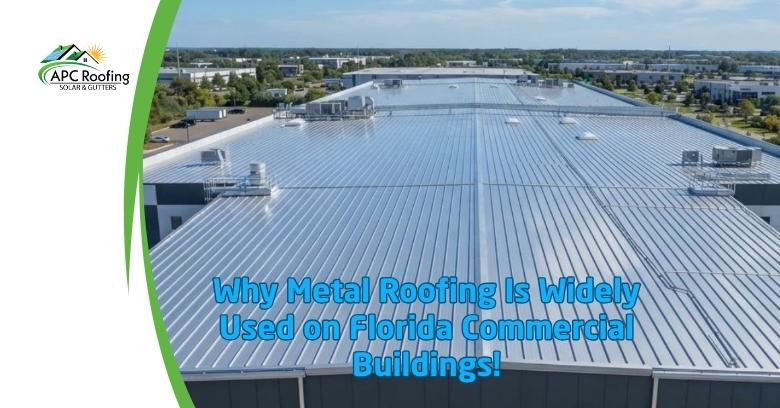
Standing seam panels use raised seams of roughly one to three inches with concealed clips, so no penetrations are exposed in the roof field. Structural versions can run down to a quarter-inch-per-foot slope, which is what makes them viable on the low-slope decks that dominate commercial stock along Mason Ave and Nova Road.
Key decisions within the category:
- Mechanically seamed 180-degree double-lock for the highest uplift and water resistance, versus snap-lock for faster, lower-cost installs on steeper slopes.
- Floating clips on long panel runs to absorb thermal movement of about one inch per hundred feet per hundred degrees of swing, versus fixed clips on short runs.
- 24-gauge as the commercial standard, with 22-gauge used where uplift demands it and 26-gauge reserved for light-duty or residential-scale work.
Because there are no field fasteners, owners can add solar later with clamps that grip the seam rather than penetrate the panel, a real advantage for phased energy work.
Exposed-Fastener Panels
R-panel, 5V crimp, and corrugated profiles screw directly through the panel face into purlins or a deck. They are less expensive, faster to install, and well suited to canopies, mansard facades, equipment enclosures, and light industrial buildings. The trade-off is slope and maintenance: the Florida Building Code and manufacturer instructions generally require a minimum 3:12 slope, and the neoprene washers under each screw typically need re-torquing or replacement somewhere around the fifteen-to-twenty-year mark.
For a Holly Hill Florida owner weighing the two, the practical question is usually how long the building will be held and whether the deck geometry even permits an exposed-fastener assembly.
Code, Approval, and Permitting in Volusia County
Every commercial metal roofing assembly installed here needs a statewide Florida Product Approval number covering the specific panel, gauge, substrate, and attachment pattern. Miami-Dade Notice of Acceptance is not required in Volusia County, though many manufacturers carry it, and reasonable roofing companies will offer it as supporting evidence of performance. Uplift testing typically references UL 580, UL 1897, ASTM E1592, or FM 1-90, and the approval must match the site’s design wind speed for the site, roughly 130 to 140 mph ultimate for Risk Category II buildings in this county under ASCE 7-16, verified address by address.
A permit runs through the local building division and any job above $2,500 requires a Notice of Commencement under Florida Statute 713.13. Senate Bill 4-D, passed in 2022, also softened the old 25 percent rule that roofs originally built to the 2007 Florida Building Code or later generally need only the repaired portion brought up to current code rather than triggering a full replacement. That change alone has made partial metal repairs economically sensible on newer buildings throughout Daytona Beach, Florida.
What It Costs and What It Returns
Side by side, the three common options compare like this, though local labor, access, and coil pricing shift the numbers:
- Exposed-fastener metal – lower installed cost than standing seam, with a service life around 25 to 40 years.
- Standing seam – the highest installed cost of the three, with a service life around 40 to 60 years.
- TPO or EPDM membrane – typically the lowest installed cost, with a service life around 15 to 25 years.
Read as annualized cost, standing seam frequently wins and it wins by more in a marine environment where membrane seams and terminations age quickly. Owners who plan to sell within five years often still choose membrane; owners holding a building for a generation almost always land on a metal roof. A roofing company that will not walk an owner through both sets of numbers honestly is not doing the job.
Retrofit Over an Existing Low-Slope Roof
Most Holly Hill commercial buildings are low-slope decks, so metal usually arrives as a retrofit rather than a ground-up install. Hat channel or sub-purlin framing is set over the existing membrane, insulation is added to meet energy requirements, and the new panels are attached to that framing. Two benefits follow immediately, namely the existing roof stays in place as a secondary barrier and tear-off disposal costs disappear.
Retrofit framing also lets the installer build positive slope where ponding has been a chronic problem, particularly at reverse-slope crickets behind curbs. In most cases, tenants stay open throughout, because the new metal roof leaves no open deck at the end of each workday. That matters enormously to retail and light industrial occupants who cannot simply close for three weeks.
Failure Modes Worth Naming
Metal roofing rarely fails across the whole field. It fails at specific, predictable points:
- Fastener back-out and oversized screw holes on exposed-fastener systems, usually driven by thermal cycling.
- Degraded EPDM washers that have gone hard and no longer seal.
- Sealant-only end laps, which have no mechanical backup once the sealant ages.
- Capillary action drawing water up through panel end laps that lack a proper anti-siphon detail.
- Condensation dripping beneath panels where the vapor control layer or insulation was skipped.
- Ponding at reverse-slope crickets, which accelerates corrosion at the one place water sits longest.
Oil canning which is visible waviness in flat panel areas is worth mentioning separately. It is an aesthetic characteristic of light-gauge metal, not a structural defect, and heavier gauge, striated panels or narrower panel widths reduce it. Owners who understand that in advance are rarely upset by it later.
Timing the Job Around Hurricane Season
Hurricane season runs June 1 through November 30, with peak threat from August through October. Hurricanes Ian and Nicole struck Volusia County within weeks of each other in 2022, flooding Daytona Beach Florida and Holly Hill, exposing every marginal roof detail in the area. The aftermath also demonstrated the second problem of post-storm permit backlogs, coil shortages, and roll-forming queues that stretch lead times well past normal.
Daily summer convective storms compress dry-in windows, so December through April remains the reliable installation season here. Owners who start the specification, product approval, and permitting work in late fall tend to get their metal roofs fabricated and installed before the next season opens. Waiting until damage occurs means competing with everyone else in the county for the same crews and the same coil.
Final Thoughts
Metal roofing has become the dominant commercial re-roof choice in the Holly Hill Florida area and this part of Volusia County for straightforward reasons of longer service life, tested uplift performance, retrofit compatibility with existing low-slope decks, and materials that can be matched to salt exposure. The decisions that determine whether a given installation lasts forty years or twenty are made on paper deciding on substrate, gauge, paint system, fastener metallurgy, and attachment pattern long before a panel reaches the building.
Owners should ask their roofing company for the Florida Product Approval documentation, confirm the assembly matches the site’s design wind speed, and understand which maintenance items will come due at year fifteen. Starting that conversation in the dry season rather than after a named storm is the single largest cost-control lever available. A commercial roof is a twenty-year capital decision, and it deserves to be specified like one!
Key Takeaways
- Aluminum panels generally outperform Galvalume steel within a mile or two of the Atlantic because salt air attacks exposed cut edges.
- Structural standing seam works down to a quarter-inch-per-foot slope, while exposed-fastener panels typically require at least 3:12.
- A PVDF finish such as Kynar 500 resists Florida chalking and fading far better than an SMP polyester coating.
- Retrofit framing over an existing membrane avoids tear-off disposal and usually lets tenants stay open during the work.
- December through April is the most reliable installation window, and pre-season planning avoids post-storm permit and material backlogs.
Frequently Asked Questions
Does a metal roof attract lightning?
No, metal does not attract lightning. Metal is conductive rather than attractive to strikes, and a grounded assembly can actually disperse energy more safely than combustible materials.
Will the building be noisier in rain?
No, not when the panels sit over a deck and insulation. Sound levels are broadly comparable to other commercial assemblies; the drumming people remember comes from uninsulated barns and carports.
Does insurance cover hail dents?
It depends on the policy, since many carriers classify denting without penetration as cosmetic damage and exclude it. Owners should review the cosmetic damage endorsement language before a claim is ever needed.
Can solar panels be mounted without drilling holes?
Yes, on standing seam roofs. Seam clamps grip the raised rib mechanically so that you can add the array without a single penetration through the panel.
Does metal change the wind mitigation form?
It can, because the OIR-B1-1802 form documents roof cover, deck attachment, and secondary water resistance. A properly documented, code-approved metal system often improves available credits.
Can metal be installed over the existing roof?
Yes, in most cases. Hat channel or sub-purlin framing is set over the existing low-slope roof, which stays in place as a secondary barrier and eliminates tear-off disposal.
What causes condensation dripping under the panels?
Warm interior moisture reaching a cold underside of the panel causes it. Correct insulation placement and a vapor control layer in the assembly prevent it.
How long does fabrication and permitting take?
Typically several weeks in normal conditions, combining product approval review, permit issuance, and roll-forming. After a major storm, those timelines can stretch considerably as queues build across the county.