You found shingles in the yard after a windy night, or a strip of roof along the ridge looks lifted when the light hits it. The ceilings are dry, so maybe it’s nothing. Or maybe the next storm finishes what this one started. Wind damage roof repair usually costs less when it’s caught early, and you want to know which side of that line your roof is on.
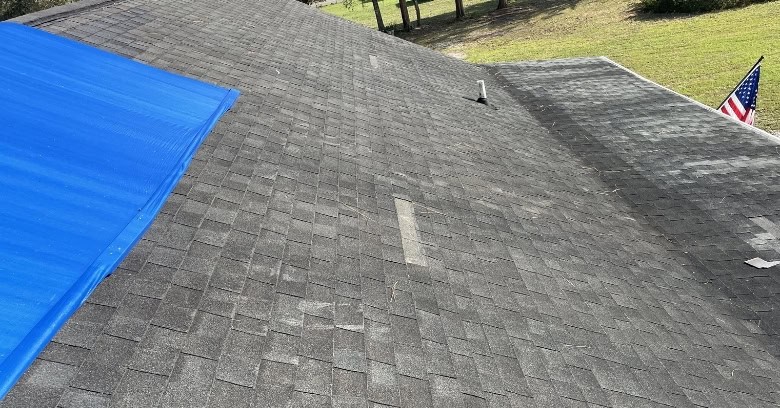
It’s hard to judge from the ground, and nobody wants to pay for a repair they don’t need, or skip one they do.
APC Roofing has repaired wind-damaged roofs since 2017 across Central Florida, the Daytona Beach area, the Kansas City metro and Springfield, Missouri. We’re GAF Certified, licensed and insured, and your inspection is free. Call 866-995-0704 to have someone take a look.
How wind damages a roof
Wind rarely tears a roof off in one go. It finds an edge, works it loose and lets the next gust get underneath. The bare patch you see after a storm usually started as a lifted corner, sometimes months earlier.
Wind pressure isn’t even across a roof. It’s strongest at the corners, along the edges and at the ridge, and that’s where shingles lift first. Once a shingle is raised, wind gets under it and pries with much more force than it could on a flat surface, and the damage spreads from there. That’s why edge metal, the starter row of shingles, ridge caps and nailing patterns matter so much. They’re also some of the least expensive parts of a roof to get right.
Signs of wind damage
Missing shingles are the obvious sign, but they’re not the most common one. Look for, or ask your inspector about:
- Creased shingles. A gust lifts a shingle, folds it back and drops it into place. The fold cracks the shingle, and it leaks within a season or two.
- Broken seals. Shingles that lost their adhesive bond sit flat and look fine but are loose, ready to blow off next time.
- Damaged ridge and hip caps. They’re the most exposed shingles on the roof, so they often go first.
- Loose drip edge and rake metal along the roof’s outer edges.
- Lifted flashing that lets wind-driven rain slip behind it.
- Debris damage from limbs and anything else the wind threw.
Almost all of these take someone on the roof to see.
Wind where you live
In Central Florida and the Daytona Beach area, strong summer thunderstorms bring sudden gusts, and hurricane season brings hours of sustained wind from changing directions. If your damage came from a hurricane or tropical storm, our hurricane damage roof repair page covers what’s different about it.
Around Kansas City and Springfield, the damage usually comes from straight-line winds blowing out of spring and summer thunderstorms. A large storm system can push damaging wind across a whole region in one evening, with no coastline anywhere nearby. Those storms often carry hail too, so check our hail damage roof repair page if you heard it hitting the house.
What wind damage roof repair involves
A proper repair starts by finding the real edge of the damage. Creased and unsealed shingles usually extend well past the bare spot, and fixing only the visible gap leaves the next failure waiting.
From there, damaged shingles come out, and the decking and underlayment that were exposed get checked. New shingles go in with the correct nail count and placement. Shingles that lifted but didn’t tear may need to be hand-sealed, since a broken seal doesn’t reliably reset on its own. In cool weather, that matters even more, because the adhesive won’t bond until the sun warms it. Edge metal and ridge caps get refastened properly rather than just caulked over.
The wind rating on the shingle package
Asphalt shingles are rated for wind in a lab under a test standard called ASTM D7158. Class D shingles passed at 90 mph, Class G at 120 mph and Class H at 150 mph.
There’s a catch. Each rating describes a shingle that was nailed exactly as the manufacturer specifies. It’s a lab result, not a promise about your roof.
Nail count and nail placement
Four nails per shingle is the standard minimum. Many manufacturers require six nails for their higher wind ratings, plus a properly sealed starter row at the eaves and rakes.
Placement matters just as much. Every nail belongs inside the narrow nailing strip printed across the shingle. A nail driven too high holds one layer instead of two. High nailing is behind a lot of repeat wind failures, and you can’t see it once the next row covers it.
Wind damage and insurance
Wind damage from a storm may be covered by your policy. That’s your insurer’s decision. You file the claim and pay your deductible. We photograph and document the damage, write a detailed estimate and work with your adjuster. Be wary of anyone who offers to waive or cover your deductible. Our storm damage roofing page explains how repair-versus-replace decisions get made after a storm.
How it works with APC Roofing
- Book your free inspection. Call 866-995-0704 or request a free online estimate.
- Get a clear, honest assessment and estimate. You’ll see photos of every lifted, creased or missing shingle, not just the obvious ones.
- The repair gets done and the site gets cleaned up. If the damage turns out to need a replacement, many residential shingle projects are finished in a single day.
Wind damage questions
Can lifted shingles be sealed back down?
Often, yes, if the shingle didn’t crease or tear. A creased shingle has a broken mat and needs replacing.
Nothing is leaking. Does wind damage still need repair?
Usually. Unsealed and creased shingles stay watertight until the next strong wind or heavy rain finds them. A quick repair now is much smaller than a torn-off section later.
Should I go up on the roof to check?
No. Look from the ground or a window, take photos and let someone with the right safety gear go up.
How strong does wind have to be to damage a roof?
There’s no single number. The roof’s age, how it was nailed and how well its seals have held up matter more than the wind speed alone. An older roof with weak seals can lose shingles in winds a newer roof shrugs off.
Get ahead of the next storm
Loose shingles hold until the day they don’t, and the weather picks that day. A prompt inspection after a windy storm can turn a torn-off slope next month into a small repair this week.
You want a roof that stays put through the next storm season and a repair you only pay for once. Call 866-995-0704 to book your free inspection.