
The hail stopped twenty minutes ago. From the driveway the roof looks about the same, but there are dents in the gutter, little white marks on the patio furniture, and a neighbor just mentioned a roofer knocking on doors down the street. You need to know whether your roof needs hail damage roof repair, and you’d like to find out from someone who’ll be straight with you.
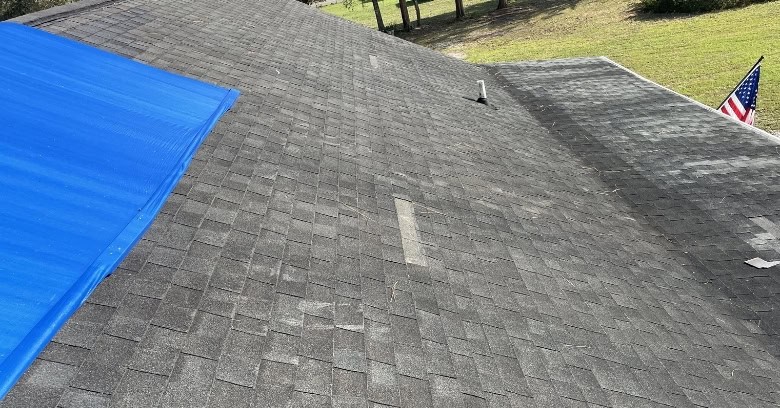
Hail is tricky that way. The damage often doesn’t leak on the day of the storm. It shows up months later, after the bruised spots have weathered through. And after a big storm, it’s hard to know who to trust.
APC Roofing has inspected and repaired hail-damaged roofs since 2017 in the Kansas City metro, Springfield, Missouri, Central Florida and the Daytona Beach area. We’re GAF Certified, licensed and insured, and your inspection is free. Call 866-995-0704 to book one.
What a hailstone does to a shingle roof
A hit from a hailstone can do damage in a few ways at once.
It knocks granules loose. Those granules protect the asphalt from the sun, so a bare spot ages fast.
It can bruise or crack the fiberglass mat inside the shingle. A bruise feels soft when you press it, a little like a dent in a piece of fruit. Over time it turns into a crack, then a leak.
It can break the seal between rows of shingles. A shingle that came through the hail fine can now lift in the next strong wind.
None of that is easy to see from the ground, which is why a close inspection matters.
Signs of hail damage you can check from the ground
You don’t need to climb a ladder to get a first read. Stay off the roof, and walk around the house looking for:
- Dents in gutters, downspouts and metal vent caps
- Dings in the fins of your AC unit
- A sudden pile of granules at the bottom of the downspouts
- Chipped paint or dents on siding, window trim or a mailbox
- Shingle pieces on the ground
Metal is a good witness. It dents in a way that’s easy to see, even when the shingles are hard to read. If the soft metals around your house took a beating, the roof likely did too.
Hail damage or just an old roof?
Not every mark is hail. Real hail damage has a pattern. Hits are scattered randomly, not lined up in rows. They’re about the same size across a slope. They’re heavier on the side of the roof that faced the storm. And they show up on the gutters and vents too, not only the shingles.
Normal wear looks different: granule loss spread evenly across the roof, blistering, or cracking along the edges as shingles age. A good inspector will tell you which is which, and will write down any older wear separately so the report stays honest.
Where hail hits hardest in our service areas
In Kansas City and Springfield, hail is part of spring and summer. Strong storms move through the region every year, and many roofs there take more than one hailstorm over their lifetime. If you’re in the KC metro, see hail damage roof repair in Kansas City or in Springfield.
In Central Florida and the Daytona Beach area, hail is less common but it does happen, usually with the strongest summer thunderstorms inland. Florida roofs also face wind and heavy rain, so a hail-weakened shingle can lose its grip faster in the next storm. See hail damage roof repair in Clermont for our Central Florida page.
What to do after a hailstorm
- Stay off the roof. Wet, damaged shingles are slippery, and walking on them can make the damage worse.
- Take photos from the ground of dented metal, granules and anything on the lawn, and write down the date of the storm.
- Get a professional inspection. A free inspection tells you whether there’s real damage. Finding none is a normal outcome, and it’s good to know.
- Decide about insurance. If there’s damage, you choose whether to file a claim, and you file it with your insurer. Your deductible is yours to pay. We document the damage with photos and notes, give you a written estimate and can meet your adjuster at the roof. Our insurance roof claims page explains the whole process.
Check your policy for reporting deadlines. The longer you wait, the harder it gets to tie damage to one storm.
Repair or replace after hail?
If the damage is limited to one slope or a few shingles, a repair may be all you need. If hits are spread across the roof and the mat is bruised in many places, replacing the roof usually makes more sense than patching it piece by piece.
When you do replace, ask about impact-rated shingles. The top rating, Class 4, has passed a lab test where a two-inch steel ball is dropped from 20 feet onto the same spot twice. In hail country it’s worth a look, and some insurers offer a premium discount for it. Ask yours.
How it works with APC Roofing
- Book your free inspection. Call 866-995-0704 or request a free online estimate.
- Get a clear, honest assessment and estimate. You’ll get dated photos of what we found, a written summary and an estimate for the repair or replacement.
- Your roof gets fixed and the site cleaned up. Many residential replacements are done in a single day, and the yard is swept for nails before the crew leaves.
Financing is available through Aqua Finance, Fortifi, Hearth and Home Run Finance for anything insurance doesn’t cover.
Hail damage roof repair questions
My roof isn’t leaking. Can it still have hail damage?
Yes, and that’s common. Bruised shingles and lost granules often don’t leak for months. That’s why an inspection soon after the storm is worth it.
How do hail damage roofing contractors tell hail from wear?
By the pattern. Hail hits are random, similar in size and heavier on the side that faced the storm, and they usually show up on soft metals too. Wear is more even and tends to follow the age of the roof.
Should I sign with the first roofer who knocks after a hailstorm?
Take your time. Check their license or registration, insurance and local address, and get a written estimate. Be wary of anyone who offers to waive or cover your deductible.
Does hail damage tile and metal roofs too?
It can. Flat concrete tiles can crack, and metal can dent. Whether a dent on metal is cosmetic or functional depends on the panel, so have it looked at.
Get answers before the next storm
A hail-damaged roof that’s left alone tends to fail on its own schedule, usually during the next heavy rain. A quick inspection now lets you decide calmly instead of reacting to a ceiling stain later.
What you want at the end of this is a sound roof, a dry house and a clear record of what happened. Call 866-995-0704 to book your free inspection, or start your estimate online.
Straight answers
How can I tell if my roof has hail damage?
Start with the soft metal around the house, not the roof: dents in gutters, downspouts, vent caps and air-conditioner fins prove damaging hail actually fell at your address. On shingles, hail leaves bruises and granule loss in a random pattern that adjusters count per test square. Do not wait to see if it leaks; a bruised shingle can fail years later, after your notice deadline.
Hail damage is the hardest storm damage for a homeowner to judge, because the worst of it is often invisible from the ground and the most visible parts of it frequently do not matter.
Start with the soft targets, not the roof
Metal shows hail before shingles do. Walk the property and look at gutters, downspouts, drip edge, air conditioner condenser fins, metal vent caps, the mailbox, painted deck rails. Dents in soft metal tell you hail of a damaging size actually fell on this address, at this angle. That single observation beats an hour of squinting at the roof.
Then look at the ground. Piles of granules below the downspouts after a hailstorm mean the shingle surface was hit hard enough to shed its protective layer.
What damaging hail actually is
The National Weather Service treats hail one inch in diameter or larger — about the size of a quarter — as severe. Roughly that size is where asphalt shingles start taking functional damage, though older, brittle shingles bruise at smaller sizes. Strong winds can drive hail in nearly sideways, which is why one slope gets destroyed while the opposite slope looks untouched.
If you want the physics, the NOAA National Severe Storms Laboratory hail primer explains how hailstones form and why the same storm produces very different stone sizes.
What a hail hit looks like on a shingle
A functional hail hit is a bruise: a round, soft spot where the impact fractured the fiberglass mat under the surface. It usually has a dark center where granules were knocked away, and it feels soft and slightly springy under a thumb, like a bruise on an apple. The mat fracture is the damage. Once the mat is broken, water and UV get at the asphalt and the shingle ages fast from that spot outward.
What is not functional damage: blistering, which is a manufacturing artifact with a dry, brittle edge rather than a soft center; normal granule loss on an old roof; scuffs from foot traffic; and marks in a line or pattern, since hail is random.
How adjusters assess it
Adjusters generally evaluate each slope separately, mark off a test area — commonly ten feet by ten feet — and count genuine impact marks inside it. A threshold in the range of eight to ten hits per test square is widely used in the industry as the point at which a slope is considered damaged enough to replace rather than repair. That convention is not written into law, and carriers, adjusters and engineers apply it differently, so treat it as background rather than a rule you can hold anyone to.
Two policy details decide a lot of hail claims before the counting even starts. A cosmetic damage exclusion lets a carrier decline dents that do not affect the roof's ability to shed water — increasingly common on Colorado policies. And a percentage wind and hail deductible can be large enough that a single-slope claim is not worth filing.
Regional notes
Colorado's Front Range sits in the most hail-prone corridor in North America. The May 2017 Front Range storm remains the costliest insured catastrophe in state history at roughly $2.3 billion, and a May 2024 Denver-area storm caused around $2 billion in a few hours. Kansas and Missouri get large hail on the same supercell pattern, often bundled with straight-line wind that adds a second damage type to the same claim.
Because hail is the biggest driver of premium in Colorado, mitigation actually pays there. The Division of Insurance calculated that an impact-resistant fortified roof could save an El Paso County homeowner around $388 a year on average. Class 4 impact-rated shingles cost more up front; in hail country, the credit and the extra survivability often justify it.
The one thing not to do
Do not wait to see whether it leaks. A bruised shingle can look fine for a season and fail two winters later, long after your policy's notice deadline has passed. If soft metal on your property is dented, get the roof looked at within weeks, not years.


















