Hoping to Find Emergency Roof Repair Around Springfield Missouri?
APC Roofing mends the spot where weather gets past the shingles, with the attention on flashing, boots and seams.
Reach us at 913-398-5020 to set up a visit from a roofer.
Where Leaks Come From: the Weak Spots in a Covering
The plain middle of a sloped roof is seldom where rain gets in, as every row overlaps the next and drains to the eave. Openings form where the covering is interrupted, at the pipes, the chimney, the valleys and the walls.
A spot on the ceiling paint shows where the drip fell, not where rain got in, since a run of wood can guide the flow several feet. Measuring from inside without following the track leads a repair astray, so the trouble returns with the next heavy rain.
Walls That Rise From the Roof: What Goes Wrong
The stepped metal is laid in a piece at a time, alternating with the rows, with a counterflashing tucked above to cover the upper edge. Once the joint under the trim opens, runoff slips behind the siding into the framing.
What holds is new metal installed correctly, so a few rows are taken up and put back. A bead of sealant across the opening is a stopgap, because heat and cold moving the joint crack any surface seal.
The Boots at the Pipes: Small Part, Damp Ceiling
Every plumbing stack through the deck is sealed by a flexible collar on a flat base, and years of ultraviolet light leave the material hard. Given long enough, the fit around the pipe fails, and the leak lands in whatever room lies beneath.
Replacement involves loosening the rows above and sliding new hardware into place, and rust in the flat metal part means swapping the whole piece. A silicone or lead boot resists the sun far better than standard rubber, where the surrounding covering is still young.
Valley Repairs: Rebuilt, Not Patched
The fold where one plane meets another funnels the drainage from each, and during a hard rain the water rushes along. Shingles laid in a valley lose grit well ahead of the field, and if no metal or membrane lies underneath, worn spots leak.
A mat of leaves settles into the groove, so rain is held back and forced sideways. A bad valley comes apart and goes back properly, because the current tears a coat of cement away within months.
Nail Pops – Pulling, Not Hammering
The deck beneath the shingles moves with every change in humidity, so anything driven into the wood creeps upward over time. A climbing nail forces a blister into the tab on top, which can leave a pinhole for the next storm.
Tapping a lifted fastener back into place is a short-lived fix, because the enlarged spot has nothing left to bite. A sound repair removes the nail, fills the hole and nails again into firm decking, with the damaged tab replaced as well.
Corrugated and Ribbed Metal: Where Water Gets Through
Exposed-fastener steel is attached with screws through the flat areas, with only a small washer between the rain and the deck. In time the little rings harden and shrink, while driving too shallow never pressed down far enough.
Every tired fastener is backed out and a replacement with a fresh gasket goes in, with a wider shank used wherever the old hole has grown. The trim at the ridge and the edges is inspected on the same pass, since what went in on the same job usually gives out in step.
Wind-Lifted Shingles: What a Gust Leaves Behind
An asphalt row relies on nails plus a strip of sealant that sticks to the row beneath, and a hard squall can pry the lower edge up. A shingle bent upward keeps a fold line after dropping back, and the next blustery rain drives water inside.
A row that merely lifted, without harm, gets stuck down with roofing adhesive, but a split shingle is taken off and replaced. A bare patch with no tab uncovers the heads of the nails beneath, and rain soon trickles down the shanks.
Ridge Caps: Where Driven Rain Gets In
The finishing pieces over the apex are creased over the fold, so years of sun leave splits on top. Beneath a ridge vent, the sheathing is cut back along the peak, and only the housing above keeps rain from dropping into the attic.
Nails that have risen let gusts drive spray inside, and the clue is moisture along the highest board. A ridge repair replaces cracked caps and resecures the vent together, because a single overlooked detail brings the leak back.
Ice Dams – Backing Up Under the Shingles
In the colder markets we serve, a roof in good shape can still take in water, since warm air under the deck softens the snow from beneath. Once past the outside wall, the dripping hardens again, and the ice thickens into a lip.
Trapped behind the obstruction, the thaw backs up, and the still water creeps up under the laps. Insulation and airflow in the attic end the problem at the source, and a self-adhering membrane along the eaves limits the harm meanwhile.
Covered Porch Roofs: When Laps Stop Working
Many homes have one area that is close to level, and the flat portion is often finished with the same asphalt as the main structure. Overlapping shingles only stay watertight while runoff keeps going, but on a lazy grade the water hangs around and seeps sideways.
The lasting answer is modified bitumen or a rubber sheet, tucked up under the bottom row of the steeper roof above.
Reading the Wood Under the Roof: Marks and Measurements
Every drip that travels the underside of the deck darkens the lumber along the way, and the tint can still be seen months later. The top of the mark lies just below where the leak gets in, so a measurement from each edge carries the position up top.
A thin nail pushed skyward through the wood makes the location plain from the ladder, unless a finished ceiling blocks the way, in which case the search happens outdoors. Flattened, damp batts reveal where the drops fall, since wet material left in place invites mold.
Water in the Attic – Airflow and Exhaust Fans
Even dampness across the whole underside of the sheathing usually has nothing to do with rain, since humid air escaping the living space turns to droplets up there. Where winters freeze, frost on the nail tips after a frigid night has the same cause, and melting brings a patter of drops.
A new covering would not stop the droplets at all, since the remedy is ventilation plus exhaust fans that vent to the open air. Our finding names the cause as a leak or as vapor from indoors, so the right trade does the job.
Where a Chimney Meets the Shingles: Water Against the Brick
An apron covers the low face, while step flashing rises up either side; counterflashing, sawn into the joints, is folded down over the lot. A chimney of any real width also needs a cricket at the rear, which parts the runoff and steers the water around.
With nothing to push rainwater off, the uphill face turns into a shelf for leaves and puddles, and the upper corners are soon soaked. Worn mortar pulls rain into the masonry higher up, so a mason may be needed alongside the roofer.
Skylight Leaks – What Actually Fails
Sealed double panes rarely admit rain, while the curb flashing often lets go. The uphill edge collects all the runoff from above, and leaves lodge in a heap.
A flashing repair does not require a new unit, provided the wooden curb is still sound. Humid indoor air misting the glazing can drip down the shaft, which calls for a fan or a vent instead of a roofer.
The Lower Edge of a Roof: the Foot of the Slope
A mark in the corner of a top-floor ceiling is often gutter trouble, since a sagging run holds water against the wood. Where no drip edge was installed, rain clings to the shingle edge and curls beneath, and the fascia and rafter ends decay over time.
Sometimes the gutter just needs clearing and rehanging at the proper angle, and screwed hangers hold far longer than the old spikes. Missing drip edge is an installation error, and putting the edge right means a continuous run of metal at the roof line.
Attachments on the Roof – Sealing the Spot
Installers often fasten receivers and lighting straight down into the sheathing, and caulk squeezed around each fastener is usually the only protection. Sun hardens the sealant until the bead cracks free, and every penetration starts to let rain in.
Removing old hardware does nothing about the holes underneath, and openings that small rarely draw the eye. Every penetration is sealed and patched with fresh shingles, while gear that stays is reset on a flashed base.
Rotted Sheathing – What Years of Drips Do
Seepage left to run soaks the plywood under the covering, and the plies swell and pull apart. A roofer on the slope notices the surface give with each step, and underneath the deck droops between the rafters.
The soft decking is sawn away back to firm material, and matching sheets go in, nailed along each truss. The area is then papered and reshingled, while the source of the water is closed off at the same time.
A Cover on a Damaged Roof: Done Properly
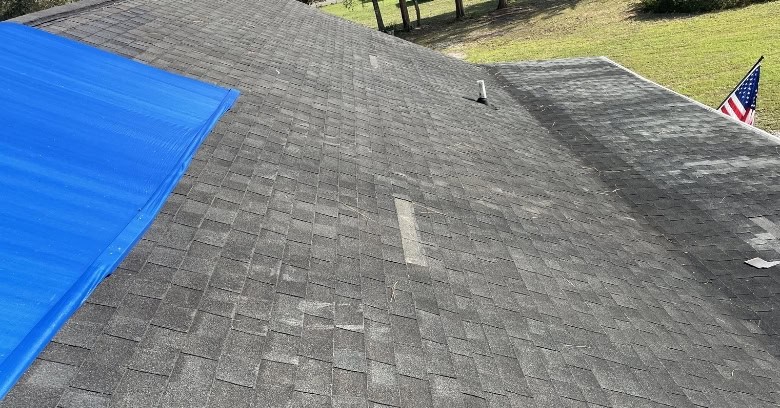
A tarp protects the rooms below, though the fault remains. A well-anchored sheet runs over the ridge with boards fixed along the edges, and anything merely weighted gets torn away.
Fixing the cover down means driving nails into the shingles, and each puncture is dealt with when the roof is properly mended. Weeks turning into months under plastic hold heat and damp against the covering, and the asphalt underneath deteriorates.
Pictures and a Written Account: Kept for the Homeowner
Once the new part is in place, the old damage is out of sight, and the culprit is often a split no longer than a finger. The camera captures the entry point and the worn component ahead of removal, and the same angles are shot once the job is done.
You get the full set of images, and the record serves a buyer, an inspector or another roofer down the line. The report states in plain words which part gave out, plus a list of the work carried out.
When a New Roof Is the Answer – Deciding Honestly
Where the shingles are healthy, a failed boot or flashing is dealt with as a separate job, because rubber and metal parts tend to age ahead of the asphalt. Replacement comes into the conversation when the tabs are brittle and bare on every slope, or when trouble keeps appearing in fresh spots.
Fixing one leak on a tired roof can help for a while, but the roof overall is no younger for the work. Our advice is plain, and so is the thinking, and you have the final word.
Color and Profile: Finding the Right Product
A fresh tab looks brighter than the aged tabs around, since ultraviolet light has worn the original surface pale. We match the profile, the size and the nearest color still made, and the gap closes as the new material weathers.
Shingles no longer sold have no perfect equivalent, so either a near substitute goes in or the work runs to a natural break. Samples laid next to the weathered tabs show the real difference, as a small chip misses the blend of granules in a full tab.
Signs of a Leak: Inside and From the Yard
- A ceiling stain that grows after rain, often in a top-floor room.
- A stale smell upstairs, which gets stronger in muggy months.
- Pinpoints of light in the sheathing, spotted from inside the attic.
- Stained, darkened wood along a rafter, below a single high point.
- Rubber at a pipe gone hard and broken, plain to see with binoculars.
- Granules washing out of the downspouts, in amounts that catch the eye.
- A course that has worked loose, seen from the ground.
- A rust stain streaking down from a flashing, at a skylight or a dormer.
APC Roofing and Emergency Roof Repair in Springfield Missouri: What to Expect
Our look begins in the attic, not on the ladder, and the highest wet mark there is matched to a spot on the slope. The faulty piece is replaced with the right part, with the same weak points across the house checked too.
We photograph what we found and what we did, along with notes in plain words. Where replacement is the honest answer, we tell you, while the decision remains yours.
Emergency Roof Repair for Homes in Springfield Missouri: Getting the House Dry Again
Call us at 913-398-5020 to arrange a visit.
Working With the Weather – Planning the Equipment
Emergency plastic can be secured in a drizzle, while the permanent fix waits for a dry surface. Adhesive strips on new tabs bond once the sun warms the shingles, so on cold days each course is sealed by hand.
Height and pitch decide how much rigging goes up, as a slide down a sharp incline is hard to stop. Tabs softened by afternoon heat mar easily when walked on, and every scuff wears away some of the mineral surface.
An Aging Covering – Small Jobs, Plain Talk
Asphalt that has baked for decades turns brittle, and bending a course up to pull a nail can break the shingle. Any shingle spoiled during the work needs replacing as well, and the patch can end up larger than the leak.
Before any tool comes out, we say whether the material is too fragile, and the images show why. A limited repair on aging shingles can be a sensible choice, as long as nobody mistakes the work for years added.
For Emergency Roof Repair in Springfield Missouri, get in touch with APC Roofing at 913-398-5020. The fault is located and repaired the lasting way, with photographs handed over.