Roof Repair

Trying to Find Emergency Roof Repair in Sanford Florida?

APC Roofing mends the spot where weather gets past the shingles and traces the drip back to the detail that failed.

Call 407-270-1129 to have a roofer come and look.


Where Leaks Come From – Why a Stain Misleads

The broad plane of a pitched roof rarely lets rain through, since each row laps over the row below and sends water down. Gaps appear wherever the surface is cut through, at the pipes, the chimney, the valleys and the walls.

A spot on the ceiling paint shows where the drip fell, not where rain got in, because the trickle clings to rafters and sheathing before falling. Measuring from inside without following the track leads a repair astray, and water keeps coming in after that.

Vertical Junctions on a Roof: Trouble Spots

The stepped metal is laid in a piece at a time, alternating with the rows; an upper strip is turned down over the full length. Once the joint under the trim opens, the house takes water where no one thinks to look.

The durable answer is replacement flashing, installed piece by piece, which means lifting several courses beside the junction. A bead of sealant across the opening is a stopgap, since expansion and contraction tear a surface seal open.

The Boots at the Pipes: Splits and Replacements

Every drain vent that pokes through is closed around by a neoprene gasket on a plate, and every summer of sun makes the material more brittle. In time a split opens where the pipe comes through, letting runoff trickle down into the house.

Replacement involves loosening the rows above and sliding new hardware into place, and a corroded flange calls for the complete assembly. An upgraded boot of silicone stands up to sunlight much longer, and suits a roof with many years ahead.

Valleys: the Wear Points

The low crease between adjoining planes carries the water shed by both planes, so a heavy storm makes a fast stream. A woven or cut valley shows age long ahead of the rest of the roofing, and without a liner below, the wear turns into a leak.

Seed pods and needles lodge in the channel, and the pooled runoff climbs under the edges. A valley that has failed is rebuilt from the deck up, because the current tears a coat of cement away within months.

Raised Nails – a Pinhole Leak

The boards under a roof soak up damp air and dry out again season after season, which slowly eases the shanks back out. A risen nail head tents the tab overhead, which can leave a pinhole for the next storm.

Tapping a lifted fastener back into place is a short-lived fix, since the same loosened spot simply lets go again. The nail comes out, the hole is sealed, and a fresh nail goes in close by, and a shingle that was pierced gets replaced.

Metal Sheets on a House – What Fails With Age

Some steel coverings are held down by screws driven through the surface, where a gasket under every head keeps the opening tight. Heat and ultraviolet light harden the small rings until cracks form, and overdriving or a crooked angle speeds the failure.

The repair is a new screw carrying a fresh washer, and a loose hole gets a larger diameter. The side laps and the ridge trim nearby are checked too, since parts put in together wear at one rate.

Wind-Lifted Shingles: Checking the Damage

An asphalt row relies on nails plus a strip of sealant that sticks to the row beneath, but heavy weather can tear the bond free. A flap that was folded over carries a crack along the bend, and wind-driven rain is forced underneath.

An undamaged piece that only lost the bond is resealed with hand-applied cement, and a shingle split lengthwise gets swapped. With a tab missing, the nails of the lower layer face the elements, and the next shower comes through.

Ridge Caps – Fixed as a Whole

The shingles across the apex are bent over a sharp angle, so years of sun leave splits on top. Beneath a ridge vent, the sheathing is cut back along the peak, and the cap above does all the work of keeping weather out.

A unit the wind has shaken loose admits blown spray, which leaves a wet band on the rafters just below the apex. A ridge repair replaces cracked caps and resecures the vent together, since leaving any part undone invites the same trouble.

Ice Dams: Runoff Pushed Uphill

At the colder end of our territory, a sound covering can still let water in, as warmth rising through the ceiling thaws the snowpack from underneath. The flow refreezes over the eave, out beyond the exterior wall, and the ice thickens into a lip.

Behind the obstruction, melted snow gathers with nowhere to drain, and lapped courses cannot keep out water that sits. Keeping the sheathing cold with ventilation and insulation stops the cycle, with an ice barrier beneath the bottom rows as the safety net.

Sunroom and Porch Roofs: When Laps Stop Working

A good number of homes have a part that hardly slopes, though the flat portion tends to receive the same tabs as everything else. Courses that overlap rely on water never sitting still, and slow drainage lets water wick back toward the nails.

The cure is a continuous membrane sealed at every seam, with the top edge slipped under the steeper roofing.

What the Attic Shows: Marks and Measurements

A trickle across the sheathing leaves a discolored path, and the discoloration remains long after everything dries. The upper tip of the stain sits nearest the gap in the covering, so a measurement from each edge carries the position up top.

Pushing a long nail up through the boards leaves a marker poking through, though a vaulted room with no crawl space sends the search outdoors. Insulation that is soaked or matted marks where the drops keep landing, since wet material left in place invites mold.

Water in the Attic – Airflow and Exhaust Fans

Moisture spread uniformly over the boards has little to do with the covering, since humid air escaping the living space turns to droplets up there. Where winters freeze, frost on the nail tips after a frigid night has the same cause, and the thaw brings water down like a leak.

No amount of shingle work cures a sweating deck, because the fix needs vents, sealed bypasses and fans that really exhaust. You hear from us whether rain or household vapor wet the wood, and the diagnosis decides who gets called in.

Masonry Stacks: Water Against the Brick

A broad apron closes the lower face, and step flashing is woven up both sides, and a second layer cut into the joints covers the upper edges. Behind a big chimney belongs a small peaked saddle called a cricket, which parts the runoff and steers the water around.

With nothing to push rainwater off, the uphill face turns into a shelf for leaves and puddles, and the upper corners are soon soaked. Crumbling mortar lets rain into the brick above the metal, so the fix sometimes needs a mason as well as a roofer.

Skylight Leaks – Reflashing Around the Frame

The glazing is seldom where water enters; the surrounding metal is where water gets past. The head of the opening takes the whole stream from overhead, while needles and debris build a small dam.

The unit stays put while the flashing around the frame is rebuilt, unless the curb has rotted. Humid indoor air misting the glazing can drip down the shaft, which calls for a fan or a vent instead of a roofer.

Eaves and Edge Metal: Overflow and Backup

Moisture where the ceiling and an outer wall join is regularly a drainage issue, as a trough that tips the wrong way sends runoff behind the trim board. Where no drip edge was installed, rain clings to the shingle edge and curls beneath, so the fascia softens and the sheathing starts to rot.

A gutter problem can be as simple to fix as a cleaning and a rehang, and a hanger screwed into solid wood stays put. Missing drip edge is an installation error, and putting the edge right means a continuous run of metal at the roof line.

Holes Left by Old Mounts – After the Equipment Goes

A receiver on a pole is typically held by lag screws through the covering, with nothing but a ring of caulk around each shank. Over a few seasons the sealant shrinks and comes loose, and each attachment becomes an entry for water.

When a receiver is removed, the bolt holes remain, and nobody notices before the ceiling marks. A sound fix fills each penetration with sealant and weaves in new tabs, with any kept item reinstalled on a flashing plate.

A Spongy Deck – When the Base Gives Way

Persistent seepage keeps the substrate under the roofing wet, until mold and decay set in. Underfoot, the ruined section bounces like a trampoline, and the ceiling of the attic shows a dip.

Weakened plywood is cut out until only solid wood remains around the opening, and matching sheets go in, nailed along each truss. Felt and shingles are laid back over the patched area, and the leak that caused the damage is fixed as well.

Storm Covers: Done Properly

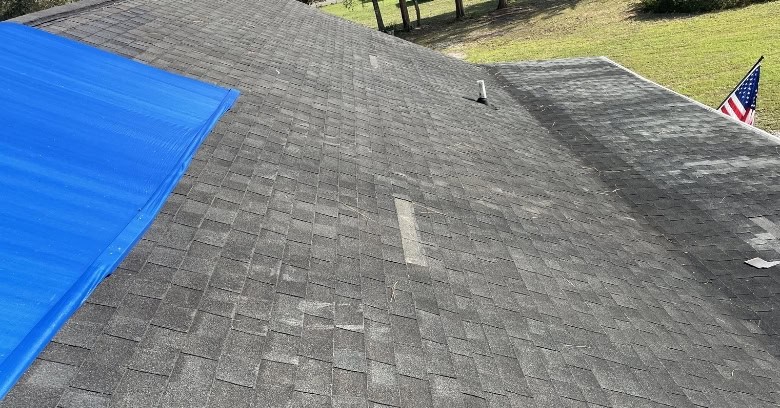
A heavy tarp keeps the interior dry, but the fault beneath is still there. A plastic sheet that survives the wind wraps the peak and is fastened through lumber strips, and anything merely weighted gets torn away.

A row of nails is driven through the courses below, and every hole is sealed during the permanent repair. A tarp kept in place for a season bakes what lies beneath, so the material underneath softens and ages early.

The Record of the Repair: For Your Files

After the replacement goes on, whatever gave way is gone from view, and the flaw behind a leak is often a crack the width of a coin. Each problem is photographed close up and from a distance while still exposed, and the finished job gets a separate set of shots.

You get the full set of images, and the record serves a buyer, an inspector or another roofer down the line. A written note names what failed and why, along with what we did about the problem.

Fixing or Starting Over: What Tips the Balance

A sound field with one faulty detail calls for mending that detail alone, as caulk and gaskets give out ahead of the asphalt. Replacement is worth raising when every tab has gone brittle, or when trouble keeps appearing in fresh spots.

A small repair on tired material can protect the rooms for now, although nothing about the remaining shingles improves. Our advice is plain, and so is the thinking, and you make the call.

Matching New Shingles to Old: What Is Still Made

A fresh tab looks brighter than the aged tabs around, since ultraviolet light has worn the original surface pale. Shape, size and the best available color are matched, and the patch blends in further each season.

A shingle the maker has dropped cannot be copied exactly, which leaves a stand-in or a larger section rebuilt to a natural break. The fit is judged properly only with a sample beside the existing courses, because printed charts rarely get granule color right.

Signs Worth a Call – Around the House

  • A discolored patch on a ceiling that widens in wet weather, usually below the attic.
  • A moldy odor in a closet under the eaves, which gets stronger in muggy months.
  • Sky visible through the deck, spotted from inside the attic.
  • Water trails on the framing, leading back toward one spot.
  • A cracked rubber collar at a vent pipe, plain to see with binoculars.
  • A layer of sandy grains in the gutter, returning after every cleaning.
  • A shingle corner flipped up, after a windy spell.
  • Cracked caulk along a flashing, at a skylight or a dormer.

APC Roofing and Emergency Roof Repair in Sanford Florida: From the Call to the Finish

The attic comes first, ahead of any ladder, and the wood there shows where on the shingles the water entered. Whatever gave way is rebuilt properly, not smeared over, and anything close to giving out is listed.

Photographs are taken of the problem and of the finished job, and you get a short report in writing. If mending no longer makes sense, we say so outright, and you decide from there.

Emergency Roof Repair Around Sanford Florida: Getting the House Dry Again

Reach us at 407-270-1129 to have someone come out.


Rigging and Weather: What the Materials Require

Emergency plastic can be secured in a drizzle, but the real repair waits for everything to dry. Roofing cement and factory seal strips need warmth to grip, so on cold days each course is sealed by hand.

Tall or steep houses get safety lines and brackets, since a slip there rarely stops short of the edge. Sun-warmed tabs dent under the lightest weight, so scuffed spots lose the protective grit.

A Covering With Little Left: Working With Care

An old tab loses flexibility as the oils cook out, and raising a course to reach a nail cracks the shingle. Whatever gets damaged along the way has to be swapped out too, and the mended section can creep outward.

We tell you in advance when the covering is too fragile to open safely, with photos showing what we mean. A small repair on a worn roof is still worth doing to stop the leak, so long as the fix is seen as a bridge, not a cure.

To book Emergency Roof Repair in Sanford Florida, phone APC Roofing at 407-270-1129. The fault is located and repaired the lasting way, and the images of each stage come to you.

Frank Smith

Verified

★★★★★
Our experience with APC roofing began with an introduction and quote by Lucio. He came to our home, explained the process and immediately went on the roof to access the damage. As we began to inquire further about what to expect Lu got us in contact with Adrian. Now Adrian became an invaluable partner in very honestly and sincerely letting us know what APC could and couldn’t do to repair or replace our damaged roof. Hurricane Milton left us scrambling to come up with thousands to meet our deductible. Patiently and empathetically Adrian dispelled our apprehension about working with a contractor or being left incomplete and in need of legal help to resolve any disputes. He gave us his assurance that he would oversee the entire project. I have to admit that he kept his word. Even when we thought there would be a last minute hiccup with financing he put me in-touch with Lucy and she did not give up until we got the information and terms I wanted. This was a truly great team from start to…

Mike Price

Verified

★★★★★
Everything went smooth on schedule nice clean job would recommend to anyone Mike Price was a great guy to work with

Tom Lewis

Verified

★★★★★
This company does fantastic work from start to finish. I couldn’t be more pleased and will refer anyone I know to APC Roofing!
★★★★★
APC Roofing recently installed a beautiful new roof on our home. Our experience, from the first visit by Lance, the APC salesman through to the finished product, was absolutely great. Their crew arrived in the morning and prepared the site, covering everything around the house so no damage would be done. They finished the job by late afternoon. The crew was polite, worked quickly, and all surrounding areas were meticulously cleaned. From the salesmen, to the hard-working roofing crew, to the team in the office, I couldn't be more satisfied. My sincere thanks to you all.

Elsa Kate Nichols

Verified

★★★★★
They were very helpful in working through and explaining the insurance process beforehand. The crew arrived earlier in the day both days than promised and worked hard. The roof and details are beautiful and everyone, from the gentleman delivering the trash trailer to the roofers to the manager, treated our property with respect and care protecting plants and cleaning up nicely.