Roof Repair

Looking for Roof Leak Repair for a Home in Orlando Florida?

APC Roofing stops rain from getting through to the rooms below, from the metal at a chimney to the collar at a vent pipe.

Phone 407-270-1129 and a roofer will come out to the house.


How Leaks Get Started: Where to Look

A pitched roof seldom fails in the unbroken middle of a slope, because the laps all face downhill. Openings form where the covering is interrupted; think of vent pipes, chimneys, skylights and walls.

A ceiling stain is seldom right below the hole, as moisture creeps along the underside of the deck. A repair aimed straight up from the evidence can miss by a yard, and the leak carries on through the next storm.

Sidewalls and Headwalls – Where the Layers Fail

Step flashing is laced in with every course as the shingles climb; a second strip above covers the upper edges. Once a section corrodes or works loose, runoff slips behind the siding into the framing.

What holds is new metal installed correctly, with the neighboring shingles lifted and relaid. A bead of sealant across the opening is a stopgap, since a surface seal hardens and shrinks away from the edges.

Pipe Penetrations – Wear and the Fix

A plumbing vent passes through the covering inside a rubber sleeve set on a flange, and exposure to the sky bakes the material hard. Eventually a crack forms right around the pipe, letting runoff trickle down into the house.

The cure is a replacement sleeve set beneath the lifted courses overhead, and a corroded flange calls for the complete assembly. A boot in lead or high-grade silicone is an option worth considering, and suits a newer covering.

Valleys: Rebuilt, Not Patched

Where two slopes meet, the runoff of both gathers in one narrow strip, and a heavy shower brings a torrent through. A woven or cut valley shows age long ahead of the rest of the roofing, and an install with no underlayment gives way once the granules are gone.

A mat of leaves settles into the groove, so water ponds and creeps beneath the laps. A failed valley is taken down to the sheathing and built again, since a smear of mastic washes out under heavy flow.

Nails That Work Loose: Why Hammering Fails

The deck beneath the shingles moves with every change in humidity, which slowly eases the shanks back out. A risen nail head tents the tab overhead, so every storm finds a path into the house.

Knocking the loose steel flush again buys only a season, because the enlarged spot has nothing left to bite. A sound repair removes the nail, fills the hole and nails again into firm decking, plus a new shingle wherever a tab tore.

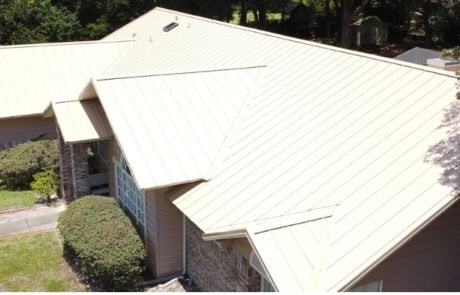
Metal Panel Roofs: Aging Hardware

Some steel coverings are held down by screws driven through the surface, with a neoprene washer under every cap keeping rain out. Over the years the small rings shrink and split, while driving too shallow never pressed down far enough.

A failed screw is replaced by a new screw with an intact washer, while an enlarged hole calls for the next diameter up. The trim at the ridge and the edges is inspected on the same pass, since what went in on the same job usually gives out in step.

Blown-Back Tabs: Checking the Damage

Every course is held by nails and by an adhesive strip that sticks to the course below, but a violent squall can peel the lower edge free. A tab that flips back is left with a crease across the tab, so blowing rain slips in beneath.

A course that simply came unstuck can be cemented down again by hand, while a tab that tore or split is replaced. A blown-away tab exposes the fasteners in the layer below, so the next storm finds a way in.

The High Line of a Roof – the Slot Under the Vent

Apex shingles wrap tightly across the meeting of the slopes, and age brings cracks across the top. The deck under a ridge vent has a strip removed on purpose, so the housing on top is all that stops water getting in.

Nails that have risen let gusts drive spray inside, and staining appears along the uppermost board. The repair along the peak takes in the caps, the vent and the fastening at once, since skipping a part means coming back.

Ice at the Eaves – Why the Attic Matters

In the snowier part of our territory, a roof with nothing wrong can still get wet, since warm air under the deck softens the snow from beneath. Out over the soffit, the runoff turns solid again, and an icy dam builds up there.

Trapped behind the obstruction, the thaw backs up, where the water seeps upward into the nail holes. Insulation and airflow in the attic end the problem at the source, and a sticky membrane under the edge rows guards against a bad season.

Porch and Addition Roofs: A Better Choice

Some homes have a low-pitched area off the back, yet builders often run the steeper-roof material straight across the flat portion. Courses that overlap rely on water never sitting still, and on a gentle grade the water lingers and creeps under the edges.

The lasting answer is modified bitumen or a rubber sheet, carried up under the tabs above for a clean transition.

Reading the Wood Under the Roof – Finding the Spot Outside

Water running along the framing leaves a dark streak on the boards, and the discoloration remains long after everything dries. The stain's upper limit lies right under the fault, and measuring from the ridge and a gable wall transfers the spot to the shingles outside.

A wire or nail poked upward from inside shows exactly where to look, unless a finished ceiling blocks the way, in which case the search happens outdoors. Soggy batts pinpoint where the water falls, and material that wet has to be replaced rather than dried.

When the Attic Sweats – Airflow and Exhaust Fans

Even dampness across the whole underside of the sheathing usually has nothing to do with rain, since humid air escaping the living space turns to droplets up there. Where winters freeze, frost on the nail tips after a frigid night has the same cause, and melting brings a patter of drops.

Nothing done to the covering dries a sweating deck, because the remedy is attic airflow, sealed gaps around light fixtures and bath fans ducted outdoors. We say plainly whether the wet wood came from rain or from the rooms, so effort goes where the trouble actually is.

Masonry Stacks: Water Against the Brick

A broad apron closes the lower face, and step flashing is woven up both sides, and a second layer cut into the joints covers the upper edges. A large chimney should have a cricket at the rear, so rain gets split and diverted around the masonry.

Where nothing was built to shed rainwater, leaves and water gather on the uphill face, and the upper corners eventually let water in. Worn mortar pulls rain into the masonry higher up, so the fix sometimes needs a mason as well as a roofer.

Skylights: Keeping the Unit

A broken pane seldom explains the drip; the surrounding metal is where water gets past. The head of the opening takes the whole stream from overhead, and leaves lodge in a heap.

The unit stays put while the flashing around the frame is rebuilt, unless the curb has rotted. Beads of vapor on the inner face can trickle down the well like a leak, which no roof work will stop.

The Eave Line: the Foot of the Slope

A mark in the corner of a top-floor ceiling is often gutter trouble, since a sagging run holds water against the wood. Where no drip edge was installed, rain clings to the shingle edge and curls beneath, which leaves the fascia and sheathing rotting.

Clearing the trough and resetting the pitch is sometimes the whole job, and screw-in hangers prevent a new sag. A drip edge left out entirely is a roofer's oversight, and the answer is one unbroken piece along the lower edge.

Old Dish and Antenna Holes: What Removal Leaves Behind

Solar lights, receivers and similar gear are usually screwed into the deck, and a squirt of caulk is the only barrier. Sun hardens the sealant until the bead cracks free, which leaves a path for water at every attachment.

Taking the equipment down leaves the bolt holes open, and grime and grit often hide the openings from view. The fix is sealant packed into each penetration under replacement shingles, and anything staying up goes back on a flashed pad.

Soft Decking: Felt Underfoot

Seepage left to run soaks the plywood under the covering, and the plies swell and pull apart. From above, the bad area feels spongy when stepped on, while from inside the boards bow downward.

The rot is cut away until the edges are firm, and properly nailed replacements fill the gap. The patch is then covered with underlayment and shingles, while the source of the water is closed off at the same time.

A Cover on a Damaged Roof: Done Properly

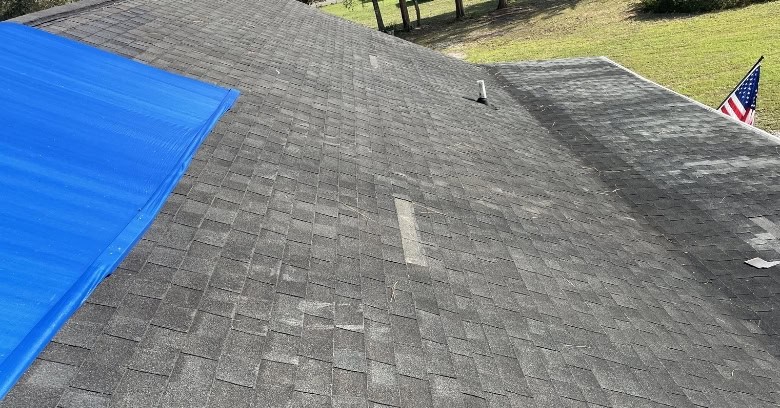
A tarp keeps the rooms dry, but the fault beneath is still there. A plastic sheet that survives the wind wraps the peak and is fastened through lumber strips, and a few bricks end up in the yard.

Fixing the cover down means driving nails into the shingles, so sensible spacing keeps the number of new openings small. Plastic that sits for months traps heat and moisture against the roof, so the material underneath softens and ages early.

Pictures and a Written Account – What Failed and What Was Done

Once the new part is in place, the old damage is out of sight, and the flaw behind a leak is often a crack the width of a coin. We photograph the opening and the worn part before anything is changed, and the finished result is shot as well.

You get the full set of images, and the record serves a buyer, an inspector or another roofer down the line. The written account says what broke, together with each step of the repair.

Repair or Replace: Where the Line Falls

Where the shingles are healthy, a failed boot or flashing is dealt with as a separate job, since rubber seals often wear out well before the surrounding asphalt. The question changes when the entire covering is cracking and bald, or once the drips move from place to place.

A repair on tired shingles can still hold off the weather for a while, although nothing about the remaining shingles improves. Our advice is plain, and so is the thinking, and you have the final word.

Matching New Shingles to Old: Finding the Right Product

A brand-new tab shows up plainly among older courses, because the surrounding granules have lightened over the years. Our match covers the shape, the size and the nearest available color, and the difference narrows over a few seasons.

A shingle the maker has dropped cannot be copied exactly, and the options are a lookalike or reroofing out to a hip or valley. Candidates compared in daylight against the old material reveal how well each candidate fits, because printed charts rarely get granule color right.

Clues That a Roof Needs Work: Inside and From the Yard

  • A water ring overhead that darkens with every downpour, in any room right under the attic.
  • A stale smell upstairs, which hangs around for days.
  • Sky visible through the deck, however small the gap looks.
  • Stained, darkened wood along a rafter, often beneath a chimney.
  • Rubber at a pipe gone hard and broken, sometimes in plain sight from the street.
  • Heavy grit piling up in the gutters, heaviest after a downpour.
  • A shingle corner flipped up, seen from the ground.
  • A rust stain streaking down from a flashing, at a skylight or a dormer.

How APC Roofing Approaches Roof Leak Repair in Orlando Florida – What We Do on Site

We look in the attic before anyone gets on a ladder, and the highest wet mark there is matched to a spot on the slope. The part that failed is mended with the material that belongs there, and the neighboring flashings get a check too.

The camera records the problem and the completed work, along with notes in plain words. When the shingles are spent, the answer is given clearly, and what happens next is your decision.

Roof Leak Repair for Homes in Orlando Florida: a Roofer Who Finds the Way In

Call 407-270-1129 to have someone come out.


Getting Up to the Work: What Sealants Ask For

A temporary cover can go on over a damp deck, but a lasting repair waits for dry wood. Sealants set up slowly in chilly air, so cooler weather calls for hand-sealing.

A high ridge demands anchored harnesses and roof jacks, because a boot finds little purchase on a sharp incline. In hot weather, asphalt turns soft enough to mark, so scuffed spots lose the protective grit.

A Roof Near the End: What a Repair Can Still Do

A tab that has spent many summers outdoors goes brittle, so prying a course up to get at the fasteners snaps the shingle. Pieces harmed while getting to the fault become part of the job, which lets a modest fix spread.

Before any tool comes out, we say whether the material is too fragile, and the photographs show the reason. Mending one leak on an old roof is reasonable to keep the house dry, so long as the fix is seen as a bridge, not a cure.

If you need Roof Leak Repair in Orlando Florida, contact APC Roofing at 407-270-1129. We track down the entry point and rebuild the detail, and you keep the photos.

Frank Smith

Verified

★★★★★
Our experience with APC roofing began with an introduction and quote by Lucio. He came to our home, explained the process and immediately went on the roof to access the damage. As we began to inquire further about what to expect Lu got us in contact with Adrian. Now Adrian became an invaluable partner in very honestly and sincerely letting us know what APC could and couldn’t do to repair or replace our damaged roof. Hurricane Milton left us scrambling to come up with thousands to meet our deductible. Patiently and empathetically Adrian dispelled our apprehension about working with a contractor or being left incomplete and in need of legal help to resolve any disputes. He gave us his assurance that he would oversee the entire project. I have to admit that he kept his word. Even when we thought there would be a last minute hiccup with financing he put me in-touch with Lucy and she did not give up until we got the information and terms I wanted. This was a truly great team from start to…

Mike Price

Verified

★★★★★
Everything went smooth on schedule nice clean job would recommend to anyone Mike Price was a great guy to work with

Tom Lewis

Verified

★★★★★
This company does fantastic work from start to finish. I couldn’t be more pleased and will refer anyone I know to APC Roofing!
★★★★★
APC Roofing recently installed a beautiful new roof on our home. Our experience, from the first visit by Lance, the APC salesman through to the finished product, was absolutely great. Their crew arrived in the morning and prepared the site, covering everything around the house so no damage would be done. They finished the job by late afternoon. The crew was polite, worked quickly, and all surrounding areas were meticulously cleaned. From the salesmen, to the hard-working roofing crew, to the team in the office, I couldn't be more satisfied. My sincere thanks to you all.

Elsa Kate Nichols

Verified

★★★★★
They were very helpful in working through and explaining the insurance process beforehand. The crew arrived earlier in the day both days than promised and worked hard. The roof and details are beautiful and everyone, from the gentleman delivering the trash trailer to the roofers to the manager, treated our property with respect and care protecting plants and cleaning up nicely.