You want a metal roof without the price of standing seam, and corrugated metal roofing looks like the answer. Maybe it’s for the house, maybe a workshop, a porch or a barn. Then someone mentions that every screw is a hole in the roof, and you start to wonder whether you’re saving money now only to pay for leaks later.
It’s a good question to ask. Corrugated panels can make a solid, long-lasting roof, but only if you know what comes with them and plan for it from day one.
APC Roofing installs and repairs corrugated panel roofs across Central Florida, the Daytona Beach area, the Kansas City metro and Springfield, Missouri. We’re GAF Certified, licensed and insured, and the inspection is free. Call 866-995-0704 to talk with us.
The basic trade-off with corrugated metal roofing
Corrugated and other exposed-fastener panels are screwed straight through the face of the metal into the roof structure. A typical house roof can have hundreds of those screws, sometimes close to a thousand, and each one is sealed by a small rubber washer.
That’s the deal. You pay noticeably less than a concealed-fastener system like standing seam metal roofing, the panels go on faster, and in exchange your roof stays watertight only as long as those washers do. Sunlight hardens them over the years. Daily heating and cooling works the screws a little loose. None of that is a defect. It’s the upkeep this kind of roof comes with, and it’s very manageable if you plan for it.
Where corrugated panels make the most sense
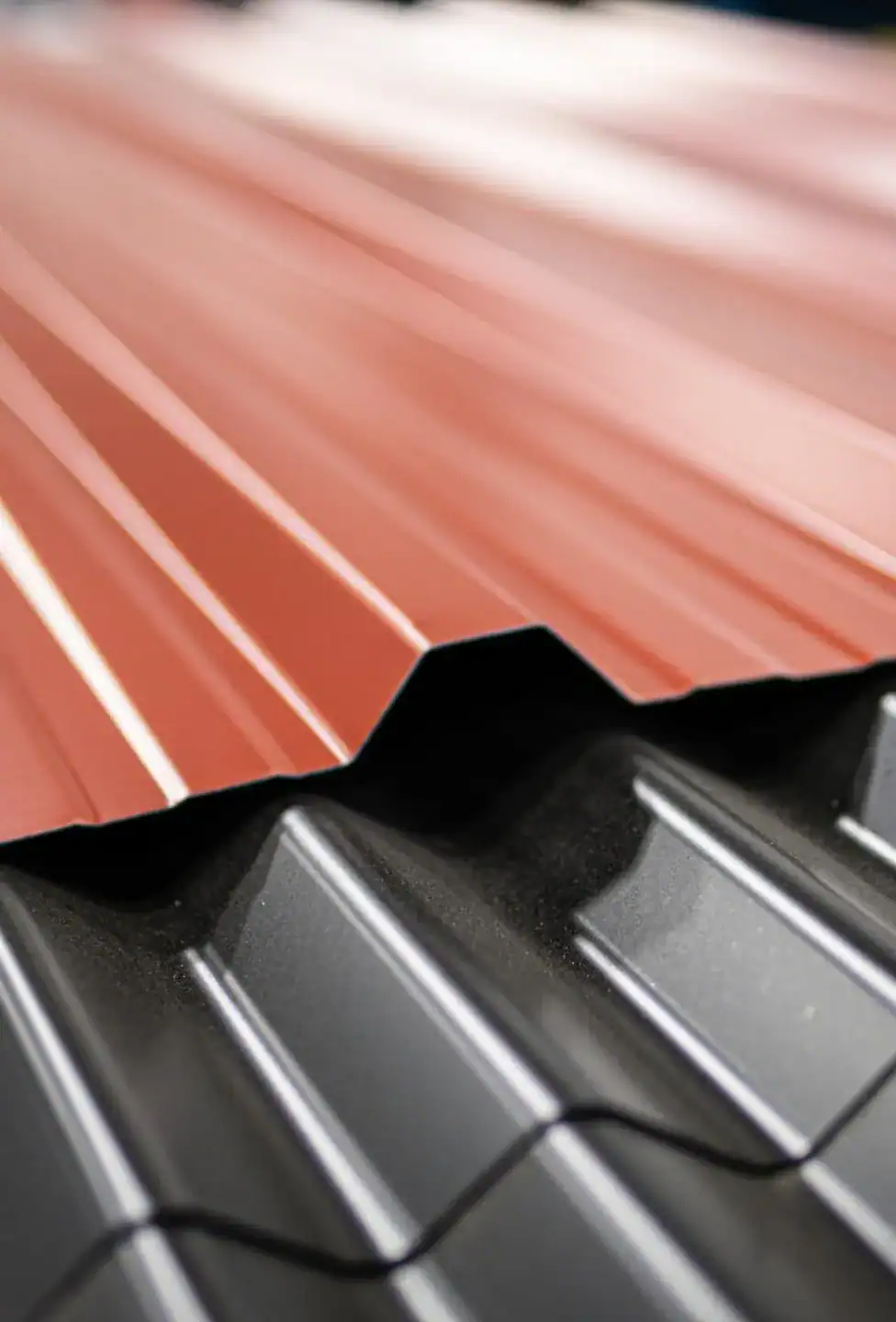
The wavy shape stiffens thin metal the same way folding stiffens a sheet of paper, so the panels can span across framing without much support. That’s why barns and shops have used them for generations.
Today’s painted panels, better trim and proper underlayment have moved them onto houses too. They’re a strong fit for:
- Detached garages, workshops and sheds
- Porches, carports and patio covers
- Homes where you want the look of metal and the budget matters
- Cabins and outbuildings with simple roof shapes
They’re a poorer fit on roofs with lots of angles, valleys and penetrations, where every cut and seam adds a place for water to get in.
Gauge matters more than most bids admit
Steel panels are sold by gauge, and the scale runs backwards. A bigger number means thinner metal. As a general guide, 29 gauge is about 0.014 inches thick and is the common budget panel. 26 gauge is about 0.018 inches. 24 gauge is around 0.024 inches, close to twice as thick as 29.
Going from 29 to 26 gauge gets you a panel that dents less in hail, spans farther between supports and feels solid underfoot for whoever works on the roof later. It’s the upgrade most often traded away by homeowners who never knew it was on the table. If your quote doesn’t list a gauge, ask.
Profile and pitch
Not every exposed-fastener panel is the classic round wave. Wider ribbed panels, often called R-panel, and box-rib shapes differ in stiffness, in how much area one sheet covers, and in the trim that finishes them. Your bidder should tell you which profile you’re getting and why.
Pitch is the other limit. These panels shed water well on ordinary roof slopes. As the roof gets flatter, most manufacturers call for sealed side laps and extra detailing, and on a truly low-slope roof a different system is usually the better choice. If your porch or addition is nearly flat, look at flat roofing instead.
What the weather does to corrugated metal
In Central Florida and around Daytona Beach, the sun ages the rubber washers fastest on south- and west-facing slopes. Hurricane-season wind finds any screw that was never fully seated, and failures usually start at the eaves, ridge and edges, then work inward. Near the coast, salt air goes after cut edges and drilled holes before it touches the painted face.
In the Kansas City metro and Springfield, hail is the bigger concern. Smaller hail can dent corrugated panels without breaking the seal, so a dented roof isn’t always a leaking one. Freeze-thaw cycles also flex panels against their screws a little more each winter.
Notice that most of those are fastener problems. That’s why the screws are the first thing a good inspection looks at.
Keeping a corrugated roof sealed
A screw driven too tight crushes its washer. One driven at an angle never sealed in the first place. From the ground, both look fine. Every few years, it’s worth having someone walk the fastener rows, reset loose screws and replace worn ones, often with a slightly larger screw so it bites into fresh metal.
Skip that for fifteen years and you can give back in leaks a good part of what you saved up front. If your corrugated roof is already leaking, our metal roof repair page covers what we look for.
How it works with APC Roofing
- Book your free inspection. Call 866-995-0704 or request a free online estimate.
- Get a clear, honest assessment and estimate. You’ll get photos and a written estimate that names the panel profile, gauge, finish and trim, so nothing is left vague. If standing seam or another roof fits your building better, you’ll hear that too.
- Get the work done and the site cleaned up. The crew installs or repairs the roof and leaves your property clean.
Financing is available through Aqua Finance, Fortifi, Hearth and Home Run Finance.
Corrugated metal roof questions
Can corrugated metal go on a house, or is it just for barns?
It can go on a house. Painted panels with matching trim and a proper underlayment make a clean, durable roof. It’s most common on simpler roof shapes.
Do you tear off the shingles before corrugated metal goes on?
Yes. APC Roofing always tears the old roof off first, because a layer of shingles hides soft decking and other problems. The deck gets checked and repaired before any metal goes on.
What trim does a corrugated roof need?
Eave, rake and ridge trim, plus closures that fill the gaps under the panel waves so wind-driven rain and pests can’t get in. Missing closures are a common cause of leaks.
How often should the screws be checked?
Every few years is a good rule, and after any major wind or hail storm. That’s a quick visit compared with fixing water damage inside.
Is corrugated metal noisy?
Over open framing on a shop, yes, rain is loud. Over a solid deck with underlayment and an insulated ceiling, most homeowners find it quiet.
Get a roof that stays sealed
The washers on a corrugated roof age quietly, and the first sign is often a stain on the ceiling. A quick look now costs you nothing and can save you a bigger repair later.
Call 866-995-0704 to book your free inspection, or start your estimate online. You’ll end up with a corrugated roof that’s built right, a plan to keep it that way and no guesswork about what comes next.