In Need of Metal Roofing Across Greater Daytona Beach Metro Area?
APC Roofing installs panel coverings and mends worn sheet, on houses, garages, porches and outbuildings.
Reach us at 386-356-2111 and a visit ends with a straight account of what was found.
Identifying a System – A Glance Up
Exposed-fastener roofing is pinned by screws passing through every panel, while standing seam is clipped down beneath upright folds. Steel with a protective coating covers most houses that have metal, though aluminum and copper have a place too.
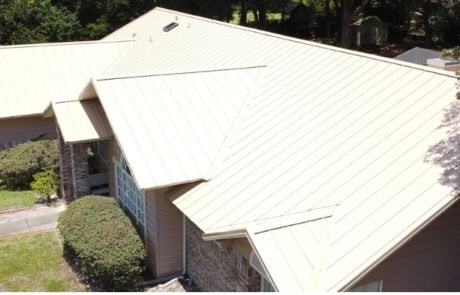
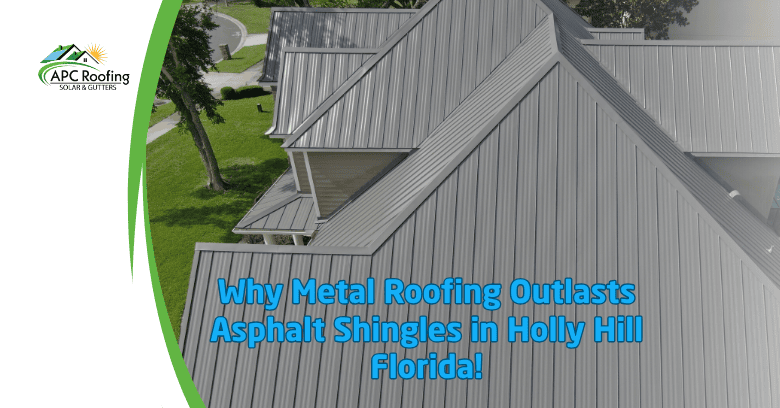
A glance from a lawn at lines of screw heads points to a through-fastened roof, and smooth pans between tall ribs with nothing poking through are standing seam. Pole buildings, sheds and porches frequently get ribbed sheet, and homes turn up with both.
The Cross-Section – Span and Style
Corrugated sheet ripples in smooth, repeating curves, and ribbed panels pair tall square ribs with broad flat areas. One length rides over a neighbor at a side lap, and screw locations follow a published diagram.
Ribs make a stiffer panel that crosses longer spans, while corrugated fits a period barn or a farmhouse style. Rib height governs how much water a long slope can move, and a shallow pattern is plenty for a small porch or shed.
Hardware in the Weather: Every Detail Counts
A screw pulls the metal tight against a purlin or the deck, and a gasketed washer under each head does the sealing. Rubber in steady sunlight hardens and cracks with age, well ahead of the painted steel nearby.
Too much torque flattens a washer at once, and a shallow or off-square setting never seals fully.
Fastener Replacement – Where Help Stops
Washers dotted across a ribbed field grow old together, and a whole-roof re-screw is routine over the years. Each original fastener is taken out, and a bigger diameter is driven in to grip where an old thread stripped.
Re-screwing with new washers fixes leaks at screw heads and snugs down sheets that flutter, though perforations, split laps and faulty trim remain as before. Thread type follows whatever support lies below, since lumber and steel purlins take different screws, and color-matched tops blend in with a painted finish.
Thermal Movement: Oval Holes and Loose Seals
Sunshine stretches steel slightly and a chilly night pulls the metal back, and forty feet of panel shifts roughly a quarter inch or more, and aluminum reaches about double. Metal held too rigidly wears fastener holes into slots, and washers then stop sealing.
Creaks as the day warms come from steel adjusting, and a roof built with slack is unharmed.
Holding Down a Seamed Covering: Tucked Away
Each long pan is fixed solid in one short zone, and floating clips everywhere else let the pan glide. A finishing piece at an opposite end has room built in underneath, and metal with no play winds up torn or kinked.
As a pan is laid, clips are driven into the deck along one leg, so nothing that holds the roof down is left exposed.
Seam Styles – Wind and Water
Snap-together panels latch by hand, and heavier-duty versions are folded over by a motorized tool. A double-lock seam rides out storms and sheds pooled water, and a gentler pitch is allowed.
Every product line has distinct spacing and rib size, and a choice depends on the home and a preferred style. Closures, clips and flashings match one panel only, and a substitute from elsewhere leaves gaps.
How Much Material Is Up There – Beyond Appearances
Panel thickness in steel is stated in gauge, and numbers fall as sheet gets thicker. Outbuildings commonly get twenty-nine, while a dwelling generally takes twenty-six or twenty-four.
Aluminum sheet is measured in decimal inches, and more material means fewer marks and less waviness. From the ground, light and heavy metal look alike, so printed product data gives a firm answer.
Factory Protection: What Lasts
At a steel mill, coil gets a metallic layer of zinc or zinc and aluminum, and an oven-cured primer and color coat are applied on top. A mark in a topcoat alone keeps steel protected, but an unprotected cut or a gouge to bare steel is where red rust starts.
PVDF systems keep color and gloss for decades, while polyester versions chalk and fade sooner. Lime in fresh concrete eats into an aluminum-zinc layer, so metal and new brick are kept apart.
Weighing Options – Trade-Offs
Aluminum carries less weight and does not redden, but a dropped tool or a falling branch dents a soft sheet sooner. At the coastal end of our territory, salt spray breaks down galvanized coatings faster, and some makers limit steel products by distance from a shoreline.
Copper appears mainly as small roofs on bays and cupolas, and years outdoors take bare metal to brown and then green.
Mixing Metals – Isolation and Compatibility
Runoff from copper eats through coated steel downhill, and discoloration arrives well before a panel gives way. Aluminum laid against treated lumber corrodes at every contact point, and a bare steel screw in soft sheet breaks down too.
A new piece of flashing belongs in a metal that matches existing work, or a strip of membrane goes between dissimilar metals.
An Appearance Question – Surface, Not Structure
In trade terms, oil canning describes soft ripples across a broad flat between seams, and low sun at dawn or dusk shows up every hollow. A slightly distorted pan sheds rain like any other, and nothing shortens the life of the roof.
Narrow pans, heavier stock and striated flats hold waves back, and an installer who does not overdrive clips helps as well. Pictures of completed homes give a sense of how visible oil canning gets, and the choice of panel is yours.
Everyday Comfort – Day and Night
An outbuilding with bare framing under the metal makes a loud din in rain, since a single skin is the only barrier. On a house, a solid deck, underlayment and ceiling insulation sit below the panels, and in a living room few can pick out any change from shingles.
A white, tan or light gray panel turns back much glare, so the attic runs noticeably cooler. A deep hue absorbs heat like any dark surface, and vents and insulation weigh as heavily as the choice of color. Metal loses daytime warmth shortly after the sun sets, so upstairs rooms settle sooner at night.
Holding a Load Up There – Only Where Needed
In the snowier part of our service area, a metal roof sheds snow fast, and a single release can take out a gutter or strike someone nearby. Guards set along a roof hold a load in place until a thaw, with placement over doorways, decks and equipment.
A standing seam roof gets brackets that squeeze an upright joint rather than pierce a pan, whereas on corrugated sheet, mounts go into solid wood with gasketed fasteners, and in milder markets roofs do without.
What Ice Does: Documented Plainly
Hail is a fact of life at the colder end of our service area, and heavier grades with stiffening ribs shrug off more stones. A strike sharp enough to break a finish lets rust start, while a buckled seam can part enough to admit water.
After a storm, we photograph and measure what we find, so the size and position of each dent are known.
Holding On in a Gale: Built to a Pattern
Corners and borders see heavy suction, an open field much less, and once air slips under an unsecured edge, pressure can roll the metal up. Finish trim is hemmed and caught on a cleat, so nothing sticks out to be grabbed.
Fasteners go in closer together near corners and a roof's rim, set by a maker's tested layout for each exposure. At the coastal end of our range, where hurricanes come ashore, rows of screws draw in further, and panels carry an uplift rating to suit.
Where Something Pokes Through – Flashing Done Right
A plumbing pipe gets a flexible boot with a base that bends to a panel profile, and a hole is cut in a flat, never across a crown. A chimney or skylight is built up on a curb with a cricket above, so no water dams up.
Sealant backs up flashing and never stands in for folded metal, as ultraviolet light turns soft compounds brittle in a few seasons.
Meeting Planes: Made to Shed
Each valley gets a separate pan in advance of the panels, and each sheet is cut to a matching angle. Raw ends are folded under and locked to a cleat, so no hole sits where runoff gathers.
A sealed endlap connects consecutive lengths on an extended run, and screws pass through both thicknesses, upper over lower.
Limits Near Flat – Measured, Not Guessed
Makers of exposed-fastener sheet commonly list three in twelve, and on a gentler slope, overlaps start to let water through. Standing seam with double-locked joints goes much lower, and product literature states an exact minimum.
A barely tilted roof over a porch or addition is common on houses, and a measured angle decides what goes on, and anything under a panel's limit is finished in a membrane.
Substrate: Rot and Spacing
Metal on a dwelling is installed over full sheathing, and a high-temperature underlayment sits beneath the panels, since ordinary felt dries out under sun-heated steel. On a barn or shop, panels often span open purlins, so support spacing and gauge are matched.
With an old roof gone, damaged sheathing is cut away and rebuilt, since a clip in decayed wood holds nothing.
Going Over the Existing Roof: What Has to Be True
Where code allows, metal can be installed over one layer of shingles, and the mess and hauling of removal are avoided. Steel panels weigh well under two pounds per square foot, and typical framing carries a little extra easily. Battens on top of a synthetic membrane are laid across existing shingles, and every fastener is sized to reach solid wood.
Soft spots, old leak stains in the attic or a second layer rule out an overlay, since dampness sealed beneath panels goes on rotting structural lumber.
Perimeter Details: Done Properly
Shaped closures fill spaces under every rib at an upper line and a lower line, and rain, insects and birds cannot get under the panels. A cap along a peak comes vented or solid, as existing ventilation requires.
Gutter aprons and rake trim wrap up a roof's outline, and water falls clear of fascia instead of running behind.
On the Job – Sheet by Sheet
Each seamed pan is rolled out to reach a whole slope, and no cross joint interrupts runoff. A long panel calls for several people spaced along the metal, and a pan that gets bent should not go on the roof.
Weight should go only into pans over framing, because a raised joint dents and deforms under load. Moisture turns a painted panel into a slide, so owners do better keeping off the roof.
What Homeowners Can Spot – A Look From Below
- Rust circles where screws go in, partway down a pitch.
- Loose screws riding high, by a peak.
- A rake edge torn free, above a porch.
- A collar gapping around a stack, on a back slope.
- Rust creeping from a trimmed end, at the bottom of a run.
- Uneven fading, on a south exposure.
- A ceiling stain in a straight line, over a closet.
- A gap along a rib, beside a hip.
How APC Roofing Takes On Metal Roofing in Greater Daytona Beach Metro Area – Our Method
Our starting point is pinning down which system is up there and how the panels are secured, followed by every screw or clip, edge, boot, valley and lap. Notes cover gauge, finish and every kind of hardware, and from inside, the attic shows any old leaks.
Every finding goes into a report with images, and every piece of advice comes with an explanation. Where a reseal will do, a reseal is what we propose, while replacement comes up only when a roof is truly spent.
Metal Roofing Across Greater Daytona Beach Metro Area – Careful Assessments
Call us at 386-356-2111 and we will book a day that suits you.
Saving What Is There – Knowing Limits
A single ruined panel can come out and a sound panel go in, though fresh color will not match weathered neighbors. New sealant at a lap ends trouble at an overlap, and new screws restore a roof full of aged seals.
When corrosion has gone through across a whole field, a tear-off is due, and metal torn loose over entire slopes is no better off. Sometimes one weathered side is re-covered alone, as long as nothing else shows wear.
The Long View – Exposed Screws Versus Hidden Clips
Properly installed panels regularly reach forty years, but estimates of service are a rough guide only. Concealed-clip panels require less upkeep because no rubber seal sits in the sun, while through-fastened sheet needs a re-screw somewhere along the way.
Metals of different kinds touching, unhemmed cuts and sealant used in place of flashing shorten a roof's service, and a check every few years catches small faults early. Piles of leaves behind a chimney keep a patch of metal damp for days, and sweeping debris clear helps a finish.
Whenever Metal Roofing in Greater Daytona Beach Metro Area comes up, call APC Roofing at 386-356-2111. We will inspect all hardware, every edge and each penetration, and a written summary lays out what we saw so you can choose.