Every afternoon storm leaves a puddle on the roof over your porch, or there’s a new water stain under the flat section of your building. You’ve heard TPO roofing in Daytona Beach is a good fix for flat roofs, but you’re not sure if it fits your roof, or whether the person selling it knows how to install it right. On a flat roof, the install matters as much as the material.
You deserve a roofer who explains the options in plain words and lets you decide.
APC Roofing installs and repairs TPO and other flat roof systems across the greater Daytona Beach area, on homes and small commercial buildings. We’re GAF Certified, licensed in Florida (CCC1337030) and insured, and inspections and estimates are free. Call 386-259-8425 and a roofer will climb up and give you a plain account of what’s there.
What TPO is and why it works here
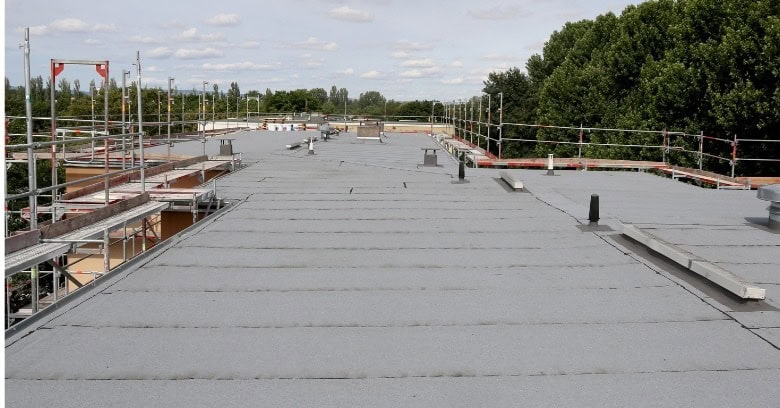
TPO (thermoplastic polyolefin) is a single-ply membrane that comes in wide rolls, usually white. The seams are heat-welded with hot air, so they fuse into one continuous sheet instead of relying on glue or tape. That welded seam is a big part of why TPO holds up on low-slope roofs, where water sits longer than it does on a pitched roof.
On a Volusia or Flagler County roof, the white surface is the other big reason. TPO reflects much of the sun’s heat instead of soaking it up, which helps keep the room or warehouse under it cooler and can take some load off your air conditioning in the summer.
What Daytona-area weather does to a flat roof
Coastal Florida is hard on flat roofs in its own way.
Heat and sun
Strong sun nearly all year bakes dark roofing and dries it out. A reflective TPO membrane runs much cooler on the surface, which slows that aging.
Summer downpours
Most summer afternoons bring a heavy thunderstorm. A flat roof has to move a lot of water fast. If the drains, scuppers or gutters can’t keep up, or the roof has low spots, water ponds and starts to work at seams and flashing.
Hurricane-season wind
From June through November, tropical storms and hurricanes can bring wind strong enough to peel back a membrane that isn’t properly attached, starting at the edges and corners. The perimeter of a TPO roof needs extra fastening and solid metal edge flashing for that reason, installed to the manufacturer’s specs and Florida’s building code.
Salt air
Near the beach, salt air speeds up corrosion on metal flashing, fasteners and rooftop equipment. Those details deserve a closer look on coastal properties.
Where TPO shows up on Daytona-area properties
On homes, TPO usually covers a porch, a Florida room, an addition or a carport, with shingles or tile on the main roof. Shingles need a real slope to shed water, and below that point a membrane is the right choice. On small commercial buildings, TPO often covers the whole roof.
TPO isn’t the only option. EPDM rubber, modified bitumen and built-up roofing all have a place, and the right one depends on your roof deck, how it drains and what sits on top of it. If you’re comparing, our EPDM roofing page covers the other common single-ply choice.
TPO repair or a new roof?
A lot of TPO problems can be repaired. A seam that’s lifting, a puncture from a dropped tool or storm debris, or failed flashing around a vent or AC stand can usually be welded or patched without redoing the roof.
A new roof makes more sense when the membrane is brittle and cracking across the surface, when the insulation under it is wet, or when it’s been patched so often that new leaks keep showing up. Wet insulation is the thing to rule out first. A new membrane over soaked insulation won’t last.
If your existing roof is dry and sound, a new TPO membrane can sometimes go over it. If not, the old layers come off. Our flat roof repair team in the Daytona area handles smaller fixes, and full replacements go to our flat roof installation crews.
How to choose TPO roofing contractors
A few checks help you hire well:
- Look up the contractor’s Florida license on the state’s license search.
- Ask for proof of insurance.
- Make sure the estimate names the membrane thickness, how it’s attached, how the edges are secured and whether the old roof comes off.
- Ask how they handle insurance. A roofer can document storm damage and work with your adjuster, but you file your own claim and pay your own deductible. Be wary of anyone who offers to waive or cover it.
How it works with APC Roofing
- Book your free inspection. Call 386-259-8425 or request a free online estimate.
- Get a clear, honest assessment and estimate. You’ll see photos of the seams, flashing and drains, and you’ll know whether you need a repair or a new roof, and why.
- Get your roof done and the site cleaned up. The crew finishes the work and hauls off the old material.
If you’d like to spread out the cost of a bigger job, we work with financing partners including Aqua Finance, Fortifi, Hearth and Home Run Finance.
Questions about TPO roofing in Daytona Beach
Is TPO good for Florida flat roofs?
Yes. The white surface reflects heat, and the heat-welded seams hold up well to the heavy rain and standing water flat roofs see here. Good installation, especially at the edges, is what makes it last through storm season.
Can TPO be repaired, or does it need replacing?
Most small problems, like a lifted seam or a puncture, can be repaired by welding on a new piece. Replacement makes sense when the membrane is worn out or the insulation under it is wet.
Can TPO go over my old flat roof?
Sometimes. If your current roof is dry, solid and only one layer, a recover may work. Wet or multi-layer roofs need to come off first.
Do you do TPO roofing for commercial buildings?
Yes. We work on small and light commercial flat roofs as well as homes.
A flat roof you can stop checking after every storm
A small flat roof leak is easy to put off, but water that gets under a membrane soaks the insulation and the deck, and a patch becomes a new roof. Getting it looked at early usually keeps the fix small.
When the next afternoon storm rolls through, the ceiling stays dry and you don’t have to think about the roof at all. That’s a sound roof, no surprise bill and a decision you feel good about. Call 386-259-8425 to book your free inspection, or start with a free online estimate.