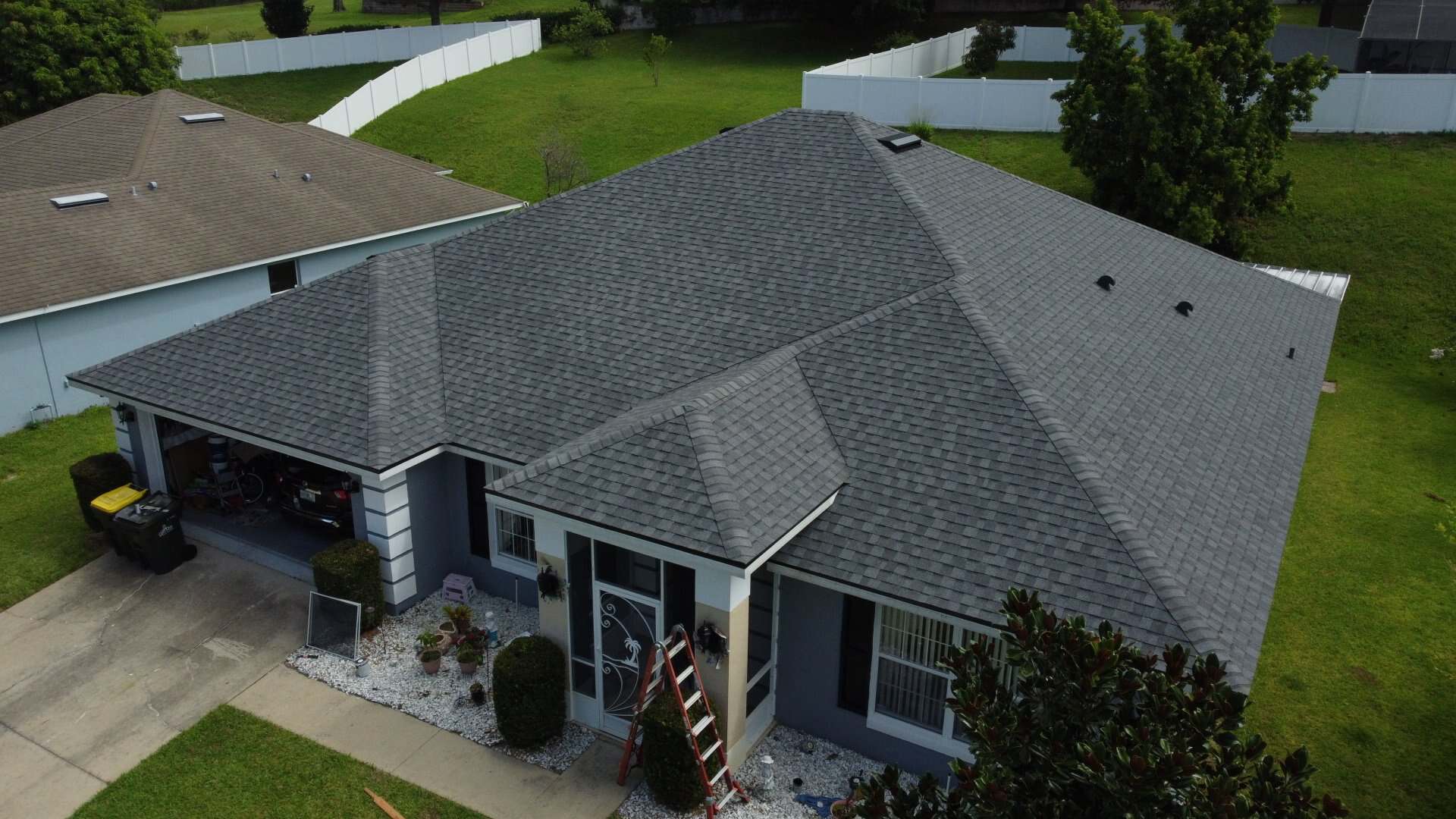
Exploring Architectural Shingle Roofing Anywhere in Clermont Florida?

APC Roofing puts down granule-surfaced coverings from the deck up on houses, garages and sheds.

Dial 407-270-1129 and a trained eye will check the details and report back.


How the Pieces Are Made – Factory Details

Strength in a shingle comes from a glass-fiber mat, while the asphalt in the sheet makes it waterproof, and a dense layer of crushed rock granules takes the glare.

Products that seem alike from the driveway can vary a good deal underneath, and more heft commonly lets a covering weather more summers. A display board reveals the shade and little else, while published data covers the wind and impact classes.

Strip Versus Laminated: The Practical Contrast

A three-tab piece has one layer and two notches that divide its face into tabs, so the surface shows neat uniform lines. An architectural shingle glues a shaped overlay onto a full-width base, and the staggered outline throws shadows that suggest depth.

Laminated products carry more asphalt and weigh more per square, and a stronger wind class is commonly assigned. On a two-layer shingle, fasteners belong in the band where both plies overlap, and a printed guide shows the right position.

The Case for Strip Shingles – Practical Niches

A detached garage, a shed or a porch often suits three-tab well, and new work can blend with existing courses of that kind. Several makers now offer that style in fewer colors than before, and some shades are no longer produced.

A dimensional surface disguises minor unevenness in the sheathing, while a thin strip follows every undulation. Underlayment and flashings are the same under either style, and only the visible layer differs.

Aging of the Top Coat: New Versus Worn

A freshly laid covering releases surplus grains during its opening months, and that is no cause for concern. A steady stream of grit from an aging covering shows the top layer is going, and the naked asphalt goes on to crack.

Faces that point south and west take the strongest sun, and dull patches gather there.

The Factory Sealant Band: Early Weeks

Each shingle carries a stripe of heat-activated glue, and a stretch of warm, sunny days softens it until the overlying row sticks. A stuck course stands up to gusts that would otherwise flip its edge, while the nails keep doing their share for decades.

In the cold months at the colder end of our territory, sealing can take many weeks to happen, and wind can peel back the tabs before then. For such work the makers' directions call for asphalt cement under each piece, and a printed diagram marks the spots and their spacing.

How Courses Are Attached: Common Slips

A narrow band, marked at the factory, is where nails go, where each shank pins the row below as well. Most shingles take four fasteners apiece, while steep pitches and windy locations need six.

Nails placed high skip the course below, a head pounded too far breaks the mat, and a slanted shank lifts the shingle laid over it. A bundle's wind class holds only when the printed pattern is followed, while one misadjusted compressor can spoil every drive on a job.

The Structural Base – Replacing Weak Sections

The deck under asphalt shingles is usually plywood or OSB, and each shank has to land in solid material. Many older homes still have spaced boards left from a wood-shake era, and sheathing is nailed over them before shingles go on.

During a tear-off, weak or water-damaged pieces are swapped for sound ones, because nails in weakened material back out over time. Adjacent sheets are spaced slightly apart at their edges, because expansion from humidity has to go somewhere.

Underlayment Basics: Known Limits

Building rules in most places require a water-resistant membrane over the deck, and it goes on in overlapping runs starting at the eave. Synthetic material has taken over from traditional felt on most jobs, because the woven fabric resists tearing and stays flat when damp.

Moisture that sneaks beneath a shingle is carried off by the membrane, but it is meant for occasional water, not months of open sky.

Guarding Against Ice Dams – Around Every Shank

Across the colder end of our territory, snow over a warm attic turns to water, and meltwater freezes solid at the unheated edge. Pooled water behind the obstruction travels uphill under the courses, where ordinary underlayment lets it through at every nail.

A rubberized self-adhering membrane is laid along the eave where ice dams form, and it continues until it passes the wall line inside the house. Across every part of our service area, valleys and skylight curbs frequently get it too, because runoff slows and gathers at those spots.

The Outer Rim: Sequence Matters

Prefinished drip edge follows each eave and each rake, so rain falls free beyond the woodwork. The underlayment covers the lower flashing, but on the gable sides the order reverses.

Codes across much of the country list edge metal as required on every perimeter of the covering, since rain creeps back onto the decking where nothing guards it.

Beginning at the Gutter – No Substitutes

A purpose-made starter strip lines the bottom of every slope, and its glue stripe sits at the extreme outer margin. A reversed field piece puts its sticky band too far up, and the tabs at the low border are held only by nails.

Many manufacturers call for starter along the rakes as well, because wind catches the outer margins along with the eaves.

Junctions of Adjoining Planes – Methods Compared

An open valley shows a strip of metal running down the crease, while the closed-cut type runs shingles from one side across and trims the other side along a chalk line. A woven junction interlaces rows from both planes, which works with three-tab, whereas two-ply shingles do not bend well enough.

The middle of the trough is kept free of fasteners, and a sealed membrane is placed below as backup. Leaves and pine needles that settle in a valley hold moisture against the shingles, and heavy rain can then spill sideways under the edges.

Brick and Framing Edges – Frequent Leak Points

An individual step flashing, one to a course, climbs beside a wall, and the exterior finish hangs down across the standing half. At the low corner by the house, a kickout piece bends outward, since water left alone tracks into the sheathing.

The flashing around a chimney is an apron below, steps on each side and counterflashing embedded in mortar, while stacks above a certain width require a cricket upslope.

Holes for Plumbing: Timing a Swap

Every pipe boot pairs a flat base of metal or plastic with a snug neoprene collar, and years of sun leave the seal brittle and split. The upper half of the flange tucks beneath the shingles above, and water running down the slope passes over the exposed lower part.

Collars frequently need attention while the rest of the covering is healthy, so new boots come with every new covering.

At the Summit – Fastener Length

The ridge and every hip are closed with cap shingles, and makers of two-ply lines sell a purpose-built companion. Tabs cut from single-layer shingles make a thinner substitute, and on frigid days at the colder end of our territory the crease may crack.

The caps often conceal a vent along the peak, and the fasteners are sized to penetrate that channel and the wood below.

The Space Under the Deck – Heat and Moisture

Fresh air is meant to enter low through soffit vents, and a ridge exhaust lets it out. Insulation that spills into the narrow cavity over the walls can shut the passage, so baffles are installed to keep a clear gap.

A stuffy attic adds heat beneath the deck, and moisture from the living areas lingers up there. At the colder end of our territory, frost gathers on exposed nail points on a freezing night, and the water runs down as the day goes on. Combining different exhaust types can make one vent pull air in through another, so the lower part of the space goes stagnant.

Across Our Range – Sunlight and Storms

The towns we cover run from hard-freeze country to places that barely see frost, and asphalt meets a different set of stresses in each. At the coastal end of our territory, a hurricane can drive powerful gusts for many hours, and product instructions call for extra nails there. Long seasons of strong sun dry out the oils in the coating, and moist air lets algae take hold.

At the colder end of our territory, freeze and thaw cycles pry at every small crack, and heavy snow adds weight on top of that.

Pelting From Above: Surface and Below

At the colder end of our territory, hail falls in many storm seasons, so shingles designed to resist impact are widely sold. A single stone can leave a dark circle where the granules came off, and a heavy blow may fracture the fiberglass below.

Manufacturers earn an impact rating by dropping steel balls onto test panels, and the better lines survive rough treatment more often. Some companies add rubber polymers to the asphalt, so the surface gives a little under a strike.

Gusty Days – Replace or Reseal

Force builds most at the eaves, the rakes and each corner, and a shingle whose seal has let go starts to flap. A tab flipped over by a gust carries a scar across it afterward, and the mat never regains its strength along that line. A shingle hurt like that is replaced with a new one, while an unfolded one can be sealed again with roofing cement.

Gaps where tabs tore away expose the membrane to sunlight, and it was never made to stand up to daylight.

Growth on the Surface – Cleaning Without Harm

Algae is what paints the long black marks on many slopes, and it feeds on limestone filler in the shingle. At the humid end of our territory, the shady side of a building is where it spreads, though the staining does little harm on its own.

Moss poses a real threat, as it traps moisture against the courses, and its roots creep under the tabs and pry them up. Power washing tears granules loose as it goes, while a soft rinse with a roof-safe cleaner does the job without damage. Algae-resistant designs mix copper into the surface, and a zinc strip near the peak slows regrowth on an older covering.

Shade and Color: Mixing Bundles

A dark covering gains more warmth from sunshine, while pale ones stay cooler. Some product lines use specially coated granules that turn back more radiation, and their performance is published as a reflectance value.

A pallet from one batch can look a touch off from another, and the recommended practice is to shuffle packs during installation. A multi-tone blend disguises minor variations well, while a solid, even finish reveals them more readily.

Standing on a Slope – Frost and Footing

A sun-baked covering loses its firmness, and a twisting heel tears the mineral layer. At the colder end of our territory, icy mornings leave the tabs ready to crack underfoot, and a glaze of ice leaves nothing to grip.

The ground is the right place for anyone without roofing gear, and a pair of binoculars shows most of what matters.

Shingles Over Shingles – Weight and Nails

Rules across much of the country accept an overlay over an original roof, as long as there are not already two and the base is sound. Nothing about a layover uncovers the decking, and damaged sheets end up sealed beneath the added material.

Irregularities beneath carry up into the finished roof, while tired metal at walls and chimneys tends to stay. A doubled covering rests on structure never meant for that weight, while longer fasteners are needed to reach solid sheathing.

Things That Turn Up: Outside and In

  • Mineral grains build up in the gutter troughs, and the heaps come back after each cleaning.
  • A few tabs sit raised above their neighbors, which tells you the glue line failed.
  • Bottom corners curl upward, which happens as the oils bake out.
  • Splits open across the middle of a tab, and moisture soaks into the mat.
  • Dark, smooth patches appear on the surface, so the base is bare to sunlight.
  • A flue or vent collar has turned brittle and torn, which lets rain into the attic.
  • Flashing at a chimney has lifted off the brick, and wind-driven storms can get behind it.
  • A water mark appears near a light fixture or a closet, even though the leak may start far from the spot.

How APC Roofing Works on Architectural Shingle Roofing in Clermont Florida: What to Expect

An inspection opens with a walk over every slope, and each valley, vent, flashing and edge is looked at closely. Up in the attic, stains and daylight are sought out, because darkened wood marks where water got in.

Every fault is photographed, and damaged areas are measured. The results are put in writing in everyday words, and each suggestion is explained. Small faults are labeled as small, and a tired covering is spoken of honestly. What happens next is the owner's decision, and waiting is one of the options.

Architectural Shingle Roofing Across Clermont Florida: Straight Answers From Up Top

Phone 407-270-1129 to book a time.


Fix or Replace – Reading the Signs

A failed vent collar, a lifted flashing or several damaged tabs calls for ordinary repair, and the rest of the shingles stay where they are. Patched areas show a visible contrast at first, and the tone that went on years ago may be out of production.

Old shingles snap when they are bent up to free a fastener, so a small job can spread to the pieces next to it. When shedding and fractures appear on every face, a full tear-off is the honest recommendation.

Useful Lifetime: Extending the Span

Flat three-tab designs usually run fifteen to twenty years, and laminated types frequently see nearly thirty. The real number depends on sun, attic air movement and how the nails went in, and a single violent storm may finish a covering off early.

Boots, flashings and sealed joints are worth checking every few years, because minor gaps closed promptly spare the sheathing.

For a roofer's view of Architectural Shingle Roofing in Clermont Florida, get hold of APC Roofing at 407-270-1129. The covering is inspected from the gutters to the ridge, and the findings reach you in writing so the decision stays yours.


Jacqueline

Verified

★★★★★
Mike Ferrai was absolutely amazing from beginning thru the end..! Our roof looks awesome..!!! Couldn't be happier.! Would definitely recommend for all your roofing needs.. A++++++++

Frank Smith

Verified

★★★★★
Our experience with APC roofing began with an introduction and quote by Lucio. He came to our home, explained the process and immediately went on the roof to access the damage. As we began to inquire further about what to expect Lu got us in contact with Adrian. Now Adrian became an invaluable partner in very honestly and sincerely letting us know what APC could and couldn’t do to repair or replace our damaged roof. Hurricane Milton left us scrambling to come up with thousands to meet our deductible. Patiently and empathetically Adrian dispelled our apprehension about working with a contractor or being left incomplete and in need of legal help to resolve any disputes. He gave us his assurance that he would oversee the entire project. I have to admit that he kept his word. Even when we thought there would be a last minute hiccup with financing he put me in-touch with Lucy and she did not give up until we got the information and terms I wanted. This was a truly great team from start to…

JOHN WEBER

Verified

★★★★★
Our rep. Holly and this company did a wonderful job while staying within our budget! I highly recommend you work with this company and Holly in particular.

Tramale Suggs

Verified

★★★★★
Honest trustworthy company with great employees… hardworking and dedicated to providing great service….thank you Adrian

Mike Price

Verified

★★★★★
Everything went smooth on schedule nice clean job would recommend to anyone Mike Price was a great guy to work with