The room under your flat roof is the hottest one in the house every summer afternoon, and now that roof is leaking too. Maybe it’s an old tar-and-gravel porch roof, a tired rubber roof over the garage or a low-slope section on a small commercial building. You’ve heard TPO mentioned and want to know if it’s worth it, and whether the crew putting it down actually knows how to weld a seam.
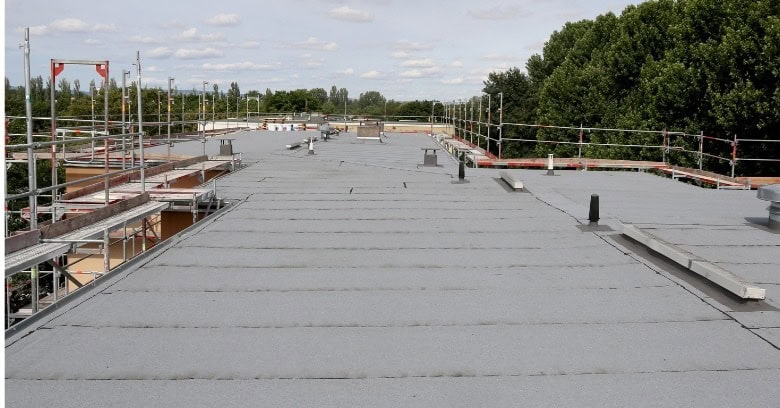
TPO roofing in Clermont is a common pick for low-slope roofs, mostly because of how it handles heat. APC Roofing installs and repairs TPO on homes and light commercial buildings, and APC is GAF Certified, licensed in Florida (CCC1337030) and insured, and your inspection and estimate are free.
What TPO is
TPO (thermoplastic polyolefin) is a single-ply roofing membrane, most often white, that comes in wide rolls. It goes over a low-slope deck as one continuous sheet. The seams between rolls are melted together with a hot-air welder, so the joint becomes part of the membrane instead of a glued overlap.
You’ll find it on porches, carports, Florida rooms, rear additions and garages, and on the flat roofs of offices, shops and other small commercial buildings.
Why TPO roofing in Clermont makes sense in the heat
Central Florida sun is hard on any roof, and a flat roof gets it all day with no pitch to angle it away. A white TPO surface reflects a large share of that sunlight. The roof stays cooler, and so does the room underneath. If you’ve ever stood in a Florida room under a dark roof at 3 p.m. in July, you know what that difference feels like.
Heat also ages roofing materials. A membrane that runs cooler takes less of a beating from the daily heat cycle.
Then there’s the rain. Summer afternoon storms dump a lot of water in a short time, and on a low roof it sits longer than on a pitched one. With TPO, the seams are welded rather than taped, which is a big reason it holds up well where water lingers, as long as those welds are done right.
The weld is what makes or breaks a TPO roof
The flat middle of a TPO sheet seldom leaks. The seams are where problems show up, and a bad weld can look fine from the ground.
A good installer adjusts the welder for the day’s temperature, keeps the seam area clean and dry, and then checks every inch of every seam with a probe to find any gap. Cold welds, dirt in the seam and wrinkles are the usual culprits when a newer TPO roof leaks. That check is part of how a TPO roof should be installed, and it’s the first thing to look at when one leaks.
What goes into a TPO roof
The membrane is just the top layer. Underneath, a typical roof has a cover board, rigid insulation and the deck itself. A few details make a real difference:
- Thickness. TPO is sold by the mil (a thousandth of an inch). Thicker sheets resist punctures better. You can’t tell the difference from the ground, so the thickness should be written on your estimate.
- Drainage. Codes generally call for at least a quarter inch of fall per foot. If the old roof held puddles, a new membrane on the same deck will too. Tapered insulation or an added drain fixes that.
- Edges and tie-ins. Edge metal holds the perimeter against wind. Where a porch meets the main roof, the TPO should run up under the shingles or tile so water lands on top of it.
- Walkway pads. If an AC unit sits on the roof, a path of pads keeps service techs from wearing through the membrane.
Replacing an old flat roof with TPO
If your current flat roof is EPDM, modified bitumen or built-up, TPO is often a good replacement. Building codes generally allow one new membrane over one existing roof, but only when the insulation underneath is dry. If the old roof is wet or there are already two layers, it comes off down to the deck. Soft decking gets replaced, and drainage can be corrected at the same time.
Moisture readings during the inspection tell you which route your roof needs before you commit. If your current roof only needs a repair, you’ll hear that too. See our flat roof repair page for how leaks get traced, or compare TPO with EPDM roofing.
Planning around Clermont weather
Rain stops all membrane work, so TPO jobs get scheduled around the forecast. A repair fits a short dry window. A full roof needs a few settled days. Any section opened during the day is sealed watertight before the crew leaves.
How it works
- Book your free inspection. Call 407-270-1129 or request a free estimate online.
- Get a clear, honest assessment and estimate. You’ll see photos of the deck, drainage and edges, and get a written estimate that lists the membrane thickness and what’s included. Financing is available through Aqua Finance, Fortifi, Hearth and Home Run Finance.
- Your roof gets done and the site gets cleaned up. The crew installs and checks the roof, then cleans up before leaving.
Holding off on a leaking flat roof tends to cost more later. Water that gets into the insulation can’t dry out under a sealed membrane, and wet insulation has to be replaced along with the roof.
TPO roofing questions from Clermont property owners
Is TPO good for a flat roof in Florida?
Yes. Its white surface reflects much of the sun’s heat, and its heat-welded seams hold up well where rain lingers. That combination is why it’s a common choice for low-slope roofs in hot, rainy climates.
Can TPO go on a residential porch or addition?
Yes. TPO is a good fit for porches, carports, garages and additions that are too flat for shingles or tile.
Can TPO be repaired?
Yes. A damaged spot gets a matching patch heat-welded over it, then the edges are probed to confirm the seal.
Do you install TPO on commercial buildings?
Yes. APC Roofing handles TPO and other membrane systems on small commercial buildings too. See our Clermont commercial roofing page.
Talk to a TPO roofing contractor in Clermont
Call 407-270-1129 for a free TPO roof inspection, or start your estimate online. For every low-slope option side by side, visit our Clermont flat roofing page.
Picture a flat roof that drains, a room underneath you can actually use in August, and a written scope you understood before the work began.