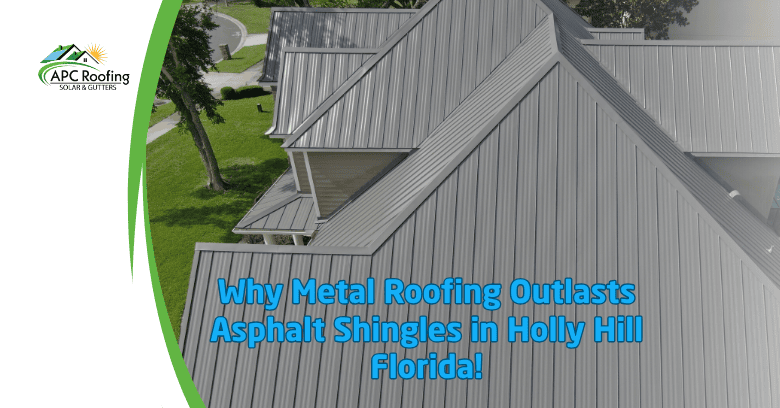
Thinking About Metal Roofing Within Daytona Beach Florida?
APC Roofing lays new panels and brings worn coverings back into shape, from a pole barn to a family home.
Call 386-356-2111 and someone who knows the trade will come out to take a look.
Identifying a System: Clues From Below
A corrugated or ribbed covering is secured with screws set through the metal, whereas standing seam hangs on clips hidden under tall ribs. Steel with a protective coating covers most houses that have metal, and aluminum and copper are less frequent choices.
Screw heads marching in rows, easy to spot from below, point to exposed fasteners, and smooth pans between tall ribs with nothing poking through are standing seam. Barns, workshops and porches often wear corrugated or ribbed sheet, though a house can suit either.
Shapes Rolled Into Steel – Span and Style
A corrugated sheet curves up and down in regular round waves, while ribbed designs show angular ribs and wide flats. Side by side, adjoining lengths overlap by one crest, and every screw lands where a maker's layout calls for.
Ribs make a stiffer panel that crosses longer spans, and corrugated suits older buildings and a farmhouse look. Taller ribs give runoff more room on a long slope, and a lean-to or porch manages fine with a gentle pattern.
Hardware in the Weather: Aging in Sunlight
A single screw pins the metal firmly to framing below, and a washer under each head keeps rain out. Rubber in steady sunlight hardens and cracks with age, well ahead of the painted steel nearby.
An overdriven screw squashes a washer flat, and a fastener stopped short or angled leaves a gap for rain.
Fastener Replacement: Scope and Limits
Washers dotted across a ribbed field grow old together, so eventually a full new set of seals is needed. Each original fastener is taken out, and a slightly fatter screw goes into each hole so a thread bites fresh wood or steel.
A re-screw stops drips around screw heads and draws lifting sheets back down, yet rusted panels, opened laps and poor flashing still need separate repairs. Screw length and thread are chosen for what sits below, wood or a steel purlin, and color-matched tops blend in with a painted finish.
A Covering in Motion: Room to Travel
A steel sheet grows in afternoon heat and shrinks back by dawn, and forty feet of panel shifts roughly a quarter inch or more, and aluminum reaches about double. Metal held too rigidly wears fastener holes into slots, and washers begin to leak.
Ticking heard as morning sun lands on steel is ordinary expansion, and a roof built with slack is unharmed.
Beneath Raised Seams: Tucked Away
A long pan is locked down at a single band, and sliding clips everywhere else let the metal move with temperature. Flashing at an unanchored end is shaped with space beneath, and a pan held rigid throughout tears loose or buckles.
Each pan is set in place, and clips are driven through into the deck along one side, and an adjacent pan then covers every anchor point.
Seam Styles – Wind and Water
A basic profile engages with a firm push along a full length, while machine-rolled designs get folded over by a motorized seamer. A double-lock seam holds far better against strong gusts and standing water, and published ratings run down to lower slopes.
Every product line has distinct spacing and rib size, and architecture and a buyer's eye decide. Clips, trim and closures are bought to suit one particular panel, so parts are not mixed between makers.
How Much Material Is Up There – Worth Confirming
Coil for roofing is sold by gauge, and numbers fall as sheet gets thicker. Outbuildings commonly get twenty-nine, while houses often take twenty-six or twenty-four.
For aluminum, sheet is sized in thousandths, and in both cases a heftier panel stays straighter and tougher. A view from below reveals nothing about grade, so a label on a bundle shows what was delivered.
Factory Protection – Finishes That Hold Up
Steel for roofing is hot-dipped in zinc or an aluminum-zinc blend, and baked-on primer and color follow. Scrapes confined to paint are harmless, but an unprotected cut or a gouge to bare steel is where red rust starts.
Fluoropolymer finishes remain true to color for many years, while polyester versions chalk and fade sooner. Lime in fresh concrete eats into an aluminum-zinc layer, and a separator goes wherever panels touch new brick.
Choosing the Metal: Matching a Location
Aluminum is light and free of red rust, though an impact leaves a deeper mark. At the coastal end of our territory, salt spray breaks down galvanized coatings faster, so a marine-rated system often goes up near a beach.
Copper is usually kept to small accent roofs over a bay or a porch, and the metal weathers to a natural patina with no paint.
Incompatible Neighbors – Isolation and Compatibility
Runoff from copper eats through coated steel downhill, and a stain shows up before a leak does. Aluminum on pressure-treated boards turns white and pits, and an incompatible screw causes slow damage nearby.
Any added flashing or trim should be the same metal as what is up there, or tape and membrane keep dissimilar metals from meeting.
Looks, Not Leaks: What Can Be Done
In trade terms, oil canning describes soft ripples across a broad flat between seams, and faint hollows show at sunrise and fade by noon. A slightly distorted pan sheds rain like any other, and useful life is unchanged.
Heavier gauge, narrower pans and pencil ribs in each flat all reduce waviness, and careful handling on a true deck makes a difference. Photos of finished roofs give a fair idea of how much oil canning shows, and the final pick is yours.
Inside the House – Sound and Temperature
A shed with bare purlins under the panels rings like a drum, since a single skin is the only barrier. A home has sheathing, a membrane and an insulated ceiling under steel panels, and in a living room few can pick out any change from shingles.
A pale or cool-pigment coat sends much of the sun back, and the attic beneath stays cooler on a summer afternoon. A deep hue absorbs heat like any dark surface, and without venting and insulation, color alone does little. Within an hour of sundown, a metal covering is cool, and the attic below catches up before long.
Protecting Whoever Is Below: Position Matters
At the colder end of our territory, snow slides readily off smooth coated steel, and an avalanche off an eave can flatten shrubs, gutters or anyone underneath. Stops attached to the metal let a load leave slowly, with placement over doorways, decks and equipment.
For standing seam, bolted clamps grip each upright joint, while screw-down sheet takes mounts fastened into framing with sealed screws, and homes where snow seldom falls go without.
Storm Marks: What a Hit Can Open
Hail is a fact of life at the colder end of our service area, and thicker steel shows fewer dents. Where a blow splits paint, bare metal can corrode, and a trim piece pushed out of place can channel rain inside.
After any storm, each affected area is photographed and measured, so the extent of damage is clear.
Uplift: Layout Matters
Gusts tug harder at corners and along a perimeter, and a loose flange gives moving air a handle. Trim along every outer line is hemmed and hooked onto a continuous cleat, so nothing sticks out to be grabbed.
Spacing shrinks where loads climb, at corners and a rim, set by a maker's tested layout for each exposure. On the hurricane coast at the far end of our territory, fastening counts rise again, and products are chosen with a wind rating to match.
Where Something Pokes Through: Detail Work
A round pipe receives a rubber or silicone boot molded to follow each rib, and a flat location lets a flange bed down evenly. A chimney or skylight is built up on a curb with a cricket above, so runoff is steered aside.
Sealant finishes a joint already made watertight by folded metal, as ultraviolet light turns soft compounds brittle in a few seasons.
Inside Corners: Built to Drain
A valley pan goes down ahead of any panel, and panels are trimmed on a diagonal to match. Ends are hemmed and held by cleats, so no fastener sits where water collects.
An endlap on a long run holds sealant between overlapping sheets, and fasteners pass through both thicknesses, with uphill metal on top.
Near-Flat Areas – When a Membrane Wins
Most ribbed sheet is specified for about three in twelve or steeper, since anything less lets rain back up at overlaps. Double-lock standing seam is rated for far shallower roofs, with some lines cleared almost down to flat.
Nearly level spots over sunrooms and porches turn up on plenty of houses, and a measured angle decides what goes on, and where metal does not belong, a membrane does.
Under Everything: Wood or Open Framing
On a house, the panels go over solid sheathing, and a synthetic barrier made for high heat sits on top, since felt paper cooks under summer metal. On a barn or shop, panels often span open purlins, and support distance dictates grade.
Once an old covering comes off, spongy sheathing is found and swapped, because screws in decay have nothing to grip.
A Recover Instead of a Strip – Battens and Underlayment
Panels can often go on top of one shingle layer where code permits, so waste is kept out of a landfill. A steel covering adds only slight dead load, so rafters rarely need reinforcing. Battens on top of a synthetic membrane are laid across existing shingles, and clips or screws go down into solid structure.
A roof that was recovered once before, or a deck with decay underneath, comes off entirely, since trapped dampness under metal has no way to dry.
Perimeter Details: Vented or Solid
Closure strips shaped to a panel profile plug hollows under every rib where a run starts and stops, so blown rain and critters are shut out. A cap along a peak comes vented or solid, and attic ventilation is what decides.
Gutter aprons and rake trim wrap up a roof's outline, and water falls clear of fascia instead of running behind.
Working at Height: Handling and Footing
Standing seam panels are formed at full slope length, so no crosswise joint sits in the path of runoff. A long panel calls for several people spaced along the metal, and a damaged pan is replaced, not flattened out.
Feet go in a flat where something solid lies below, because a raised joint dents and deforms under load. Dew or rain makes coated steel as slick as glass, and nobody without a harness should go up.
Signs Worth a Call – A Look From Below
- Red staining around each screw, just above a gutter line.
- Screws no longer tight against metal, on long panels.
- Edge metal curled back, after a windstorm.
- A pipe collar tipped to one side, close to a ridge.
- Red streaks at a raw end, at the bottom of a run.
- Color gone patchy, on one panel more than on panels nearby.
- A drip that follows a row of screws, over a closet.
- A gap along a rib, where slopes meet.
How APC Roofing Goes About Metal Roofing in Daytona Beach Florida – Our Method
Everything begins with identifying which panel system is installed and how the panels are fastened, and after that every fastener, trim piece, penetration, valley and lap gets a close look. Gauge, finish and hardware are noted as we go, while the underside of the deck is inspected from the attic.
Every finding goes into a report with images, and each recommendation carries reasons. If new fasteners are enough, that is what we suggest, and a finished roof is described without softening.
Metal Roofing for Daytona Beach Florida Homes: Plain Findings
Call us at 386-356-2111 and someone will arrange to stop by.
Deciding on Scope: Piece by Piece
A panel torn by a falling limb can be changed individually, though new metal looks brighter than weathered neighbors. A new pipe boot or a resealed lap ends a local drip, while re-fastening cures aged washers.
Rust through sheet after sheet calls for a new covering, and a covering the wind has twisted out of shape is in the same position. Somewhere in between, a single worn plane of the roof can be redone, when damage stays in one place.
Longevity: Upkeep Over Time
A carefully installed panel system can pass forty years, and every estimate is approximate. Concealed-clip panels require less upkeep because no rubber seal sits in the sun, while corrugated and ribbed sheet calls for fresh screws in time.
Copper runoff, bare edges and caulked joints where flashing belongs shorten the life of a roof, and a periodic look finds problems while minor. Leaves and twigs that collect against a curb or in a valley hold moisture against coated steel, and sweeping debris clear helps a finish.
Before deciding on Metal Roofing in Daytona Beach Florida, reach APC Roofing at 386-356-2111. We will inspect all hardware, every edge and each penetration, and a written summary lays out what we saw so you can choose.
Verified

Verified
Verified
Verified