You’ve decided the old roof has to go, or a hailstorm decided for you. Now you’re comparing estimates that list the same shingle at different prices, and you can’t tell what you’d actually be paying for. A roof installation in Springfield, MO is a big check to write, and most of the work that decides how long it lasts ends up hidden under the shingles where you’ll never see it.
That’s a fair thing to worry about. You should know what goes on your house, layer by layer, before anyone starts tearing anything off.
APC Roofing is a GAF Certified contractor, licensed and insured, and we’ve been installing roofs since 2017. Your inspection and written estimate are free, and the estimate spells out every layer so you can compare it line by line with anyone else’s.
Why we start by stripping the old roof
Some homes can legally take a second layer of shingles over the first. It’s quicker, and it’s tempting. The trouble is that a layover hides the roof deck, the wood the whole roof is nailed to. Soft spots, old leaks and rusted flashing stay right where they are, and new shingles laid over an uneven surface tend to show every bump and lift early.
A full tear-off takes the roof down to the deck. Once it’s bare, any rotted or spongy sections can be cut out and replaced with new wood before anything else goes on. If your home already has two layers, both have to come off anyway.
What goes on your roof, in order
A proper roof installation is a stack of layers, and each one has a job.
The roof deck
Damaged decking gets replaced first. Older Springfield homes sometimes have plank decking with gaps between the boards, and that usually needs new sheathing over it so the shingles have a solid base to nail into.
Ice and water protection at the eaves
Southwest Missouri winters bring ice and freeze-thaw cycles. When snow melts on the warm upper roof and refreezes at the cold edge, water can back up under the shingles. A self-sealing membrane along the eaves, and in the valleys where two roof slopes meet, seals around each nail and keeps that water out of the house.
Underlayment
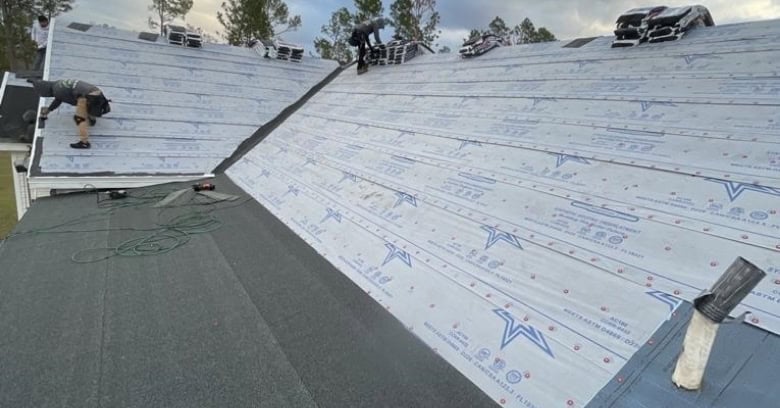
A synthetic underlayment covers the rest of the deck. It’s a second line of defense if wind ever tears a shingle loose, and it keeps the deck dry while the job is underway.
Drip edge and flashing
Metal drip edge along the eaves and rakes guides water into the gutters instead of letting it soak the fascia board behind them. Flashing goes wherever the roof meets a wall, chimney or pipe. Old flashing is bent, rusted and full of nail holes, so on a new roof it should be replaced, not reused.
Shingles, hips and ridge
Starter shingles go along the edges, then the field shingles are nailed in the pattern the manufacturer calls for. Ridge and hip caps finish the high points. Nail placement matters more than most people realize, because a shingle nailed in the wrong spot can blow off in the first hard wind.
Choosing the right roof for Springfield weather
Hail is the big one here. Spring and early summer storms in the Ozarks can drop hail that bruises asphalt shingles and knocks off the granules that protect them from the sun. Many homeowners in hail country choose impact-rated shingles. That rating comes from a lab test, so it tells you the shingle is tougher, not that it can’t be damaged. Some insurers offer a discount on impact-rated roofs, so it’s worth asking your agent.
Wind is the other factor. Straight-line winds from summer thunderstorms test every shingle edge, and the installation pattern does as much to keep a roof on as the shingle itself.
Most homes in the area get architectural shingles. Metal roofing is a good fit for homeowners who want a roof that sheds hail and wind well and lasts a long time. If you have a nearly flat section over a porch or addition, shingles don’t belong there. That part needs a flat roof system tied in to the shingled roof. We’ll tell you what we’d recommend and why, and the decision is yours.
Living at home during the installation
You can usually stay home while your new roof goes on, but it’s loud. A few things help:
- Move cars out of the garage and off the driveway, since the dumpster and deliveries need the space.
- Take pictures and mirrors down from walls on the top floor. Hammering shakes the house.
- Cover anything you store in the attic. Dust and grit will fall through.
- Keep kids and pets inside or away from the edges of the house while old shingles come down.
Many residential projects are finished in a single day. Bigger or steeper roofs take longer, and your estimate will give you a realistic timeline. When the work is done, the site gets cleaned up.
Most cities require a permit for a full reroof, so ask anyone you’re considering who pulls it. A closed permit is also useful paperwork when you sell the house someday.
How it works with APC Roofing
- Book your free inspection. We look at the whole roof and the attic, not just the part you’re worried about.
- Get a clear, honest assessment and estimate. If a repair will do, we’ll say so. If you need a new roof, the written estimate lists the decking, underlayment, flashing and shingles so nothing is vague. Financing is available through Aqua Finance, Fortifi, Hearth and Home Run Finance.
- Your new roof goes on and the site gets cleaned up.
Waiting on a worn-out roof rarely saves money. A slow leak can soften the decking for months before a stain shows on the ceiling, and by then the job includes wood replacement that didn’t need to happen.
Roof installation questions from Springfield homeowners
Can you put new shingles over my old ones?
Sometimes it’s allowed, but we usually recommend a full tear-off so the deck can be checked and repaired. If the house already has two layers, both have to come off.
How long does a roof installation take?
Many residential projects are finished in a single day. Larger, steeper or more complex roofs take longer.
Is a new roof the same as a roof replacement?
Yes, for most homeowners. Our roof replacement page covers when replacing makes sense. This page covers what the installation itself involves.
Can my insurance pay for a new roof?
If storm damage is the reason you need one, it might. You file the claim with your insurance company and pay your deductible. We document the damage, provide the estimate and work with your adjuster.
Book your free roof inspection in Springfield
Call 913-398-5020 or request your free estimate online. We’ll come out, measure the roof and walk you through what it needs.
You’ll end up with a roof you don’t have to think about every time a spring storm rolls through, a dry attic, and a bill that matches the estimate you signed. Trust matters, and that’s how we earn it.