Looking for Corrugated Metal Roofing Across Sanford Florida?
APC Roofing builds and maintains coverings made of coated sheet and aluminum, from a pole barn to a family home.
Dial 407-270-1129 and a roofer will look closely and explain plainly what is up there.
Which System Is Up There: Hints in Plain Sight
Corrugated and ribbed sheet is held down by screws driven straight through the metal, while standing seam is clipped down beneath upright folds. Coated steel is what the great majority of metal-roofed homes carry, and aluminum or copper appears now and then.
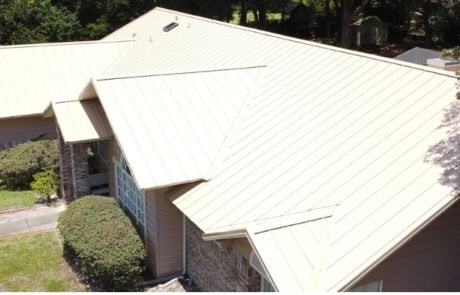
Screw heads marching in rows, easy to spot from below, point to exposed fasteners, and clean flats between raised joints, bare of hardware, belong to standing seam. Corrugated sheet is a regular choice on barns, shops and porches, and homes turn up with both.
Cross-Section Choices: Which Suits a Building
Corrugated sheet rises and falls in rounded, evenly spaced waves, while ribbed designs show angular ribs and wide flats. Each sheet laps over a neighbor along a long edge, and screw locations follow a published diagram.
Ribbed stock is stiffer and spans further between supports, and corrugated suits older buildings and a farmhouse look. A tall rib keeps heavy rain inside a channel on a broad roof plane, whereas a short porch covering gets by with a low pattern.
What Keeps Sheet Down: Every Detail Counts
A single screw pins the metal firmly to framing below, and a sealing washer beneath each head closes a drilled hole. Years of sun and heat stiffen synthetic rubber until cracks form, well ahead of the painted steel nearby.
Driving a screw past snug crushes a washer and dimples the metal, while too little pressure or a crooked angle leaves an opening.
Swapping Out Hardware – Benefits and Gaps
On corrugated or ribbed sheet, every washer ages at one pace, and a full re-screw is an ordinary step somewhere along the way. Old fasteners are backed out one at a time, and a bigger diameter is driven in to grip where an old thread stripped.
A re-screw stops drips around screw heads and draws lifting sheets back down, but corrosion, parted laps and bad flashing are left as found. Replacements are chosen for whatever framing lies underneath, lumber or steel, and tops painted in a panel color keep new work from standing out.
A Covering in Motion: Oval Holes and Loose Seals
A steel sheet grows in afternoon heat and shrinks back by dawn, and a longer run shifts farther still, while aluminum goes about twice as far. A panel pinned at both ends slowly slots every screw opening, and a washer stops sealing.
Ticking heard as morning sun lands on steel is ordinary expansion, and a well-built roof takes no harm from some noise.
Anchoring Standing Seam: Out of the Weather
A long pan gets one fixed point, often near a ridge or an eave, and floating clips farther along give the metal freedom to shift. A finishing piece at an opposite end has room built in underneath, and metal with no play winds up torn or kinked.
A pan is positioned and clips are screwed to the deck beside a long edge, so no fastener head is left out in the weather.
Quick-Fit or Heavy-Duty: Which Suits the House
Snap-together panels latch by hand, and heavier-duty versions are folded over by a motorized tool. A double-lock grips harder against wind-driven rain, and a gentler pitch is allowed.
Pan width and rib height vary from product to product, so the house and a preferred look guide a decision. Clips, trim and closures are bought to suit one particular panel, and a mismatch shows up as gaps and loose joints.
Stock Weight: Dents and Ripples
Steel thickness is given as a gauge, and numbers fall as sheet gets thicker. Twenty-nine is a regular sight on sheds and pole barns, and residential work leans on twenty-six and twenty-four.
Aluminum is called out in decimal inches, and more material means fewer marks and less waviness. A view from below reveals nothing about grade, so a label or order sheet is what gets checked.
Factory Protection: Choosing a Finish
Coil stock is dipped in molten zinc or an aluminum-zinc alloy, and a color coat is baked on afterward. A scratch that stays within paint does no harm, but a sheared edge exposes steel that will corrode.
PVDF finishes hold color for decades, and polyester types chalk white sooner. Wet mortar and fresh concrete attack an aluminum-zinc coating, and a separator goes wherever panels touch new brick.
Which Metal Suits – Coast and Country
Aluminum is lighter than steel and never forms red rust, though a thicker grade is needed to resist dents. Along the coastal end of our service area, salt in the air shortens the life of zinc-based coatings, and makers restrict certain products near surf.
Copper usually goes on small accent roofs over bays and entries, and years outdoors take bare metal to brown and then green.
Mixing Metals – Isolation and Compatibility
A copper pipe or flashing above steel sends corrosive drainage down over the panels, and a dark streak shows long before any hole. Pressure-treated framing corrodes aluminum laid directly on top, and a bare steel screw in soft sheet breaks down too.
Flashing added later should match whatever metal is already installed, or a strip of membrane goes between dissimilar metals.
An Appearance Question – Why Installation Counts
Oil canning is a gentle waviness across the flat of a standing seam pan, and a sun low in the sky exaggerates every contour. A slightly distorted pan sheds rain like any other, and the roof lasts no less.
Heavier gauge, narrower pans and pencil ribs in each flat all reduce waviness, and a deck without humps or dips matters too. Photographs of finished houses show how noticeable oil canning can be, and the choice of panel is yours.
Inside the House: Noise and Heat
A shed with bare purlins under the panels rings like a drum, since one thin layer is all that stands between sky and interior. A dwelling puts decking, a membrane and insulation between the panels and any bedroom, and indoors, few people notice more noise than under asphalt.
Cool-pigment coatings return the bulk of the sunshine, so the space under the roof runs cooler. Dark metal heats up like any black roof on a clear day, and ventilation and insulation underneath matter as much as finish. Metal loses daytime warmth shortly after the sun sets, and the attic eases off soon afterward.
Retention Hardware – Only Where Needed
At the colder end of our range, snow lets go of a metal surface easily, and a heavy sheet coming off in one piece can hurt a person or tear away a gutter. Retention bars keep a load up top to melt off gradually, and hardware sits over entries, paths and meters.
Brackets on standing seam bite an upright fold, not a flat, while exposed-fastener sheet takes mounts screwed into framing, and homes where snow seldom falls go without.
Storm Marks: When Paint Cracks
Hail visits the colder end of our range with some regularity, and thicker steel shows fewer dents. A sharp blow that chips a color coat leaves metal bare to weather, while a buckled seam can part enough to admit water.
After a storm, we photograph and measure what we find, and each dent and damaged panel is located.
Uplift – A Denser Pattern
Perimeter bands of a roof take a heavier pull than a central field, and a loose flange gives moving air a handle. Trim along every outer line is hemmed and hooked onto a continuous cleat, leaving nothing for a storm to seize.
Spacing shrinks where loads climb, at corners and a rim, as manufacturer tables call for at each site. On the hurricane coast at the far end of our territory, fastening counts rise again, and a whole assembly has to carry a matching rating.
Where Something Pokes Through – Flashing Done Right
Each pipe takes a boot made for panel roofs, with a base pressed to follow corrugations, and placement is down in a pan rather than on a crest. A chimney or skylight is built up on a curb with a cricket above, so no water dams up.
Sealant finishes a joint already made watertight by folded metal, because sunlight dries and cracks sealing compounds within a few years.
Channels Between Roof Planes – No Screws in the Water
A valley pan goes down ahead of any panel, and every sheet is trimmed on the skew. Ends are hemmed and held by cleats, so no hole sits where runoff gathers.
On a run too long for one sheet, an endlap joins pieces with sealant between, and uphill metal always goes on top, screwed through.
Near-Flat Areas – When a Membrane Wins
Corrugated and ribbed sheet usually needs around three inches of rise in every foot, and on a gentler slope, overlaps start to let water through. Double-lock standing seam is rated for far shallower roofs, with some lines cleared almost down to flat.
Nearly level spots over sunrooms and porches turn up on plenty of houses, and a measurement comes before any panel is named, and anything under a panel's limit is finished in a membrane.
Under Everything: Rot and Spacing
Metal on a dwelling is installed over full sheathing, and a high-temperature synthetic underlayment goes between, because traditional felt degrades quickly up there. An outbuilding may have nothing but purlins under the metal, and distance between supports sets a minimum gauge.
Once the deck is exposed, any board that gives underfoot comes out, since punky fibers offer a screw no bite.
When the Old Roof Stays: Light Enough to Add
Many building codes allow metal over a single layer of asphalt shingles, and noise and a dumpster are avoided. New steel adds well under two pounds per square foot, so most framing takes extra weight without reinforcement. Battens on top of a synthetic membrane are laid across existing shingles, and fasteners are long enough to bite solid boards below.
Where a roof was already recovered once, or the decking is soft, everything comes off, because a problem covered with steel keeps growing out of sight.
Finishing Off – Tight Against Weather
Shaped closures fill spaces under every rib at an upper line and a lower line, and rain, insects and birds cannot get under the panels. A ridge cover can include a vent or be solid, as existing ventilation requires.
A drip edge along an eave and trim on each rake complete a border, and fascia boards stay dry.
Working at Height: Where to Step
Each seamed pan is rolled out to reach a whole slope, and nothing overlaps partway up. Carrying an extended panel takes people spaced along the metal, and a crimped or creased pan is no longer usable.
Feet go in a flat where something solid lies below, since pressure on a rib bends the metal out of shape. Morning dew alone can make metal treacherous, so the safest place for the household is indoors.
What Homeowners Can Spot: Plain to See
- Rust circles where screws go in, low on a slope.
- Hardware sticking up, by a peak.
- Flashing flapping in a breeze, following a gusty night.
- A flue collar sitting crooked, over a kitchen.
- Rust creeping from a trimmed end, in a valley.
- Uneven fading, on one panel more than on panels nearby.
- Water marks lined up on drywall, in an upstairs bedroom.
- A lock pulled apart, above a gutter.
How APC Roofing Tackles Corrugated Metal Roofing in Sanford Florida – Step by Step
We start by identifying which panel type is installed and how the panels are held, and next come screw locations, perimeter trim, pipes, valleys and overlaps. Gauge, finish and hardware are noted as we go, and the attic is searched for stains and soft decking.
What we find goes into a report with photographs, and each repair is explained. If a covering needs only new screws, we say exactly that, while replacement comes up only when a roof is truly spent.
Corrugated Metal Roofing in Sanford Florida: A Careful Look
Call 407-270-1129 and we will pick a time together for a visit.
Keeping the Roof: Guided by Evidence
An individual rusted sheet can be unscrewed and exchanged, although new paint never quite matches older metal. Resealing a lap or replacing a boot stops a local leak, while a re-screw takes care of hardened washers.
Once red rust has eaten through large areas, patching no longer makes sense, and metal torn loose over entire slopes is no better off. A partial job on just one side is sometimes a sensible middle course, when harm is local.
The Long View: Upkeep Over Time
Coated steel put on properly often gives forty years or better, though climate, care and material all make a difference. A seamed pan roof has fewer parts that age, while through-fastened sheet needs a re-screw somewhere along the way.
Mixed metals, raw cut edges and caulk doing the job of flashing all shorten a roof's service, and a visit now and then spots trouble early. Leaves and needles piled in a valley or behind a chimney keep the metal wet, and brushing debris off protects paint.
For a roofer's view on Corrugated Metal Roofing in Sanford Florida, dial APC Roofing at 407-270-1129. Every detail, including how the panels are fastened, is read in person, and you get photographs, notes and a recommendation to consider.
Verified

Verified
Verified
Verified
Verified