In Need of Metal Roofing Throughout Sanford Florida?
APC Roofing puts up and mends screw-down sheet and clip-held panels, on houses, garages, porches and outbuildings.
Dial 407-270-1129 and a roofer will look closely and explain plainly what is up there.
Sorting Out Types – A Glance Up
Corrugated and ribbed sheet is held down by screws driven straight through the metal, while standing seam is attached with clips tucked inside raised joints. Nearly every residential job uses coated steel, while aluminum and copper account for a minority.
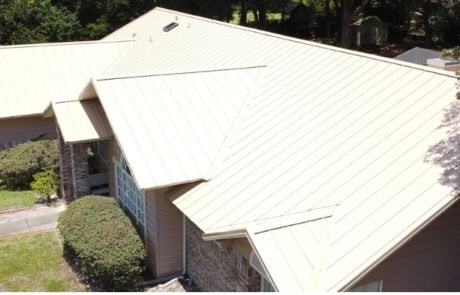
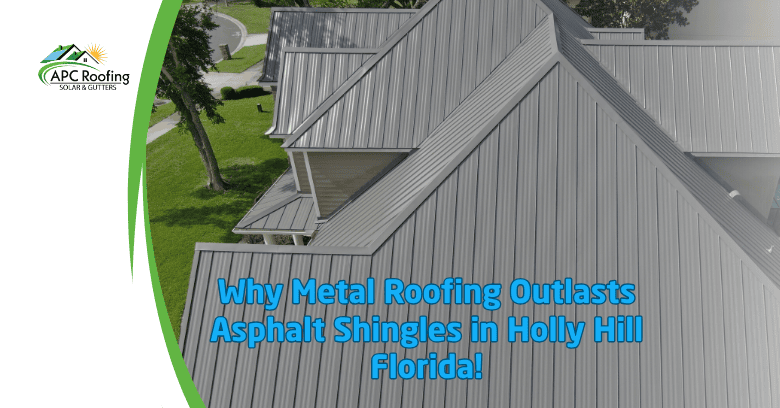
Rows of fastener heads, visible from the street, give away a screw-down roof, and smooth pans between tall ribs with nothing poking through are standing seam. Pole buildings, sheds and porches frequently get ribbed sheet, while residences take either style.
The Cross-Section: Old Look, New Look
Corrugated sheet ripples in smooth, repeating curves, while ribbed panels carry squared ribs with wide flats between. Adjacent lengths share a narrow side lap, and fastener placement follows a published pattern.
Ribs make a stiffer panel that crosses longer spans, while corrugated fits a period barn or a farmhouse style. A tall rib keeps heavy rain inside a channel on a broad roof plane, whereas a short porch covering gets by with a low pattern.
Hardware in the Weather – Why Installation Matters
Every screw draws a panel down onto a support, and a washer under each head stops water getting in. Ultraviolet light slowly bakes neoprene brittle, and the panels can go on for decades more.
A screw set too tight crushes a washer out sideways, and a slack or crooked fastener leaks on one side.
Refreshing Hardware: Scope and Limits
Every washer across a ribbed or corrugated field weathers at the same rate, so eventually a full new set of seals is needed. Each original fastener is taken out, and a slightly fatter screw goes into each hole so a thread bites fresh wood or steel.
Re-fastening stops water at every head and holds down sheets that lift, though perforations, split laps and faulty trim remain as before. Thread type follows whatever support lies below, since lumber and steel purlins take different screws, and a painted cap keeps new work inconspicuous.
Expansion and Contraction: Oval Holes and Loose Seals
Sunshine stretches steel slightly and a chilly night pulls the metal back, and forty feet of panel shifts roughly a quarter inch or more, while aluminum goes about double. Metal screwed down with no give wears each hole into an oval, and washers then stop sealing.
Creaks as the day warms come from steel adjusting, and nothing is damaged where every detail allows for slack.
Under Upright Joints – Out of Sight
A long pan gets one fixed point, often near a ridge or an eave, and sliding clips everywhere else let the metal move with temperature. At an unanchored end, trim is bent with clearance, while a pan fastened hard along every foot pulls loose or ripples.
Clips are screwed to the deck along one edge of every pan as work proceeds, so nothing that holds the roof down is left exposed.
Seam Styles – Wind and Water
One kind of rib clicks shut under a firm push, and heavier-duty versions are folded over by a motorized tool. A double-lock seam holds far better against strong gusts and standing water, and maker approvals cover shallower slopes.
Profiles come in different widths and heights, so the house and a preferred look guide a decision. Accessories such as clips and closures fit a single system, and a substitute from elsewhere leaves gaps.
Heavier and Lighter Stock: Dents and Ripples
Coil for roofing is sold by gauge, and higher numbers mean thinner sheet. Twenty-nine is a regular sight on sheds and pole barns, and homes typically get twenty-six or twenty-four.
Aluminum is specified in thousandths of an inch instead, and with either metal, a stouter panel holds shape. A view from below reveals nothing about grade, so a label on a bundle shows what was delivered.
Protection Built In – Finishes That Hold Up
Coil stock is dipped in molten zinc or an aluminum-zinc alloy, and a color coat is baked on afterward. Scrapes confined to paint are harmless, but an unprotected cut or a gouge to bare steel is where red rust starts.
A PVDF finish stands up to sunlight for a long time, and polyester types chalk white sooner. Wet masonry corrodes aluminum-zinc coated sheet, and a separator goes wherever panels touch new brick.
Base Material – Trade-Offs
Aluminum is lighter than steel and never forms red rust, but a dropped tool or a falling branch dents a soft sheet sooner. Salt air at the coastal end of our territory attacks zinc-based layers, so a marine-grade finish is often chosen for homes near a beach.
Copper is usually kept to small accent roofs over a bay or a porch, and with nothing applied, color shifts over the years.
Metals That React – Matching or Separating
A copper pipe or flashing above steel sends corrosive drainage down over the panels, and discoloration arrives well before a panel gives way. Chemicals in treated lumber pit any aluminum resting on top, and fasteners of an unsuited metal leave a ring of damage.
Flashing added later should match whatever metal is already installed, or tape and membrane keep dissimilar metals from meeting.
Looks, Not Leaks: What Can Be Done
What the trade calls oil canning is a mild wave in a flat pan, and a midday sun hides what a low evening sun reveals. A warped look in the metal lets no rain through, and service life is unaffected.
Thicker metal, a slimmer width and striations rolled into every pan tame rippling, and a deck without humps or dips matters too. Photos of finished roofs give a fair idea of how much oil canning shows, and you decide what to order.
Everyday Comfort – Sound and Temperature
Panels laid straight over bare purlins ring out in a downpour, because nothing there soaks up impact. A dwelling puts decking, a membrane and insulation between the panels and any bedroom, and indoors most people hear little more than on shingles.
A white, tan or light gray panel turns back much glare, so the space under the roof runs cooler. Deep shades absorb as much as dark asphalt, and airflow and insulation lower down count just as much. Metal loses daytime warmth shortly after the sun sets, and the attic below catches up before long.
Protecting Whoever Is Below: Position Matters
At the colder end of our territory, snow slides readily off smooth coated steel, and a heavy sheet coming off in one piece can hurt a person or tear away a gutter. Rows of cleats hold a load back until melting clears the roof, and positions are chosen where anything below could be hit.
Brackets on standing seam bite an upright fold, not a flat, whereas on corrugated sheet, mounts go into solid wood with gasketed fasteners, and homes where snow seldom falls go without.
Pounding From the Sky: Documented Plainly
At the colder end of our territory, hail is a regular event, and thicker steel shows fewer dents. Where a blow splits paint, bare metal can corrode, and a bent seam or a dislodged trim piece can let water in.
After a storm, we photograph and measure what we find, so the size and position of each dent are known.
Holding On in a Gale – A Denser Pattern
Perimeter bands of a roof take a heavier pull than a central field, and a loose flange gives moving air a handle. Finish trim is hemmed and caught on a cleat, and nothing is left free to flap.
Spacing shrinks where loads climb, at corners and a rim, following a maker's layout for a site's exposure. At the coastal end of our range, where hurricanes come ashore, rows of screws draw in further, and a whole assembly has to carry a matching rating.
Breaking Through the Metal: Sealant as Backup
A round pipe receives a rubber or silicone boot molded to follow each rib, and a hole is cut in a flat, never across a crown. Larger units get a raised curb plus a cricket on an uphill side, and runoff is parted to either flank.
Sealant finishes a joint already made watertight by folded metal, as ultraviolet light turns soft compounds brittle in a few seasons.
Changes of Direction – No Screws in the Water
A broad flashing lines each valley in advance, and each sheet is cut to a matching angle. Ends are hemmed and held by cleats, so no hole sits where runoff gathers.
An endlap on a long run holds sealant between overlapping sheets, and fasteners pass through both thicknesses, with uphill metal on top.
Shallow Sections – Measured, Not Guessed
Makers of exposed-fastener sheet commonly list three in twelve, since anything less lets rain back up at overlaps. Mechanically seamed panels are approved much lower, and product literature states an exact minimum.
Many homes have a gentle stretch over a porch or a later addition, and pitch is measured rather than judged by eye, and a part too low for any panel gets a membrane instead.
Substrate: Rot and Spacing
On a house, the panels go over solid sheathing, and a high-temperature underlayment sits beneath the panels, as asphalt felt turns brittle up there. On a barn or shop, panels often span open purlins, so wider gaps call for thicker steel.
Once an old covering comes off, spongy sheathing is found and swapped, because crumbling plywood cannot anchor a clip.
Going Over the Existing Roof – Battens and Underlayment
Panels can often go on top of one shingle layer where code permits, and noise and a dumpster are avoided. Sheet steel is light, at well under two pounds a square foot, so rafters rarely need reinforcing. Battens on top of a synthetic membrane are laid across existing shingles, and clips or screws go down into solid structure.
A roof that was recovered once before, or a deck with decay underneath, comes off entirely, because a problem covered with steel keeps growing out of sight.
Completing the Job: Done Properly
Strips cut to match a profile close off space under each rib at high and low points, so blown rain and critters are shut out. A cap along a peak comes vented or solid, and attic airflow needs are what decide.
Drip edge, rake trim and a gutter apron finish every outer line, so rain does not run down behind fascia.
Care With the Metal: Slick When Wet
A seamed panel comes off a forming machine cut to the length of a run, so a single piece covers eave to ridge without an endlap. Carrying an extended panel takes people spaced along the metal, and a pan that gets bent should not go on the roof.
On panels, a step belongs in a flat above a purlin or deck, since a heel on a rib crushes a fold. Dew or rain makes coated steel as slick as glass, so climbing up for a look is unwise.
What Homeowners Can Spot: Easy to Notice
- Orange halos at fasteners, low on a slope.
- Screws backed out of holes, on a south exposure.
- Trim bent up at a corner, facing prevailing wind.
- A vent cap knocked askew, beside a chimney.
- Rust creeping from a trimmed end, along a rake.
- Color gone patchy, on one panel more than on panels nearby.
- A drip that follows a row of screws, over a closet.
- A gap along a rib, at the low end of a panel.
How APC Roofing Takes On Metal Roofing in Sanford Florida – Step by Step
Everything begins with identifying which panel system is installed and how the panels are fastened, before each fastener, edge, boot, valley and lap is read in sequence. We note thickness, coating and hardware along the way, and a trip into the attic catches past leaks.
Every finding goes into a report with images, and every item comes with the why. Where a reseal will do, a reseal is what we propose, and a roof past saving is described plainly.
Metal Roofing Across Sanford Florida: A Careful Look
Reach us at 407-270-1129 and we will schedule an inspection.
Deciding on Scope – When a Tear-Off Makes Sense
A lone bad pan can be taken out and exchanged, but brand-new paint stands out against faded neighbors. A new pipe boot or a resealed lap ends a local drip, while new fasteners seal screw holes again.
Once red rust has eaten through large areas, patching no longer makes sense, and a covering riddled with failed seams is no better off. One tired face of the house can be redone alone, when damage stays in one place.
The Long View: Upkeep Over Time
A well-built steel covering commonly serves forty years or more, though climate, care and material all make a difference. Standing seam asks for less upkeep, since nothing pierces a pan, while ribbed sheet gets new fasteners once washers tire.
Dissimilar metals, raw edges and sealant used instead of proper flashing wear out a covering ahead of schedule, and a visit now and then spots trouble early. Piles of leaves behind a chimney keep a patch of metal damp for days, so getting debris off the panels is worth the effort.
Before deciding on Metal Roofing in Sanford Florida, get hold of APC Roofing at 407-270-1129. We will inspect all hardware, every edge and each penetration, and a written report puts options in front of you.
Verified

Verified
Verified
Verified
Verified