Once a new roof is on, you’ll never see most of it again. The shingles or panels are the only part anyone looks at, but whether your roof installation keeps water out for decades depends on layers buried underneath. That’s hard to judge from a one-page quote, and it’s easy to wonder what you’re actually paying for.
You don’t need to become a roofer to protect yourself. You just need to know what a complete roof looks like and what to ask for in writing.
APC Roofing is GAF Certified, licensed and insured, and has installed roofs since 2017 across Central Florida, the Daytona Beach area, the Kansas City metro and Springfield, Missouri. Your inspection and estimate are free. Call 866-995-0704 to get started.
A roof installation is a system, not a covering
The visible material is the last layer in a stack that only works when every part is there. On a typical sloped roof, from the bottom up:
- Roof deck. The plywood or boards everything else fastens to. It has to be solid and dry.
- Drip edge. Metal trim at the eaves and rakes that sends water off the roof edge instead of letting it curl back onto the fascia.
- Ice and water barrier. A self-adhering membrane in the spots water pushes hardest: valleys, around penetrations and, in colder areas, along the eaves.
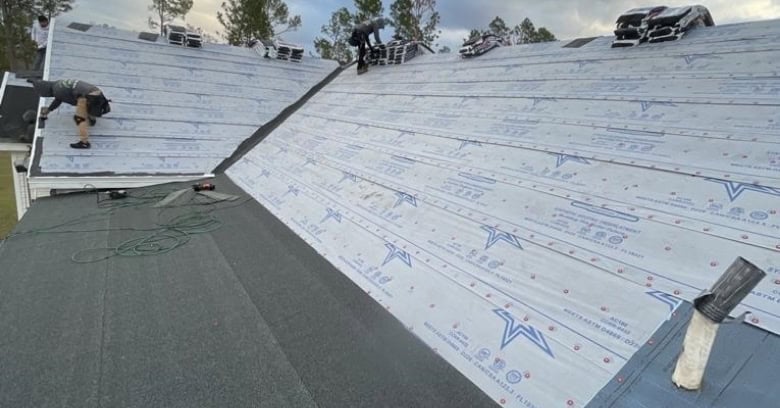
- Underlayment. The layer across the rest of the deck that keeps water out when wind drives rain sideways under the roofing.
- Starter course. A sealed first row at the eaves that anchors the first course of shingles against wind.
- Flashing. Formed metal at every wall, chimney and pipe, and in the valleys.
- The roofing itself, then ridge cap.
Skip a layer or use caulk where formed metal belongs, and the roof has a countdown on it from the first day.
The parts that get skipped on low bids
Drip edge. It’s one of the least expensive parts of a roof and one of the most often missing on older work. Without it, water wicks back into the fascia and roof deck.
Ice barrier along the eaves. In the Kansas City metro and Springfield, ice can form at the roof’s edge and push meltwater back under the shingles. A self-adhering barrier along the eaves, running past the inside line of the exterior wall, is the protection. On low-pitched roofs or deep overhangs, that can mean more than one row of membrane, which is why it gets short-changed.
Flashing. Reusing old, tired flashing under a new roof is one of the most common reasons a nearly new roof leaks. Ask which flashings are new.
Nailing pattern. Shingle wind ratings are earned in testing with the nailing pattern the manufacturer specifies, which for high-wind ratings is usually six nails per shingle instead of four. In Florida’s hurricane country, that pattern matters. Each nail also has to land in the narrow zone printed on the shingle.
Matching the installation to your weather
Central Florida and the Daytona Beach area bring year-round sun, heavy afternoon storms and hurricane-season wind. Edge metal, starter strips and fastening at the perimeter carry a lot of weight here, because wind lifts roofs from the edges first.
The Kansas City metro and Springfield bring hail, freeze-thaw and the occasional ice storm. Impact-rated shingles and a full ice barrier at the eaves are worth discussing.
Whatever the material, the installation should match the manufacturer’s instructions, since that’s usually what their product warranty depends on.
New construction and additions
On a new build, the roof has to go on before interior work can start, so scheduling matters as much as the workmanship. A roofer who shows up when promised keeps the whole project moving.
Additions are harder. The new roof has to tie into the existing one so the joint is both watertight and hard to spot. Matching aged shingles exactly is rarely possible, and if the new section will look different from the street, you should hear that before materials are ordered, not after they’re nailed down.
Choosing your roofing material
The layers above apply no matter what goes on top. The material you pick changes the details:
- Shingle roofs are the most common. Our shingle roof installation page covers them.
- Metal roofs have their own fastening and underlayment needs. See metal roof installation.
- Tile roofs depend heavily on the underlayment beneath the tile. See our tile roofing page.
If you’re replacing an existing roof, our roof replacement page explains how to tell whether it’s time and what replacement day looks like.
What to ask your installer
Before you sign, ask for a written specification that covers the parts you’ll never see again: the deck check and decking rate, underlayment type, where ice and water barrier goes, which flashings are new, the nailing pattern and who pulls the permit. That page, more than the shingle color, is where the quality of your roof gets decided.
How it works with APC Roofing
- Book your free inspection. Call 866-995-0704 or request a free online estimate.
- Get a clear, honest assessment and estimate. You’ll get photos and a written estimate that spells out the layers, not just the brand and color.
- Get your roof installed and the site cleaned up. Many residential shingle projects are finished in a single day, and the crew cleans up before leaving.
Financing is available through Aqua Finance, Fortifi, Hearth and Home Run Finance.
Roof installation questions
How long does a roof installation take?
Many residential shingle projects are finished in a single day. Metal, tile, flat and larger or more complex roofs take longer, and your estimate will include a timeline.
What’s the difference between underlayment and an ice and water barrier?
Underlayment covers the whole deck as a second line of defense. Ice and water barrier is a sticky, self-sealing membrane used in the spots most likely to leak, like valleys and eaves.
Do I need a permit for a new roof?
Most roof installations need one, and the work gets inspected. Your contractor should pull the permit.
Can a new roof match my existing roof on an addition?
Often close, rarely exact, since the old roof has weathered. You’ll see samples and hear what to expect before anything is ordered.
A new roof you never have to second-guess
The layers you can’t see are the ones that decide how your roof does in its first real storm. Getting them right costs far less than fixing them later.
Call 866-995-0704 to book your free inspection, or start your estimate online. You’ll know what’s going on your house, layer by layer, and you can stop wondering whether it was done right.