Two crews can take the same pallet of shingles and put two very different roofs on your house. The difference is almost all in the layers nobody sees once the job is done. If you’re getting a new roof, you’re paying for those hidden layers too, and it’s fair to want to know they’ll be done right.
Most homeowners only go through a shingle roof installation once or twice in their lives. You shouldn’t have to become a roofer to know what a good one looks like. Here’s the sequence from the bare deck up, and the questions worth asking at each step.
APC Roofing has installed shingle roofs since 2017 in Central Florida, the Daytona Beach area, the Kansas City metro and Springfield, Missouri. We’re GAF Certified, licensed and insured, and many of our residential installs are finished in a single day. Call 866-995-0704 for a free inspection and estimate.
Step 1: Tear-off and a close look at the deck
With the old shingles stripped, the wooden deck underneath gets checked across the whole roof. The crew is looking for soft spots, plywood that’s separating into layers, stains around old leaks and gaps at the seams. Bad sections get replaced.
This matters more than any shingle you could pick. Nails don’t hold in rotten wood, and no underlayment can bridge a bad deck. It’s also the only time anyone will see your roof structure for many years, which is a big reason to tear off instead of laying new shingles over old ones.
Step 2: Drip edge and underlayment
Metal drip edge goes on along the bottom edges and the sloped sides of the roof. It guides water into the gutters instead of letting it curl back behind the fascia.
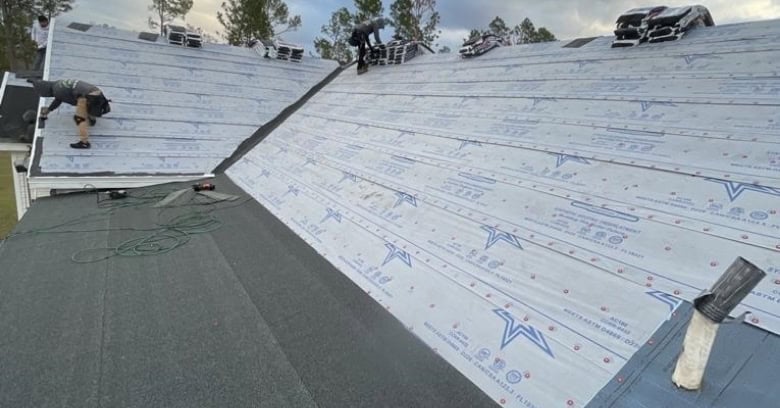
Then underlayment covers the whole deck. Think of it as the backup roof. When wind drives rain under a shingle, the underlayment is what keeps it out of your attic. In valleys and around other spots where water collects, a self-adhering membrane adds extra protection. In Kansas City and Springfield, that membrane along the eaves also helps against ice dams, where snowmelt refreezes at the roof edge and backs up under the shingles. Florida has its own building code rules for how underlayment is installed, and a permitted job is inspected against them.
Step 3: The starter strip
Before the first full row, a starter strip goes along the eaves and rakes. It has a strip of sealant that bonds to the first course of shingles, so the edge of your roof is sealed instead of loose. Roof edges are where wind starts peeling. Skipping the starter is a common shortcut.
Step 4: Nailing the shingles
This is where most wind failures start, so it’s worth understanding.
Every shingle has a narrow nailing strip printed across it. Nails belong in that strip. A nail placed too high misses the shingle underneath and holds one layer instead of two. A nail driven too deep cuts into the shingle, and one left sticking up keeps the next row from sealing flat.
The count matters too. Four nails per shingle is a standard installation. Many manufacturers require six nails, plus a sealed starter, before they’ll back the shingle’s highest wind rating. It’s mostly extra labor, not extra material. Ask which pattern your estimate includes. In Florida’s hurricane season and Kansas City’s spring storms alike, it’s money well spent.
Step 5: Flashing, pipe boots and valleys
Flashing is the metal that seals the joints where your roof meets a wall, a chimney or another roof plane. On a new roof, new step flashing should go in along walls instead of reusing the old metal. Rubber pipe boots around plumbing vents should be replaced, not just caulked. Valleys, where two slopes meet and carry a lot of water, should be built the way the shingle manufacturer specifies.
Most leaks on newer roofs come from these details, not from the shingles in the middle of the roof.
Step 6: Ridge cap, inspection and cleanup
Ridge cap shingles finish the peak. If your job needs a permit, the city or county inspector signs off on the work. Then the crew hauls away debris, clears tear-off grit out of the gutters and runs a magnet over the yard and driveway for stray nails.
You should get a walk-around before the crew leaves, along with your warranty paperwork. For what the day itself feels like as a homeowner, our roofing contractors page covers the logistics.
How it works with APC Roofing
- Book your free inspection. Call 866-995-0704 or request a free online estimate.
- Get a clear, honest assessment and estimate. Your estimate spells out the shingle, the underlayment, the flashing and how rotted decking is handled, so you know what you’re paying for.
- Your new roof goes on and the site gets cleaned up. Many residential shingle roofs are installed in a single day, and we clean up like we were never there.
Financing is available through Aqua Finance, Fortifi, Hearth and Home Run Finance. Compare shingle options on our shingle roofing page, or see shingle roof installation in Orlando and in Kansas City.
Shingle roof installation questions
How long does a shingle roof installation take?
Many homes are done in one day, tear-off to cleanup. Large or steep roofs, homes with a lot of rotted decking and bad weather can stretch it out.
Can new shingles go over my old roof?
Local code sometimes allows one extra layer. It’s usually a poor trade, because it skips the deck inspection, adds weight and can affect your shingle warranty.
What should my installation estimate include?
The shingle brand and line, underlayment, drip edge, starter strip, new flashing and pipe boots, ridge cap, how much rotted decking is included or what it costs per sheet, the permit and debris removal.
Do I need a permit for a new roof?
Most roof replacements do. Your roofer should pull it under their own license or registration and schedule the inspections.
A new roof you can stop thinking about
An old roof that’s losing shingles won’t get cheaper to replace, and every storm it takes adds to the work underneath. When the time comes, have it done once and done right.
The goal is simple: a roof installed correctly from the deck up, a house that stays dry, and an estimate that matched the final bill. Call 866-995-0704 to book your free inspection, or start your estimate online.