The afternoon storm passes, and there’s a drip in the Florida room again. You had it patched last year, and now there’s a bucket on the floor and a soft brown ring on the ceiling. Good flat roof repair in Palm Coast starts with finding where the water is really getting in, which is often not where it drips.
You’re probably wondering whether this is a small fix or the start of a much bigger bill. That’s a reasonable worry, and you shouldn’t have to guess. You deserve someone who’ll show you the problem on your own roof and tell you plainly what it needs.
APC Roofing is GAF Certified, licensed in Florida (CCC1337030) and insured, and we’ve been fixing roofs since 2017. Your inspection is free.
Why flat roofs leak around Palm Coast
Most flat roof leaks come from a handful of places. On homes here, the usual suspects are:
- Seams that have opened. Where two sheets of membrane overlap, heat, sun and movement slowly work the joint loose.
- The tie-in to the main roof. Where a porch or addition roof meets the house, the membrane has to run up under the shingles or flashing above it. If that order is reversed, wind-driven rain gets pushed behind it.
- Water that won’t drain. Low spots and clogged scuppers leave water standing for days, and the membrane under a puddle ages faster.
- Punctures. A dropped tool during AC service, a branch thrown by wind, or someone walking the roof in hard shoes.
- Lifted edge metal. Strong gusts pull up at the perimeter, and once the edge loosens, the membrane can peel back.
- Cracked boots and seals around plumbing vents and anything else that passes through the roof.
The coast adds its own pressure. Summer storms dump a lot of rain fast, hurricane season runs June 1 through November 30, and fall nor’easters can bring days of wind-driven rain. Each of those finds the weak spot on a low roof sooner than a gentle shower would.
Finding the real source of the leak
Water on a flat roof can travel a long way under the membrane or through wet insulation before it shows up inside. A stain near the middle of the porch ceiling may start at the wall joint eight feet away.
That’s why a proper inspection walks the whole surface slowly instead of glancing at it from a ladder. Seams get probed along their full length. Flashing at walls, curbs and pipes gets checked. If the roof feels soft or there’s been a long-running leak, a moisture meter and a small core sample show how far the water has spread into the insulation. You’ll get photos of what was found, so you can see it for yourself.
Flat roof repair in Palm Coast: fix it or replace it?
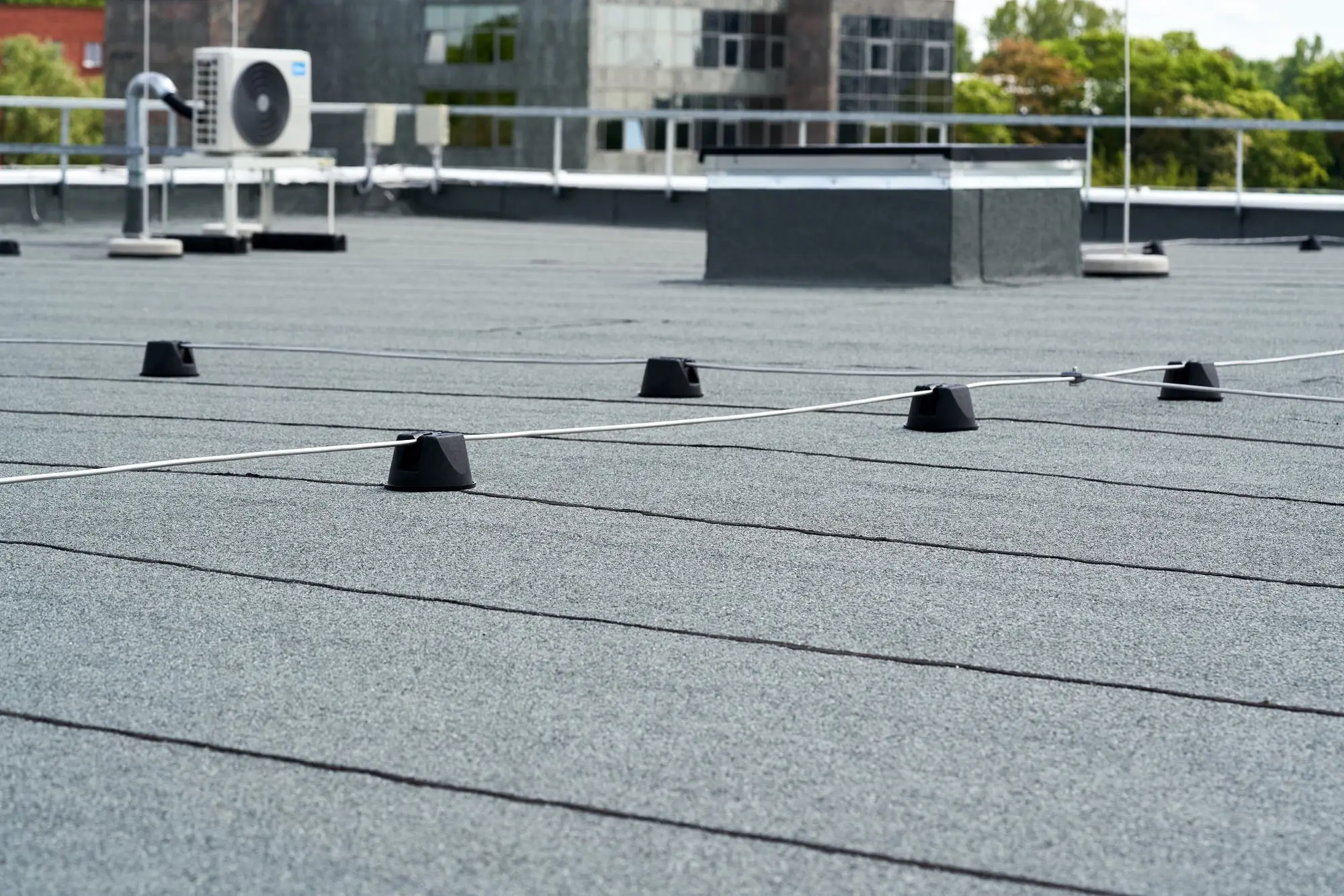
A repair is usually the right call when the damage is in one area and the rest of the membrane is still flexible and well bonded. A punctured TPO roof gets a matching patch welded on with hot air. An EPDM roof gets a primed, taped cover patch with rounded corners so the edges don’t lift. A bad wall joint gets rebuilt in the right order so water runs over it, not behind it.
Ponding needs a different kind of fix. Patching the membrane under a puddle doesn’t change where the water collects. The lasting answer is reshaping the drainage with tapered insulation, a small cricket or an added outlet, so the water leaves.
Replacement starts to make sense when seams are opening across the roof, the membrane has turned brittle, or large areas of insulation are wet. At that point, patches tend to chase one leak to the next. If that’s where your roof is, our page on flat roof installation in Palm Coast explains what a new system involves. You’ll hear which way we’d go and why, and the choice is yours.
After a storm
High wind and flying debris are what usually damage a flat roof in a storm. Once it’s safe, look from the ground or a window for lifted edge metal, torn membrane or branches lying on the roof. Stay off the roof itself.
If a storm caused the damage, you file the claim with your insurance company and pay your deductible. We document the damage with photos, provide a written estimate and work with your adjuster. Be wary of anyone who offers to waive or cover your deductible. Our storm damage roofing page has more on what to do after a big blow.
Signs your flat roof needs a look
You can spot most of these without a ladder:
- A tea-colored stain on the ceiling under the low roof, or where the porch ceiling meets the house
- Water still standing on the roof two days after rain
- Bubbles or blisters you can see from an upstairs window
- Edge metal that’s bent or lifted after a windy day
- Dark streaks along the roof edge where runoff never clears
How it works
- Book your free inspection. Call 386-259-8425 or request a free online estimate.
- Get a clear, honest assessment and estimate. You’ll see photos of the leak source and anything else we found, and get a written estimate for the repair. Financing is available through Aqua Finance, Fortifi, Hearth and Home Run Finance if you need it.
- The repair gets done and the site gets cleaned up. Membrane repairs need a dry surface, so the work is scheduled around the weather.
A small flat roof leak doesn’t stay small for long. Each rain pushes more water into the insulation and decking, and a simple patch can turn into a section replacement if it waits a season.
Flat roof repair questions from Palm Coast homeowners
Why does my flat roof only leak in heavy storms?
Wind-driven rain gets into openings that light rain never reaches, like a loose wall joint, a lifted edge or a seam that’s started to open. Those are usually repairable once they’re found.
Is it normal for water to sit on a flat roof?
A little water that’s gone within a day or two is common. Water that stays longer than 48 hours points to a drainage problem, and over time it shortens the life of the membrane.
Can you repair my flat roof or does it all have to be replaced?
Many flat roofs can be repaired, especially when the damage is in one spot. If the membrane is brittle or the insulation is wet across the roof, replacement is often the better use of your money. Photos and moisture readings make that call clear.
Can you fix both TPO and rubber roofs?
Yes. TPO is patched with hot-air welding and EPDM rubber with primer and seam tape. We match the repair to the membrane already on your roof.
Get your Palm Coast flat roof dry again
Call 386-259-8425 to book your free inspection, or start online. The goal is a dry ceiling, a roof you stop thinking about every time it rains and a repair you understand before you pay for it.