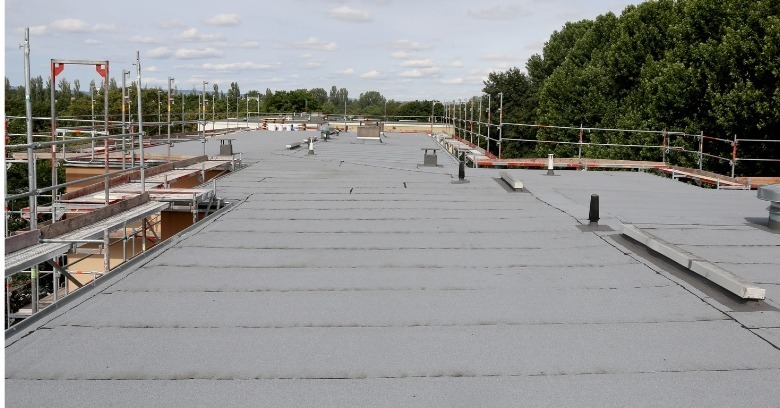
Hoping to find Commercial Roof Repair in Overland Park Kansas?
APC Roofing builds and mends the wide, low coverings above places of work, along with the details at units and drains.
Call us at 913-398-5020 and a roofer will come out and look everything over.
Workplaces and Storefronts – Some Background
Employees, inventory and equipment are what the membrane protects, and dripping water can idle a conveyor or spoil a pallet of product. The area on top of a big building stretches wide at a very shallow pitch, and the drainage layout and fastening pattern are calculated.
Air handlers, fans and communications gear sit on the membrane, and every line or support is a hole that must be flashed. The work done below decides which assembly suits, and cold storage calls for vapor control an office can skip.
Common Low-Slope Materials – Names Decoded
Single-ply means one factory-made layer of TPO, PVC or EPDM, modified bitumen is rubberized asphalt sold by the roll, and built-up roofing alternates felt with hot tar. The laps on a thermoplastic sheet are fused by a welding machine, but rubber sheets are joined with primer and splice tape.
Cooking vents on a restaurant leave fat beside the fans, and asphalt and EPDM membranes break down under oily buildup, so PVC tends to be installed across the exposed zone. Built-up work finished with gravel carries real weight and holds up for decades, and the rock cover screens the bitumen from the sun.
Steel Over a Warehouse: What to Watch
Through-fastened sheets take a screw at intervals across the flats, and the purlins below take the grip. UV exposure cracks the rubber seal under every head, and fasteners loosen as the metal moves with temperature.
Clips concealed in the raised seams secure a standing-seam roof, and the pans shift slightly through the day. Corrosion gathers where sheets overlap and at trimmed ends, and a coating applied while the steel is sound can slow the spread.
Deck Types – Why the Base Counts
Attachment methods are limited by what the original builders put in, and reroofing leaves the framing in place. Corrugated steel gives screws a firm bite, concrete calls for adhesive or drilled anchors, and wood planking takes ring-shank nails or plates.
Moisture trapped for years can rust through metal decking, and failing stretches are replaced rather than covered. From inside, the underside is inspected wherever the ceiling allows, and small cuts from the upper side answer the rest.
Securing the Field: Choosing an Approach
Mechanically fastened sheets carry rows of plates and screws in the laps, fully adhered systems are glued across the whole underside, and ballasted sheets are held down by rock or pavers. The deck, the building's height and the site's exposure steer the decision, and a frame with no spare capacity rules out a heavy layout.
Between the plates, a fastened sheet balloons in stiff gusts, but adhered work stays motionless and needs a dry surface to grip. Inspecting a ballasted system takes time, because the stone or pavers must be moved aside to expose a seam.
Gusts and the Membrane: Setting the Screw Pattern
The strongest suction lands at each corner, since air accelerates on rolling over the perimeter. The strips along the sides rank next, and the middle of the field takes a small fraction.
Fasteners go in closer together near corners and edges, and published wind tables fix the spacing for each height. Skimping on anchors at the outside angle lets the covering pry loose, and a blow-off can run well across the field.
Thermal Resistance – an Overlooked Component
Panels of polyisocyanurate rest on the structural deck in offset rows, and a tough cover board over the stack takes foot traffic. Insulation keeps utility bills in check, and tapered units can slope a dead-flat deck to the outlets.
Waterlogged foam barely resists heat flow, and the heavy mass adds weight and rusts a steel deck. Scanning at dusk, with a few cores for proof, marks out the damage, and spoiled sections come out while new stock goes in.
Drains and Overflows: The Path Down
Each interior sump wears a cast strainer dome, and trash and gravel stop at the bars instead of in the pipe. A clogged grate slows the outflow to a trickle, so a shallow lake forms across the low area.
An overflow scupper sits a little higher than the main drain, and runoff spilling at the upper level points to a plug further down. An inch of standing water weighs about five pounds per square foot, and a puddle that survives two days hints at settling or a choked strainer.
Tracing a Leak – No Guesswork
A soggy tile shows the spot where moisture emerged below, though the actual flaw may be far across the bay. Steel decking guides runoff down the corrugations, and joints between boards lead a trickle further still.
A roofer probes the laps, curbs and outlets upslope of the stained area, and a low-voltage test can trace an elusive leak. Guesswork patches above the ceiling spot usually miss, so the trouble returns with the following storm.
Rooftop Mechanical Units: Where Care Is Needed
A built-up curb lifts each machine above the field, and base flashing climbs the sides under a metal cap. Inside corners need preformed pieces or patient detailing, and a pinhole at the crease lets rain run down behind.
A new unit from the HVAC contractor may sit on an adapter with no flashing, so a new leak follows within a season. Condensate lines left dribbling onto the membrane grow algae, so the stream ought to be carried to a drain.
Objects That Rise Above the Surface – the Small Stuff
Round stacks take a factory-made boot with a stainless band, while odd shapes go into a pitch pocket filled with sealant. The compound shrinks and cracks as the years pass, and a top-up is standard upkeep.
Gas lines and conduit are meant to float on movable supports, since a bracket screwed through the covering becomes a leak. A rubber pad beneath every foot distributes the weight, so daily movement rubs the buffer rather than the covering.
Glazing and Access Points – How Leaks Begin
Years of strong sun make plastic lenses chalky and brittle, and fractures tend to start at the fastener holes. Water gets in through a hardened gasket or a loose frame joint, and the covering gets accused of a fault in the glazing.
Every trip up the ladder means lifting the hatch cover, which wears out the springs, latch and weatherstrip. Heat-activated vents over a warehouse are designed to fling wide, so work nearby leaves every mechanism free.
Masonry Above the Roofline – What Goes Where
At the vertical face, the sheet climbs as base flashing, a termination bar grips the upper end, and metal counterflashing laps down from higher up. Coping along the crest keeps rain out of the core of the parapet, but joints whose sealant has cracked admit runoff beneath.
Brick and block soak up a long downpour, and the ceiling stain that follows mimics a membrane problem. Inspection extends past the sheet to the coping, the flashings and the wall, and a gap in the mortar is repointed, never just caulked.
Perimeter Trim on Open Edges – Parts and Purpose
The flange is hooked onto a cleat fastened along the eave, and a cover strip of membrane is laid over the upper face. Tested wind ratings decide which profile suits a given height, and an underrated section can let go in a gale.
A box gutter on a long wall moves a torrent in heavy rain, which calls for sturdy hangers and oversized downspouts. Bent or lifted trim belongs on the repair list, because refastening early lowers the risk of a blow-off.
Other Trades Overhead: Setting Some Ground Rules
Refrigeration and heating crews climb up to the equipment month after month, and a worn lane appears between the hatch and the units. An abandoned screw gets forced through the sheet by a passing boot, and a falling wrench can split the sheet.
Walkway pads outline a lane from the hatch to each unit, and grinding hits dense material instead of the field. Managers can require contractors to keep off the unprotected sheet, and a bucket for scraps and screws keeps the membrane clear.
Upkeep Through the Year: What Gets Done
Twice annually is a sensible rhythm for a walk-through of a commercial system, plus an extra check after a severe storm. Upkeep includes emptying every strainer, every lap is probed for loose spots, and sealant at pockets and terminations is pressed for give.
The trip ahead of the stormy months focuses on outlets and perimeter metal, and the next round, after a hard season, searches for fresh movement. Minor faults get noted and pinned to a sketch, and trouble shows up long before water comes through.
Paperwork Worth Keeping – a Long Memory
A scaled drawing shows where each unit, drain and hatch sits, and a layer-by-layer description runs from the deck upward. A dated photo log follows each repair, and core and scan results are added whenever taken.
Many older properties change hands without a scrap of information about the covering, which leaves every new contractor guessing. Roof documentation outlasts any single service firm, so a future manager or purchaser inherits a copy.
Fix, Refresh or Rebuild: What Tips the Balance
Localized faults on a healthy sheet are patched in place, and a weathered surface that is still dry can take a fresh liquid layer. Insulation ruined over broad areas points to tear-off, and so do seams that have turned brittle everywhere, though years alone never decide the matter.
Cleaning, priming and repairs underneath come before any coating, and material below that holds water never dries out. A partial tear-off of the spoiled areas can be a reasonable compromise, when the surrounding field is still performing.
Reroof Paths – Picking a Direction
With a recover, the old sheet stays and a new membrane goes over the top, and a thin board keeps the surfaces apart. An overlay is allowed by code over no more than a single existing covering, and the foam underneath must be dry.
A complete strip-off clears away every layer, and any soft or rusted area can be rebuilt. A tapered system can be designed to empty the low spots, and crickets set between outlets push runoff aside.
Signs Worth Reporting – Reasons to Call
- Rain gushing out of the high overflow, which suggests a plugged strainer.
- A brown ring overhead that widens with each downpour, which indicates water reaching the interior.
- Dark streaks running down the outside wall below a scupper, which can come from open joints up top.
- A gravel stop that moves when a gust hits, which can hand a gale a lever.
- Ponding visible from a higher window days after rain, which can indicate a settled structure or a fouled drain.
- A skylight dome gone cloudy or crazed, which may give way under a misstep.
- Rust spots spreading on the underside of a steel deck, which suggests an opening some distance uphill.
- Water spilling over the lip of an eave gutter, which can soak the wall and the ground below.
How APC Roofing Carries Out Commercial Roof Repair in Overland Park Kansas: Readings Before Advice
We begin with every drain, scupper and overflow, and next we go along each lap, curb and edge. Where there is a leak, the insulation is metered for moisture, and no recommendation is made until the readings are in.
Everything we find is written up with photographs and a sketch, and every defect is keyed to a location. Each proposal names a choice: repair, restore or replace, and the why is explained in terms you can verify.
Commercial Roof Repair Around Overland Park Kansas – Get the Facts
Reach us at 913-398-5020 and a time to look things over gets agreed.
Working Above Occupants – What Gets Agreed
Power fastening through steel echoes through the space beneath, and adhesive vapors may be pulled in by the air handlers. Noisy steps are discussed with the manager beforehand, and vents near the work can be shut while the cement cures.
Old membrane and foam are lowered by hoist or dropped through a covered chute, and anything valuable underneath can be protected. Water-based adhesives give off far less odor than solvent-based glue, so the softer-smelling kind is common above occupied rooms.
Phasing a Large Replacement – the Discipline Involved
No more old material comes off than can be closed up before dark, and the bare deck gets new boards and membrane promptly. A night seal links the finished part to the untouched field, and the extra piece is sliced off the next morning.
The outlook decides how far the tear-off goes, and a front on the way shrinks the stretch. A sudden soaking ruins exposed insulation, and runoff may find a path to the offices underneath.
Regional Conditions: Planning Locally
Toward the colder end of our territory, hail and heavy snow both figure in, so a hard cover board and an engineer's review of the framing are sensible. Across all the towns we serve, UV and high temperatures age a membrane, so a bright, reflective finish reduces solar gain.
At the coastal end, hurricane wind pushes attachment requirements up, and heavy tropical rain calls for extra overflows. Glues and primers carry a temperature floor, but heat-welded seams tolerate chilly air as long as the deck is dry.
Safety for Everyone Who Goes Up: Rules on the Job
A knee-high parapet or a bare perimeter leaves a sheer drop, and anyone close to the edge wears a harness tied to an anchor. Plastic skylights break under someone who stumbles onto the dome, so every opening should get a screen or a railing.
Permanent anchors help everyone who services the units, and a safety gate at the ladder completes the setup. Any missing guard is noted in our findings, since even a low building is high enough for a serious fall.
If Commercial Roof Repair in Overland Park Kansas is on your agenda, speak with APC Roofing at 913-398-5020. A roofer will inspect the drainage, the seams and the flashings, and a written report follows, with the next step up to you.
Verified

Verified