Looking for Metal Roofing Across Orlando Florida?
APC Roofing puts up and mends screw-down sheet and clip-held panels, across homes as well as sheds and barns.
Call 407-270-1129 and someone who knows the trade will come out to take a look.
Sorting Out Types: Visible Clues
Exposed-fastener roofing is pinned by screws passing through every panel, whereas standing seam relies on clips that sit under locked joints. On homes the metal is usually coated steel, with aluminum and copper turning up less often.
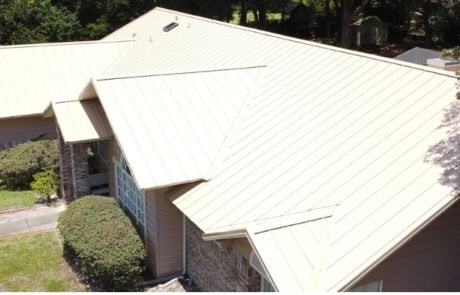
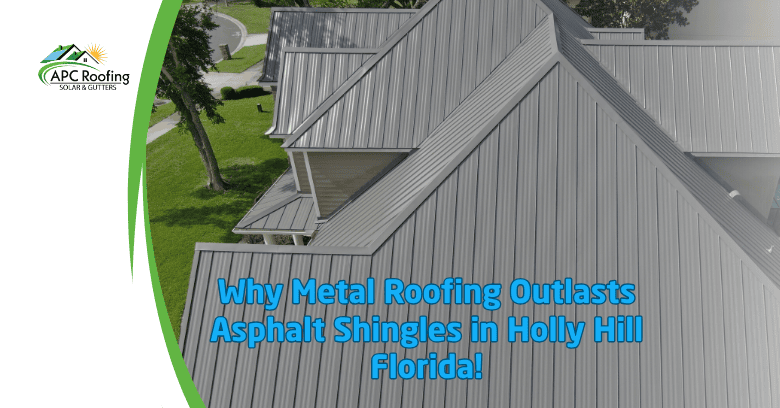
A glance from a lawn at lines of screw heads points to a through-fastened roof, while plain pans and tall ribs with nothing in sight are standing seam. Corrugated sheet is a regular choice on barns, shops and porches, while residences take either style.
Profile Options: Which Suits a Building
Corrugated material makes a run of soft, even undulations, and ribbed panels pair tall square ribs with broad flat areas. Side by side, adjoining lengths overlap by one crest, and fastener placement follows a published pattern.
Ribbed stock is stiffer and spans further between supports, while corrugated fits a period barn or a farmhouse style. Rib height governs how much water a long slope can move, while modest runs need little depth.
What Keeps Sheet Down – Driven Right or Wrong
Each screw clamps a panel down onto wood or steel framing, and a washer under each head keeps rain out. Ultraviolet light slowly bakes neoprene brittle, though the coated metal nearby stays sound far longer.
A screw set too tight crushes a washer out sideways, and a fastener stopped short or angled leaves a gap for rain.
Swapping Out Hardware: Part of Upkeep
Rubber rings across a ribbed or corrugated field wear out together, so a complete re-screw comes due at some point. Tired fasteners are pulled one by one, and a wider replacement goes back in where threads can still find purchase.
Re-fastening stops water at every head and holds down sheets that lift, yet rusted panels, opened laps and poor flashing still need separate repairs. Replacements are chosen for whatever framing lies underneath, lumber or steel, and color-matched tops blend in with a painted finish.
Growth and Shrinkage: Why Slack Matters
Sunshine stretches steel slightly and a chilly night pulls the metal back, and a long run adds up to a measurable distance, while aluminum goes about twice as far. Metal held too rigidly wears fastener holes into slots, and water gets past a washer.
Ticking heard as morning sun lands on steel is ordinary expansion, and a properly detailed roof suffers no harm.
Holding Down a Seamed Covering: Hidden Hardware
Each long pan is fixed solid in one short zone, while floating clips elsewhere allow the pan to slide. Trim at an end that travels is bent with clearance underneath, and a pan held rigid throughout tears loose or buckles.
Clips are screwed to the deck along one edge of every pan as work proceeds, so nothing that holds the roof down is left exposed.
Joint Styles: Which Suits the House
A snap-together rib engages when an installer presses down, while machine-rolled designs get folded over by a motorized seamer. A double-lock seam rides out storms and sheds pooled water, and maker approvals cover shallower slopes.
Every product line has distinct spacing and rib size, so the house and a preferred look guide a decision. Hardware and trim are sold for one system only, so any repair hinges on knowing exactly which panel is installed.
Choosing a Weight: Barn or Residence
Coil for roofing is sold by gauge, and a low figure signals thick metal. Outbuildings commonly get twenty-nine, and homes typically get twenty-six or twenty-four.
Aluminum uses decimal figures rather than gauge, and more material means fewer marks and less waviness. A light grade and a heavy grade are indistinguishable from a driveway, so a product data sheet is a reliable guide.
Rust Resistance – Finishes That Hold Up
Roofing steel leaves a mill with a zinc or aluminum-zinc layer over plain sheet, and baked-on primer and color follow. Paint scuffed but not broken through is fine, but an unprotected cut or a gouge to bare steel is where red rust starts.
High-end fluoropolymer finishes keep a bright look for years, while polyester grades dull faster in strong sun. An aluminum-zinc surface is damaged by contact with fresh mortar, and a barrier belongs wherever panels meet new stonework.
Picking an Alloy: Salt Air
Aluminum carries less weight and does not redden, but softness means a heavier grade for equal toughness. At the coastal end of our territory, salt spray breaks down galvanized coatings faster, and some makers limit steel products by distance from a shoreline.
Copper is usually kept to small accent roofs over a bay or a porch, and the metal weathers to a natural patina with no paint.
Chemistry on a Rooftop: Separation Helps
Runoff from copper eats through coated steel downhill, and staining shows up well ahead of pinholes. Chemicals in treated lumber pit any aluminum resting on top, and a bare steel screw in soft sheet breaks down too.
Replacement flashing should come from a metal already present, or an isolating layer separates unlike metals.
An Appearance Question: Choices That Help
Oil canning names shallow dips and bulges across a flat pan, and a sun low in the sky exaggerates every contour. An irregular-looking finish keeps weather out just as well, and the roof ages no faster.
Thicker metal, a slimmer width and striations rolled into every pan tame rippling, and a smooth, straight base under the panels counts. Photographs of finished houses show how noticeable oil canning can be, and the decision on profile rests with you.
For People Inside: Noise and Heat
An outbuilding with bare framing under the metal makes a loud din in rain, since a single skin is the only barrier. A home has sheathing, a membrane and an insulated ceiling under steel panels, and indoors most people hear little more than on shingles.
Light tones and cool pigments bounce a large share of sunlight away, and the attic beneath stays cooler on a summer afternoon. A deep hue absorbs heat like any dark surface, and ventilation and insulation underneath matter as much as finish. Thin steel cools off right after dusk, and the attic eases off soon afterward.
Guards and Placement – Only Where Needed
Across the colder end of our territory, snow does not cling to painted steel, and a single release can take out a gutter or strike someone nearby. Guards break a load into small harmless chunks, and typical spots are above doors, walks, decks and gas meters.
Standing seam takes clamp-on brackets that grip each rib without piercing the metal, whereas on corrugated sheet, mounts go into solid wood with gasketed fasteners, and homes where snow seldom falls go without.
Storm Marks: When Paint Cracks
Hail is a fact of life at the colder end of our service area, and a heavier gauge or striated pans resist dents better. Paint knocked off at a crease leaves base metal exposed to corrosion, while a buckled seam can part enough to admit water.
Following a storm, our roofer takes pictures and measurements, and the depth of each dent is gauged.
Uplift: Layout Matters
Perimeter bands of a roof take a heavier pull than a central field, and an unfastened edge lets pressure build beneath. Trim hooks over a continuous strip fastened to the deck, and nothing is left free to flap.
Screw and clip spacing tightens at corners and around a perimeter, following a maker's layout for a site's exposure. Where hurricanes reach, at the coastal end of our territory, the number of fasteners goes up again, and panel and hardware are rated as one assembly.
Breaking Through the Metal: Keeping Water Out
A pliable-based collar is shaped to fit a panel and clamped onto a pipe, and a hole is cut in a flat, never across a crown. A bigger penetration is framed with a curb and a small cricket upslope, and water cannot pool at an upper edge.
Sealant finishes a joint already made watertight by folded metal, because sunlight dries and cracks sealing compounds within a few years.
Inside Corners: Made to Shed
Each valley gets a separate pan in advance of the panels, and each sheet is cut to a matching angle. Raw ends are folded under and locked to a cleat, and nothing pierces a channel that carries rain.
Long runs made of more than one piece get an endlap with sealant sandwiched inside, and fasteners through both thicknesses keep water from backing up.
Limits Near Flat – When a Membrane Wins
Makers of exposed-fastener sheet commonly list three in twelve, and on a gentler slope, overlaps start to let water through. Mechanically seamed panels are approved much lower, with certain lines suited to decks that are nearly flat.
Many homes have a gentle stretch over a porch or a later addition, and we measure pitch on site, and where metal does not belong, a membrane does.
A Base Layer – Purlins on Outbuildings
Residential panels are laid on a solid deck, and a high-temperature synthetic underlayment goes between, since ordinary felt dries out under sun-heated steel. An outbuilding may have nothing but purlins under the metal, and support distance dictates grade.
A stripped roof is probed, and weak sections are replaced, since punky fibers offer a screw no bite.
A Recover Instead of a Strip – Battens and Underlayment
Many building codes allow metal over a single layer of asphalt shingles, so the house is spared a tear-off and debris. A steel covering adds only slight dead load, and ordinary framing copes without trouble. A synthetic underlayment and rows of battens come next, and clips or screws go down into solid structure.
Where a roof was already recovered once, or the decking is soft, everything comes off, since trapped dampness under metal has no way to dry.
Small Parts at Edges: Done Properly
Profile-cut closures fill openings beneath each rib at the upper and lower lines of a run, and rain, insects and birds cannot get under the panels. A ridge cap can be vented to let warm air escape or left solid, and attic airflow needs are what decide.
Trim at every rake plus a drip edge over a gutter finish a roof's border, and fascia boards are kept out of runoff.
Day of Installation – Carrying and Stepping
Standing seam panels are usually roll-formed to the full length of each slope, and no cross joint interrupts runoff. Carrying an extended panel takes people spaced along the metal, and a pan that gets bent should not go on the roof.
Weight should go only into pans over framing, as a seam under a boot can bend open. Moisture turns a painted panel into a slide, so owners do better keeping off the roof.
Signs Worth a Call: Easy to Notice
- Rust rings around screw heads, on a slope facing afternoon sun.
- Screws no longer tight against metal, on a south exposure.
- Trim bent up at a corner, following a gusty night.
- A vent cap knocked askew, over a kitchen.
- Corrosion along a cut, in a valley.
- Peeling paint, on one panel more than on panels nearby.
- A ceiling stain in a straight line, down a hallway.
- A lap that has separated, where slopes meet.
How APC Roofing Tackles Metal Roofing in Orlando Florida: What Happens on a Visit
Our starting point is pinning down which system is up there and how the panels are secured, and after that every fastener, trim piece, penetration, valley and lap gets a close look. Panel grade, paint and hardware are recorded, and the attic is searched for water marks.
Findings come to you in a report with pictures, and each recommendation carries reasons. Where a reseal will do, a reseal is what we propose, and a roof at the end of service life is named as such.
Metal Roofing Across Orlando Florida: Plain Findings
Call us at 407-270-1129 and we will schedule an inspection.
Fix or Redo: Piece by Piece
An individual rusted sheet can be unscrewed and exchanged, but brand-new paint stands out against faded neighbors. Replacing a cracked boot deals with water at a pipe, while new fasteners seal screw holes again.
Rust through sheet after sheet calls for a new covering, and a covering the wind has twisted out of shape is in the same position. One tired face of the house can be redone alone, as long as nothing else shows wear.
Longevity – Upkeep Matters
A well-built steel covering commonly serves forty years or more, but estimates of service are a rough guide only. A seamed pan roof has fewer parts that age, while corrugated and ribbed sheet calls for fresh screws in time.
Copper runoff, bare edges and caulked joints where flashing belongs shorten the life of a roof, and regular inspection turns up faults while minor. Leaves and needles piled in a valley or behind a chimney keep the metal wet, and brushing debris off protects paint.
Whenever Metal Roofing in Orlando Florida comes up, reach APC Roofing at 407-270-1129. Every detail, including how the panels are fastened, is read in person, and a written summary lays out what we saw so you can choose.
Verified

Verified
Verified
Verified
Verified