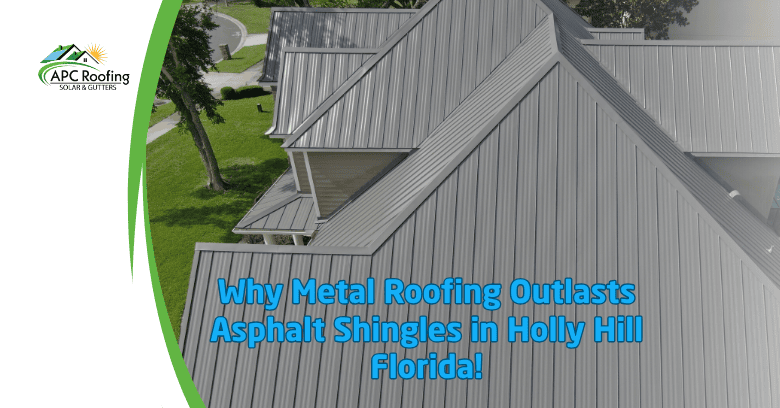
Searching for Standing Seam Metal Roofing Here in Orlando Florida?
APC Roofing lays new panels and brings worn coverings back into shape, on houses, garages, porches and outbuildings.
Phone 407-270-1129 and a roofer will look closely and explain plainly what is up there.
Telling Systems Apart: Clues From Below
Corrugated and ribbed sheet is held down by screws driven straight through the metal, while standing seam is attached with clips tucked inside raised joints. Most metal on houses is coated steel, though aluminum and copper have a place too.
A glance from a lawn at lines of screw heads points to a through-fastened roof, and smooth pans between tall ribs with nothing poking through are standing seam. Pole buildings, sheds and porches frequently get ribbed sheet, and homes turn up with both.
Rolled Shapes: Matching a Building
Corrugated sheet rises and falls in rounded, evenly spaced waves, while ribbed panels carry squared ribs with wide flats between. Each sheet laps over a neighbor along a long edge, and a maker's pattern says where screws go.
A ribbed profile stands up to flexing and can bridge wider gaps, and a rounded wave appeals on older or rustic structures. On a big roof plane, taller ribs keep a downpour from spilling over side laps, while a low pattern handles short runs like a porch or lean-to.
Hardware in the Weather – Why Installation Matters
Every screw draws a panel down onto a support, while a washer at each head keeps rain from following a shank. Ultraviolet light slowly bakes neoprene brittle, though the coated metal nearby stays sound far longer.
A screw set too tight crushes a washer out sideways, and a slack or crooked fastener leaks on one side.
Fresh Fasteners: Part of Upkeep
Rubber rings across a ribbed or corrugated field wear out together, so at some stage all seals get changed. Tired fasteners are pulled one by one, and a slightly fatter screw goes into each hole so a thread bites fresh wood or steel.
Re-screwing with new washers fixes leaks at screw heads and snugs down sheets that flutter, but corrosion, parted laps and bad flashing are left as found. Screw length and thread are chosen for what sits below, wood or a steel purlin, and tops painted in a panel color keep new work from standing out.
Thermal Movement – Stress at Screw Holes
Steel lengthens on a hot afternoon and shortens on a cold night, and a long run can gain a quarter inch between noon and midnight, and aluminum reaches about double. A tightly fixed panel enlarges fastener holes a little with every cycle, and water gets past a washer.
A tick from warming metal after sunrise is normal, and a well-built roof takes no harm from some noise.
Under Upright Joints – Laid in Sequence
Each long pan is fixed solid in one short zone, and floating clips everywhere else let the pan glide. At an unanchored end, trim is bent with clearance, and a pan held rigid throughout tears loose or buckles.
Clips are screwed to the deck along one edge of every pan as work proceeds, so nothing that holds the roof down is left exposed.
Joint Styles: Choosing Between Options
A basic profile engages with a firm push along a full length, and heavier-duty versions are folded over by a motorized tool. A double-lock grips harder against wind-driven rain, and approvals extend to flatter roofs.
Manufacturers offer a range of pan widths and rib heights, and building shape and personal taste steer a buyer. Accessories such as clips and closures fit a single system, so a repair calls for knowing exactly which panel is up there.
Heavier and Lighter Stock – Beyond Appearances
Steel thickness is given as a gauge, and numbers fall as sheet gets thicker. Twenty-nine is a regular sight on sheds and pole barns, while a dwelling generally takes twenty-six or twenty-four.
Aluminum sheet is measured in decimal inches, and more material means fewer marks and less waviness. From the ground, light and heavy metal look alike, so a label on a bundle shows what was delivered.
Corrosion Defense: Choosing a Finish
Steel for roofing is hot-dipped in zinc or an aluminum-zinc blend, and an oven-cured primer and color coat are applied on top. A scratch that stays within paint does no harm, while a sheared edge or a deep gouge lets rust begin.
A PVDF finish stands up to sunlight for a long time, while polyester versions chalk and fade sooner. An aluminum-zinc surface is damaged by contact with fresh mortar, so panels are kept away from a new chimney or stone wall.
Picking an Alloy: Near the Water
Aluminum is light and free of red rust, but a dropped tool or a falling branch dents a soft sheet sooner. Salt air at the coastal end of our territory attacks zinc-based layers, and makers restrict certain products near surf.
A copper accent over a bay window is a familiar touch, and the metal is left bare to weather.
Metals That React: Separation Helps
A copper pipe or flashing above steel sends corrosive drainage down over the panels, and streaks appear years ahead of perforation. Treated wood touching aluminum pits the metal at each contact, and a bare steel screw in soft sheet breaks down too.
Flashing added later should match whatever metal is already installed, or a plastic barrier divides unmatched metals.
A Matter of Taste: Setting Expectations
Oil canning is a gentle waviness across the flat of a standing seam pan, and a midday sun hides what a low evening sun reveals. A slightly distorted pan sheds rain like any other, and nothing shortens the life of the roof.
Heavier gauge, narrower pans and pencil ribs in each flat all reduce waviness, and an even deck beneath helps as well. Pictures of houses with and without oil canning make comparison easy, and the final pick is yours.
Everyday Comfort: Noise and Heat
A shed with bare purlins under the panels rings like a drum, since one thin layer is all that stands between sky and interior. Metal on a home rests on a deck and underlayment, over an insulated ceiling, and indoors most people hear little more than on shingles.
Cool-pigment coatings return the bulk of the sunshine, so the space under the roof runs cooler. Dark finishes on metal get as hot as black shingles, and without venting and insulation, color alone does little. Metal loses daytime warmth shortly after the sun sets, and an attic beneath follows suit.
Guard Rows – Only Where Needed
Where winters bring real snow in our territory, slick panels shed a snowpack quickly, and a whole mass may come down at once on anything under an eave. Stops attached to the metal let a load leave slowly, and hardware sits over entries, paths and meters.
On standing seam, brackets clamp onto a rib without a hole, while screw-down sheet takes mounts fastened into framing with sealed screws, and where snowfall is rare, nothing is added.
Damage From Above: When Paint Cracks
At the colder end of our territory, hail is a regular event, and thicker steel shows fewer dents. Paint knocked off at a crease leaves base metal exposed to corrosion, and a trim piece pushed out of place can channel rain inside.
After any storm, each affected area is photographed and measured, so the extent of damage is clear.
Holding On in a Gale – Rated Assemblies
Corners and borders see heavy suction, an open field much less, and a loose flange gives moving air a handle. Trim hooks over a continuous strip fastened to the deck, and no gap is left to work into.
Fasteners go in closer together near corners and a roof's rim, as manufacturer tables call for at each site. At the coastal end of our territory, hurricane country asks for more holding power still, and only systems with a high wind rating qualify.
Breaking Through the Metal: Keeping Water Out
A plumbing pipe gets a flexible boot with a base that bends to a panel profile, and a flat location lets a flange bed down evenly. A bigger penetration is framed with a curb and a small cricket upslope, and water from higher up is divided and sent past.
Caulk is a secondary barrier behind formed metal, as ultraviolet light turns soft compounds brittle in a few seasons.
Changes of Direction: Built to Drain
Valley metal is laid before a single panel, and panels are sheared to a matching slant. Ends are hemmed and held by cleats, and no screw goes through any path where water flows.
Long runs made of more than one piece get an endlap with sealant sandwiched inside, and screws go through both thicknesses at close spacing.
Shallow Sections – Measured, Not Guessed
Screw-down panels typically call for roughly three in twelve, and on a gentler slope, overlaps start to let water through. A mechanically locked seam can be installed far lower, and some products are allowed on nearly flat decks.
Porches, additions and back rooms often carry a barely tilted section, and a measured angle decides what goes on, and below every panel limit, a membrane goes on.
Substrate: Wood or Open Framing
A house takes panels on a solid, continuous deck, and a heat-rated synthetic membrane goes in between, because traditional felt degrades quickly up there. Farm buildings frequently carry metal over bare purlins, and wider spacing calls for heavier stock.
On a tear-off, soft or rotted boards are cut out and replaced, as fasteners driven into mush pull straight out.
Going Over the Existing Roof – Battens and Underlayment
Many building codes allow metal over a single layer of asphalt shingles, so the house is spared a tear-off and debris. A steel covering adds only slight dead load, so reinforcement is rarely needed. Furring strips and a new underlayment go down over existing shingles, and fasteners are long enough to bite solid boards below.
Where a roof was already recovered once, or the decking is soft, everything comes off, because a problem covered with steel keeps growing out of sight.
Small Parts at Edges: All Around
Strips cut to match a profile close off space under each rib at high and low points, and rain, insects and birds cannot get under the panels. A ridge piece either breathes or is left solid, and attic ventilation is what decides.
A drip edge along an eave and trim on each rake complete a border, and water falls clear of fascia instead of running behind.
On the Job: Handling and Footing
Standing seam panels are formed at full slope length, so no crosswise joint sits in the path of runoff. Big panels need a team so nothing buckles in transit, and a kinked pan is not usable.
Weight should go only into pans over framing, because ribs and seams crush under a boot. Wet or dewy panels offer almost no grip, so owners do better keeping off the roof.
Signs Worth a Call: Easy to Notice
- Red staining around each screw, low on a slope.
- Loose screws riding high, on long panels.
- Flashing flapping in a breeze, facing prevailing wind.
- A flue collar sitting crooked, on a back slope.
- A cut end turning red, next to a skylight.
- Uneven fading, on one panel more than on panels nearby.
- Spots on a ceiling in a row, in a garage.
- A lock pulled apart, above a gutter.
How APC Roofing Takes On Standing Seam Metal Roofing in Orlando Florida – Our Method
The first thing we do is identify which panel system is on the house and what holds the panels down, and after that every fastener, trim piece, penetration, valley and lap gets a close look. Gauge, finish and hardware are noted as we go, while the underside of the deck is inspected from the attic.
A report with photos sets out what is up there, and a reason sits beside every recommendation. Where a reseal will do, a reseal is what we propose, while a worn-out roof is named as such.
Standing Seam Metal Roofing for Property Owners in Orlando Florida: Plain Findings
Reach us at 407-270-1129 and a visit gets put on the calendar.
Repair or Replacement: Weighing Choices
One badly damaged sheet can be swapped alone, but brand-new paint stands out against faded neighbors. A new pipe boot or a resealed lap ends a local drip, and a full set of screws fixes tired rubber.
Rust through sheet after sheet calls for a new covering, and a covering with every joint and collar given out is no different. One tired face of the house can be redone alone, as long as nothing else shows wear.
Looking Down the Road – Exposed Screws Versus Hidden Clips
A carefully installed panel system can pass forty years, though climate, care and material all make a difference. Standing seam asks for less upkeep, since nothing pierces a pan, whereas screw-down sheet has washers changed out at some point.
Mixed metals, raw cut edges and caulk doing the job of flashing all shorten a roof's service, and a periodic look finds problems while minor. Pine needles packed into a valley trap water against coated steel, so getting debris off the panels is worth the effort.
When you are weighing Standing Seam Metal Roofing in Orlando Florida, reach APC Roofing at 407-270-1129. Someone will climb up and read how the panels are attached, along with every edge and opening, and findings come to you written up, with any choice left to you.
Verified

Verified
Verified
Verified
Verified