Your old gutters drip at every joint. You’ve resealed them more than once, and there’s still a stain on the fascia where water sneaks behind the trough. Seamless gutters keep coming up as the fix, and you want to know whether they’re worth it and what separates a good install from a mediocre one.
That’s a fair thing to wonder. Gutter quotes all sound alike on paper, and the differences that matter, like metal thickness and how the gutter is hung, are rarely spelled out. You deserve to know what you’re buying before it goes up on your house.
APC Roofing installs seamless gutters on homes and small commercial buildings across Central Florida, the Daytona Beach area, the Kansas City metro and Springfield, Missouri. We’ve been in business since 2017, we’re licensed and insured, and estimates are free. Call 866-995-0704.
How seamless gutters are made
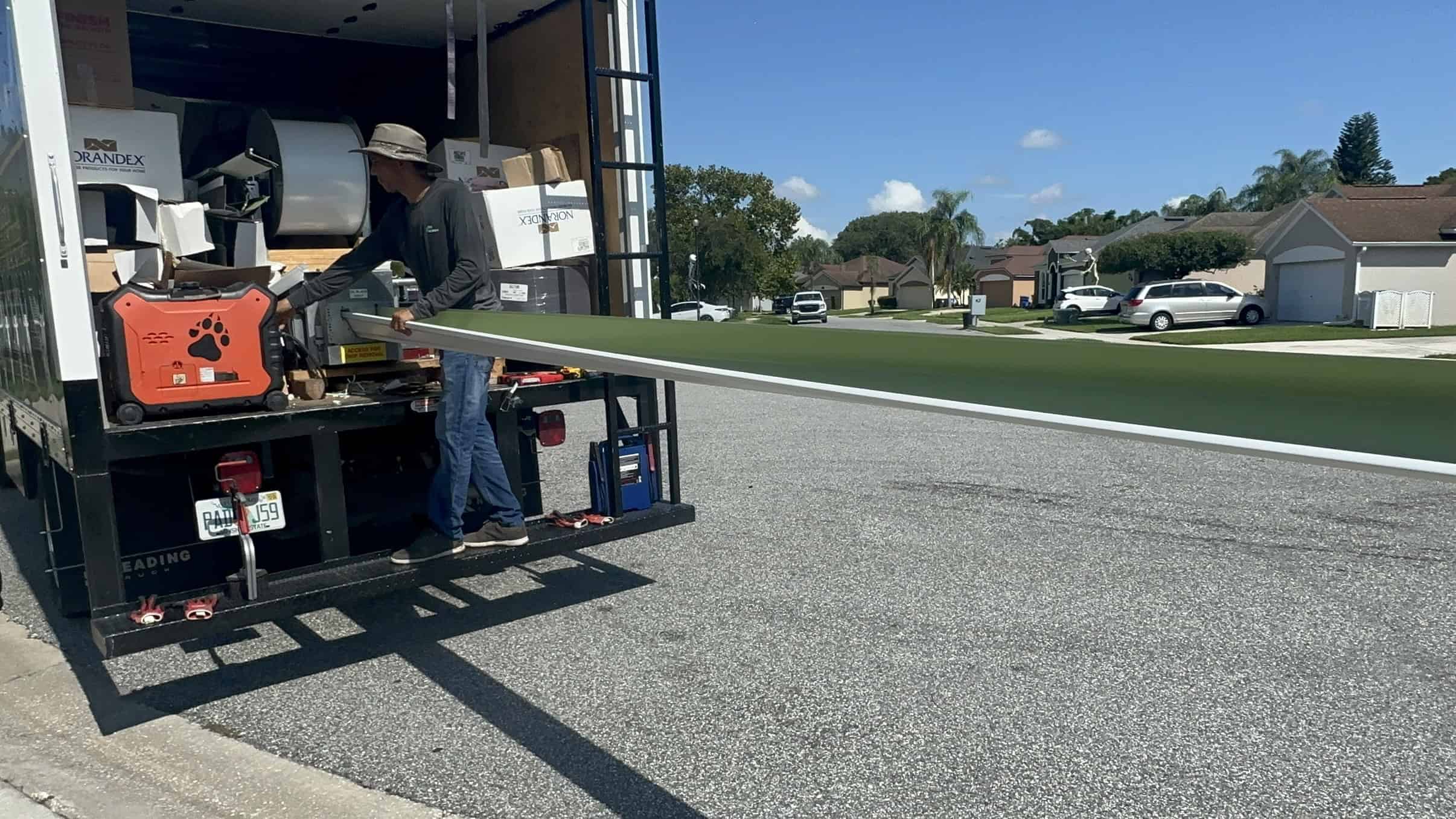
Seamless gutters aren’t bought in pieces. They’re formed on site from a coil of flat metal, usually aluminum, fed through a forming machine that bends it into the gutter shape and cuts it to the exact length of each wall. A 45-foot wall gets one 45-foot piece of gutter.
That means the only joints are the ones the house forces: inside and outside corners, the outlets where downspouts drop, and the end caps. Everything in between is one continuous run.
What fewer joints get you
Every joint in a gutter is a future maintenance job. Sealant dries out with age, and the metal expands in summer heat and contracts in winter cold, which slowly works joints loose. That happens faster where summers are hot and winters are cold, which describes the Kansas City metro and Springfield. In Florida, constant heat and heavy downpours wear on joints in their own way.
Take away the joints along the run and most of the spots where a gutter drips behind the fascia go away with them. Debris has fewer edges to catch on inside the trough. And the roofline looks cleaner, since your eye follows one straight edge instead of a row of overlapping sections.
Seamless gutters: what to ask in a quote
Metal thickness
Aluminum for seamless gutters comes in different thicknesses. You’ll commonly see 0.027 inch as the standard, 0.032 inch as the heavier option and 0.019 inch as the thinnest. That small-sounding difference matters. Thicker metal holds its shape when a ladder leans on it, when ice sits in the trough and when hail hits it. Two quotes that both say “seamless aluminum” can describe noticeably different gutters, so ask for the thickness in writing.
Size
A seamless gutter still has to be big enough for the roof. A 5-inch gutter works on many homes, while larger or steeper roofs often need 6-inch gutters and bigger downspouts. Seamless doesn’t add capacity on its own. Our rain gutters page explains how sizing works.
Hangers and fascia
One long run of metal catches wind as a single piece, so it has to be fastened along its whole length into solid wood. Hidden hangers screwed into sound fascia at close spacing keep it in place through storms and under ice. If the fascia behind your current gutters is soft or rotted, it should be replaced before the new gutters go up, not after.
Color and downspouts
Seamless aluminum comes in many baked-on colors, so you can match or contrast your trim. Ask where the downspouts will go and how far from the foundation they’ll carry water.
What seamless gutters won’t fix
Seamless gutters are a real improvement, but they aren’t magic, and it’s better to say so up front.
They don’t keep leaves out, so you’ll still need to clean them, especially under trees. They don’t fix a gutter hung without enough slope toward the downspout. They don’t add capacity to a gutter that’s too small for the roof. And the corners and outlets still depend on careful workmanship, so those are the first spots to check if a seamless gutter ever drips.
Repairs work a little differently, too. With sectional gutters, a damaged piece can be swapped out. With seamless gutters, a badly damaged run is often replaced as a full length, so the fix is cleaner but not always smaller.
A good time to do gutters
If your roof is due for replacement, it’s a natural time to replace the gutters as well. The fascia is exposed, any rotted boards can be swapped, and the new gutters go up on a roof edge that’s in good shape. See our roof replacement page if that’s where you’re headed.
How it works
- Book your free estimate. Call 866-995-0704 or request a free estimate online.
- Get a clear, honest assessment and estimate. We’ll measure each run, check the fascia and look at where the water goes now. Your written estimate will list the gutter size, metal thickness, color and downspout plan. Financing is available through Aqua Finance, Fortifi, Hearth and Home Run Finance.
- Your gutters get installed and the site gets cleaned up.
Leaky joints are easy to live with until the water behind them rots the fascia, and then the gutter job comes with carpentry.
Seamless gutter questions
Are seamless gutters leak-proof?
No gutter is, but seamless gutters remove most of the joints where leaks start. The corners and outlets are still joints, so they need to be sealed well.
Do seamless gutters need cleaning?
Yes. Leaves and debris still collect in them. Twice a year is a good baseline, more if you have trees over the roof.
Can a seamless gutter be repaired?
Small leaks at corners and outlets can be resealed. A badly dented or bent run is usually replaced as one full length.
What material are seamless gutters made of?
Most are aluminum. Copper and steel can also be formed seamless, but aluminum is the most common choice for homes.
Gutters that just work
What you want is a clean roofline, a dry fascia and water that ends up well away from your foundation. Call 866-995-0704 or request your free estimate online. For everything else we do with gutters, see our gutters page.