In Need of Roof Leak Repair Near Deltona Florida?

APC Roofing stops rain from getting through to the rooms below and traces the drip back to the detail that failed.

Reach us at 386-356-2111 to have a roofer come and look.


The Places Leaks Begin: the Weak Spots in a Covering

A pitched roof seldom fails in the unbroken middle of a slope, because overlapping courses carry water downhill. Gaps appear wherever the surface is cut through, at chimneys, skylights, valleys and stacks.

The wet patch indoors rarely lines up with the damage above, because the trickle clings to rafters and sheathing before falling. Guessing from inside puts the repair in the wrong place, so the trouble returns with the next heavy rain.

Roof-to-Wall Junctions – What Hides Under the Trim

Every row of shingles gets a separate bent flashing piece; an upper strip is turned down over the full length. If rust eats a hole through the bend, water gets in behind the siding and runs down inside the wall.

The lasting repair is new flashing, laced back in properly, so a strip of shingles comes up and goes back down. Tar smeared over the gap is no substitute, because heat and cold moving the joint crack any surface seal.

Pipe Boots – Why the Bathroom Gets Wet

A plumbing vent passes through the covering inside a rubber sleeve set on a flange, and years of ultraviolet light leave the material hard. Eventually a crack forms right around the pipe, and the leak lands in whatever room lies beneath.

Replacement involves loosening the rows above and sliding new hardware into place, and a corroded flange calls for the complete assembly. A silicone or lead boot resists the sun far better than standard rubber, where the surrounding covering is still young.

The Valley Channel: Wear and Debris

The crease between neighboring planes collects the drainage from each, so a heavy storm makes a fast stream. Valley shingles go bare well before the rest, and without a liner below, the wear turns into a leak.

Twigs and needles collect where the planes join, and the pooled runoff climbs under the edges. A leaking valley is stripped to the wood and redone, as a surface patch cannot survive a fast stream.

Loose Nails – a Pinhole Leak

A wooden deck swells in damp spells and shrinks in dry ones, and that movement nudges up whatever holds the shingles down. A climbing nail head can punch through the shingle above, and wind-blown rain can slip in underneath.

Sinking the loose metal home again gets undone, as the widened socket cannot grip the shank tight. The right approach is extraction, a dab of sealant and a replacement nail nearby, and any punctured tab is changed too.

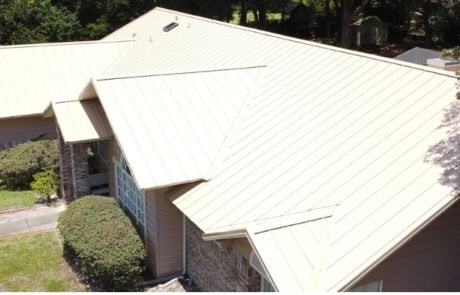
Ribbed Metal Roofing – What Fails With Age

On screw-down steel, every fastener goes straight through the exposed face, with only a small washer between the rain and the deck. With age the rings shrink and stop gripping, and overdriving hastens the damage.

The repair is a new screw carrying a fresh washer, and a loose hole gets a larger diameter. Seams and trim nearby deserve a close look as well, as the whole batch has had the same sun.

Tabs the Wind Has Raised – Reseal or Replace

An asphalt course is held partly by nails and partly by a band of adhesive, but a violent squall can peel the lower edge free. A shingle that bends back takes a permanent kink, and wind-driven rain is forced underneath.

An undamaged piece that only lost the bond is resealed with hand-applied cement, and a shingle split lengthwise gets swapped. With a tab missing, the nails of the lower layer face the elements, which lets water reach the deck.

The High Line of a Roof: Leaks at the Summit

Apex shingles wrap tightly across the meeting of the slopes, and weather opens splits over time. Under any ridge vent lies a gap cut out of the decking, so the housing on top is all that stops water getting in.

Missing end plugs leave an open door for wind-blown spray, and the clue is moisture along the highest board. Fixing the peak treats caps and vent hardware as one piece of work, as one neglected component undoes the rest.

Ice That Builds at the Edge: the Overhang Problem

Where the winters are long and snowy, a covering with no defect can still admit water, since warm air under the deck softens the snow from beneath. Out over the soffit, the runoff turns solid again, so a thick band of ice forms at the edge.

Above the obstruction, meltwater has nowhere to go, so the water works backward beneath the courses. Insulation and airflow in the attic end the problem at the source, and a self-adhering membrane along the eaves limits the harm meanwhile.

Sunroom and Porch Roofs: A Better Choice

Some homes have a low-pitched area off the back, and the main material is often carried onto the flat portion regardless. Overlapping shingles only stay watertight while runoff keeps going, so a sluggish trickle climbs beneath the joints.

The cure is a continuous membrane sealed at every seam, carried up under the tabs above for a clean transition.

Evidence in the Attic – Finding the Spot Outside

Every drip that travels the underside of the deck darkens the lumber along the way, and the discoloration remains long after everything dries. The uppermost reach of the stain marks the source, so a measurement from each edge carries the position up top.

A nail driven up through the decking can flag the location for the crew overhead, though a vaulted room with no crawl space sends the search outdoors. Compressed, discolored insulation sits under the drip, since wet material left in place invites mold.

When the Attic Sweats – the Ventilation Side

Sheathing that is evenly wet everywhere, with no stain leading anywhere, is seldom a hole, because showers, cooking and breathing all put vapor into the air that settles there. Where winters freeze, frost on the nail tips after a frigid night has the same cause, and melting brings a patter of drops.

Repairs up on the roof do not touch moisture from inside, as the answer is moving the humid air out and keeping more from rising. You hear from us whether rain or household vapor wet the wood, and the diagnosis decides who gets called in.

Masonry Stacks: Water Against the Brick

Along the front runs an apron, and short stepped pieces go up each flank, with counterflashing set into the joints and turned down over everything beneath. A good-sized chimney calls for a cricket upslope, which divides the flow and sends the water past.

Where nothing was built to shed rainwater, leaves and water gather on the uphill face, and the upper corners give way in time. Worn mortar pulls rain into the masonry higher up, so a mason may be needed alongside the roofer.

Leaking Skylights: Reflash or Replace

Sealed double panes rarely admit rain; the stepped metal along the curb is what gives way. The head of the opening takes the whole stream from overhead, and twigs trap small puddles.

Reflashing keeps the existing unit in place, as long as the seal between the panes has not failed. Beads of vapor on the inner face can trickle down the well like a leak, which no roof work will stop.

At the Overhang: Small Gaps, Big Stains

Moisture where the ceiling and an outer wall join is regularly a drainage issue, as a trough that tips the wrong way sends runoff behind the trim board. A roof finished without edge flashing lets rain cling and roll under, so the fascia softens and the sheathing starts to rot.

A gutter problem can be as simple to fix as a cleaning and a rehang, and a hanger screwed into solid wood stays put. A drip edge left out entirely is a roofer's oversight, and the fix is a full-length piece slipped under the bottom course.

Attachments on the Roof – Sealing the Spot

Installers often fasten receivers and lighting straight down into the sheathing, and caulk squeezed around each fastener is usually the only protection. Sun hardens the sealant until the bead cracks free, and water then runs down each shaft into the attic.

Taking the equipment down leaves the bolt holes open, and gaps that small are easy to overlook afterward. Every penetration is sealed and patched with fresh shingles, while gear that stays is reset on a flashed base.

Rot Under the Shingles: Replacing the Boards

Months of seepage saturate the plywood beneath the roofing, until mold and decay set in. On top, the area feels springy under a boot, while inside the attic the sheathing bows between the framing.

The rot is cut away until the edges are firm, and matching sheets go in, nailed along each truss. The patch is then covered with underlayment and shingles, so the original leak is stopped too.

Emergency Covers: Anchoring the Sheet

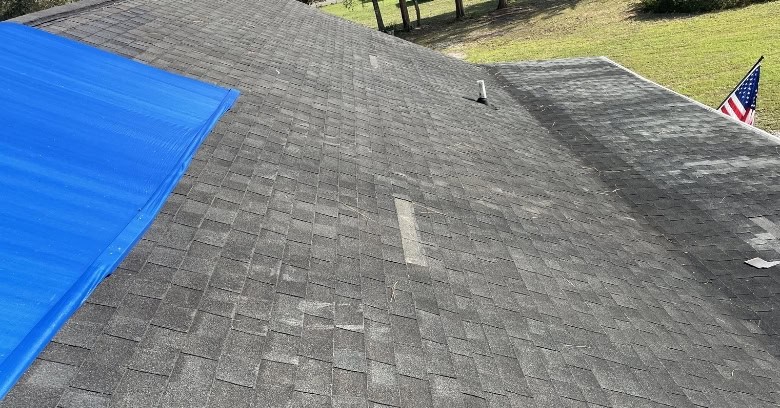
A tarp keeps rain off the deck, but no repair has been made. A secure installation laps over the ridge and clamps the edges under strips of wood, whereas rocks piled on the corners soon roll off.

A row of nails is driven through the courses below, and every hole is sealed during the permanent repair. Plastic that sits for months traps heat and moisture against the roof, which wears out the tabs beneath.

What You Are Given – Useful Later On

Once the new part is in place, the old damage is out of sight, and the cause is often a detail no bigger than a hand. The camera captures the entry point and the worn component ahead of removal, with a second set taken at the end.

Copies of the images are handed over, so anyone who asks later can see the history. Alongside the pictures comes a short write-up of the fault, together with each step of the repair.

The Replacement Question – Reading the Whole Covering

Where the shingles are healthy, a failed boot or flashing is dealt with as a separate job, since rubber seals often wear out well before the surrounding asphalt. A full new roof comes up when the granules have worn away everywhere, or when one opening follows another all over.

A small repair on tired material can protect the rooms for now, but the roof overall is no younger for the work. We give our view and the reasons behind the view, and you have the final word.

Getting a Close Match: What Is Still Made

A just-installed piece reads darker and crisper than the neighboring courses, because years outdoors have bleached the granules on the rest. We match the profile, the size and the nearest color still made, so the contrast eases within a few seasons.

When a manufacturer retires a design, an identical replacement is gone, which leaves a stand-in or a larger section rebuilt to a natural break. The match is judged with a sample next to the existing shingles, because a color chart flattens the mix of granules.

Warning Signs: Inside and From the Yard

  • A ceiling stain that grows after rain, most often near a wall or a chimney.
  • A mildew smell in a linen closet, which hangs around for days.
  • Light peeking between boards, spotted from inside the attic.
  • Tide lines on the underside of the roof, leading back toward one spot.
  • Rubber at a pipe gone hard and broken, sometimes in plain sight from the street.
  • Heavy grit piling up in the gutters, heaviest after a downpour.
  • A lifted, creased or missing tab, seen from the ground.
  • Cracked caulk along a flashing, visible with binoculars from the yard.

The Way APC Roofing Works on Roof Leak Repair in Deltona Florida – Our Method

Our look begins in the attic, not on the ladder, and the wood there shows where on the shingles the water entered. What let the water in is repaired the lasting way, and the neighboring flashings get a check too.

Every stage is photographed, from the problem to the finish, and a short written note is added. When the shingles are spent, the answer is given clearly, and you decide from there.

Roof Leak Repair Across Deltona Florida: Getting the House Dry Again

Dial 386-356-2111 and tell us what you are seeing.


Working With the Weather – Planning the Equipment

A temporary cover can go on over a damp deck, though shingles and flashing go on only once the wood has dried. Sealants set up slowly in chilly air, so a job in the cold includes sealing by hand.

Steep pitches and upper-story eaves mean fall protection and staging, as a slide down a sharp incline is hard to stop. Summer heat leaves shingles tender and easy to scar, which strips grit from the places stepped on.

Older Roofs – Small Jobs, Plain Talk

Asphalt that has baked for decades turns brittle, which means raising a course to reach the fasteners splits the shingle. Shingles ruined on the way in are added to the repair, so the section being fixed can grow as things proceed.

We tell you in advance when the covering is too fragile to open safely, and the images show why. Patching an old roof still makes sense to stop the water, so long as the fix is seen as a bridge, not a cure.

To arrange Roof Leak Repair in Deltona Florida, phone APC Roofing at 386-356-2111. We track down the entry point and rebuild the detail, with photographs handed over.


Elaine Lee

Verified

★★★★★
I couldn’t be more pleased with the work done by APC Roofing. From start To finish, They were very professional, reliable, Incredibly efficient. The team Showed up on time, communicated clearly throughout the process, and completed the job exactly as promised. The quality of their work is outstanding. My roof looks great, and I feel confident, knowing it was done by such a skilled and trustworthy crew. They cleaned up everything throughly after the job was done, leaving no mess behind. It’s not often you come across a company that combines craftsmanship, integrity, and top-notch Customer Service, but this roofing company nailed it. I highly recommend them to anyone needing roofing work. They truly went above and beyond I’m grateful and thankful for Mike helping me through this process.

Glenn MacKinnon

Verified

★★★★★
APC Roofing did a great job replacing our roof damaged by Hurricane Helene. Our initial contact was with Anthony Fontan, sales rep/roofing expert who helped us successfully navigate the insurance claim and all actions necessary to have our roof replaced quickly. Anthony coordinated temporary repairs on the day after the hurricane. He always provided timely responses to our questions. Work to replace the roof started on schedule and was finished in two days. Site cleanup was well done and the end result exceeded our expectations. We would not hesitate to recommend APC to replace your roof. Make sure to ask for Anthony Fontan

bill lewin

Verified

★★★★★
Anthony was a great advisor and kept us informed during the process. I recommend APC and Anthony. Great job

Michael May

Verified

★★★★★
APC roofing installed a metal roof on my house. I'm highly pleased with communication, workmanship and crew. A real easy experience. The roof looks perfect and should last a lifetime.. Alan kept me posted through all the phases of process and made many options available. Want a quality roof and caring service ask for Alan.

Katty garcia

Verified

★★★★★
Good job!