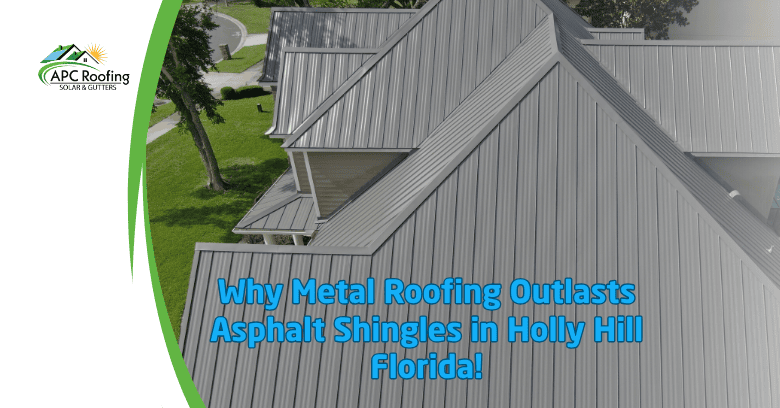
Searching for Steel Roofing Within Daytona Beach Florida?
APC Roofing works on ribbed sheet and concealed-clip panels alike, for houses as well as workshops and barns.
Phone 386-356-2111 and someone who knows the trade will come out to take a look.
Sorting Out Types: Clues From Below
Screw-down panels, corrugated or ribbed, are fastened with screws through the exposed metal, while standing seam is attached with clips tucked inside raised joints. Steel with a protective coating covers most houses that have metal, with aluminum and copper turning up less often.
Seen from a sidewalk, dotted lines of screws signal an exposed-fastener system, while flat pans divided by upright folds with no hardware showing are standing seam. Outbuildings and porches lean toward ribbed or corrugated sheet, while residences take either style.
The Cross-Section: Old Look, New Look
Corrugated sheet rises and falls in rounded, evenly spaced waves, and ribbed panels pair tall square ribs with broad flat areas. Adjacent lengths share a narrow side lap, and fastener placement follows a published pattern.
Ribbed stock is stiffer and spans further between supports, and a rounded wave appeals on older or rustic structures. Taller ribs give runoff more room on a long slope, and a lean-to or porch manages fine with a gentle pattern.
Exposed Hardware – Why Installation Matters
A screw pulls the metal tight against a purlin or the deck, and a washer under each head stops water getting in. Ultraviolet light slowly bakes neoprene brittle, and the panels usually last a great deal longer.
Driving a screw past snug crushes a washer and dimples the metal, while an underdriven or tilted fastener never seals all the way around.
Fresh Fasteners: Part of Upkeep
Washers dotted across a ribbed field grow old together, so a complete re-screw comes due at some point. Each original fastener is taken out, and a screw one size larger takes each place so threads grip solid material.
A full re-screw with new washers closes leaks at each head and tightens loose sheets, but rust damage, open laps and failed flashing are untouched. New screws are matched to whatever framing lies beneath, with wood threads for lumber and drill points for steel, and tops come painted to suit a colored finish.
A Covering in Motion – Built to Allow Travel
Steel lengthens on a hot afternoon and shortens on a cold night, and forty feet of panel shifts roughly a quarter inch or more, with aluminum going about twice as far. Metal screwed down with no give wears each hole into an oval, and a washer stops sealing.
Creaks as the day warms come from steel adjusting, and a roof built with slack is unharmed.
Anchoring Standing Seam: Hidden Hardware
One short stretch of every long pan is pinned tight, while clips on every other section permit movement. Trim at an end that travels is bent with clearance underneath, and metal with no play winds up torn or kinked.
As a pan is laid, clips are driven into the deck along one leg, so each new pan conceals all hardware below.
Quick-Fit or Heavy-Duty: Choosing Between Options
One kind of rib clicks shut under a firm push, while other designs are crimped over by a machine. Double-lock construction resists uplift and ponding, and published ratings run down to lower slopes.
Pan width and rib height vary from product to product, and architecture and a buyer's eye decide. Parts made for one system rarely suit a rival brand, and a mismatch shows up as gaps and loose joints.
Light or Heavy: Reading a Label
Steel is described by gauge rather than inches, and higher numbers mean thinner sheet. Outbuildings commonly get twenty-nine, and residential work leans on twenty-six and twenty-four.
Aluminum sheet is measured in decimal inches, and with either metal, a stouter panel holds shape. Different grades look identical once installed, so printed product data gives a firm answer.
Protection Built In: What Lasts
Roofing steel leaves a mill with a zinc or aluminum-zinc layer over plain sheet, and an oven-cured primer and color coat are applied on top. Damage no deeper than paint is cosmetic, but a sheared edge exposes steel that will corrode.
PVDF finishes hold color for decades, and polyester families fade and chalk more quickly. Wet masonry corrodes aluminum-zinc coated sheet, so panels are kept away from a new chimney or stone wall.
Base Material: Salt Air
Aluminum carries less weight and does not redden, though an impact leaves a deeper mark. Salt air at the coastal end of our territory attacks zinc-based layers, and makers restrict certain products near surf.
Copper usually goes on small accent roofs over bays and entries, and left unpainted, the metal darkens with age.
Galvanic Trouble: A Slow Chemical Fight
A copper pipe or flashing above steel sends corrosive drainage down over the panels, and a stain shows up before a leak does. Chemicals in treated lumber pit any aluminum resting on top, and an ordinary screw of an unsuited alloy fails as well.
Replacement flashing should come from a metal already present, or an isolating layer separates unlike metals.
A Matter of Taste: Choices That Help
Oil canning names shallow dips and bulges across a flat pan, and faint hollows show at sunrise and fade by noon. A slightly distorted pan sheds rain like any other, and the roof lasts no less.
Striations, heavier stock and narrower pans keep rippling in check, and an installer who does not overdrive clips helps as well. Photographs of finished houses show how noticeable oil canning can be, and the choice of panel is yours.
Inside the House: What Reaches Living Space
An outbuilding with bare framing under the metal makes a loud din in rain, because a single thin skin vibrates freely. A dwelling puts decking, a membrane and insulation between the panels and any bedroom, and indoors, few people notice more noise than under asphalt.
A pale or cool-pigment coat sends much of the sun back, so upstairs spaces bake less. Dark metal heats up like any black roof on a clear day, and without venting and insulation, color alone does little. Panels cool fast at nightfall, so evenings indoors feel better sooner.
Protecting Whoever Is Below: Chosen With Care
At the colder end of our range, snow lets go of a metal surface easily, and a whole mass may come down at once on anything under an eave. Retention bars keep a load up top to melt off gradually, and positions are chosen where anything below could be hit.
For standing seam, bolted clamps grip each upright joint, while exposed-fastener sheet takes mounts screwed into framing, and where snowfall is rare, nothing is added.
What Ice Does: Documented Plainly
Hail is common across the colder end of our territory, and panels with an impact rating are an option. Where a blow splits paint, bare metal can corrode, and a trim piece pushed out of place can channel rain inside.
Following a storm, our roofer takes pictures and measurements, with every dent pinned to a location on the roof.
Uplift: Layout Matters
Perimeter bands of a roof take a heavier pull than a central field, and once air slips under an unsecured edge, pressure can roll the metal up. Trim hooks over a continuous strip fastened to the deck, leaving nothing for a storm to seize.
Screw and clip spacing tightens at corners and around a perimeter, as manufacturer tables call for at each site. On the hurricane coast at the far end of our territory, fastening counts rise again, and products are chosen with a wind rating to match.
Vents and Stacks: Keeping Water Out
A flexible boot is formed around every rib and banded tight to a pipe, and a hole is cut in a flat, not through a seam. A chimney or skylight is built up on a curb with a cricket above, so runoff is steered aside.
Caulk is a secondary barrier behind formed metal, since weather hardens and splits any compound long before the panels are done.
Meeting Planes: Hooked and Clear
A broad flashing lines each valley in advance, and every sheet is trimmed on the skew. Exposed ends are bent back and gripped by cleats, so no hole sits where runoff gathers.
Where a long run needs more than one length, a lap is sealed between layers, and screws go through both thicknesses at close spacing.
Shallow Sections: Where Membrane Takes Over
Screw-down panels typically call for roughly three in twelve, and on a gentler slope, overlaps start to let water through. Machine-folded seams go much lower, with certain lines suited to decks that are nearly flat.
Many homes have a gentle stretch over a porch or a later addition, and a measurement comes before any panel is named, and where metal does not belong, a membrane does.
Substrate: Wood or Open Framing
A home gets metal over a continuous plywood or OSB deck, and a synthetic sheet rated for heat is sandwiched between, because old felt bakes and sticks under hot steel. An outbuilding may have nothing but purlins under the metal, and support distance dictates grade.
Once the deck is exposed, any board that gives underfoot comes out, as fasteners driven into mush pull straight out.
An Overlay: Condition Decides
Panels can often go on top of one shingle layer where code permits, so waste is kept out of a landfill. Steel panels weigh well under two pounds per square foot, so reinforcement is rarely needed. Battens over a fresh membrane go across existing shingles, and every fastener is sized to reach solid wood.
A second layer already in place, soft decking or stains from past leaks mean a full tear-off, because a problem covered with steel keeps growing out of sight.
Finishing Off: Vented or Solid
Strips cut to match a profile close off space under each rib at high and low points, so blown rain and critters are shut out. A ridge piece either breathes or is left solid, and attic airflow needs are what decide.
Gutter aprons and rake trim wrap up a roof's outline, and runoff is steered clear of a fascia board.
Working at Height: Slick When Wet
Each seamed pan is rolled out to reach a whole slope, and one pan spans eave to ridge with no joint across. Carrying an extended panel takes people spaced along the metal, and a creased pan should not be installed.
On panels, a step belongs in a flat above a purlin or deck, because a raised joint dents and deforms under load. A damp or dew-covered pan gives a shoe nothing to hold, so the safest place for the household is indoors.
Warning Signs: Plain to See
- Orange halos at fasteners, partway down a pitch.
- Hardware sticking up, mid-panel.
- A rake edge torn free, facing prevailing wind.
- A flue collar sitting crooked, by a bathroom fan.
- Corrosion along a cut, along a rake.
- Peeling paint, on one panel more than on panels nearby.
- A drip that follows a row of screws, over a closet.
- An endlap gaping, where slopes meet.
How APC Roofing Tackles Steel Roofing in Daytona Beach Florida – Our Method
We start by identifying which panel type is installed and how the panels are held, followed by every screw or clip, edge, boot, valley and lap. Panel grade, paint and hardware are recorded, and a trip into the attic catches past leaks.
You receive a report, pictures included, and a reason sits beside every recommendation. A sound covering is called sound, while replacement comes up only when a roof is truly spent.
Steel Roofing Around Daytona Beach Florida – Details Read Closely
Dial 386-356-2111 and we will book a day that suits you.
Keeping the Roof: Weighing Choices
A panel torn by a falling limb can be changed individually, although new paint never quite matches older metal. A new pipe boot or a resealed lap ends a local drip, and new screws restore a roof full of aged seals.
Widespread perforation puts replacement on the table, and a covering with every joint and collar given out is no different. Sometimes one weathered side is re-covered alone, provided trouble goes no further.
The Long View: Upkeep Over Time
Coated steel put on properly often gives forty years or better, but estimates of service are a rough guide only. Standing seam asks for less attention, with no hardware exposed, whereas screw-down sheet has washers changed out at some point.
Mixed metals, raw cut edges and caulk doing the job of flashing all shorten a roof's service, and a visit now and then spots trouble early. Leaves and needles piled in a valley or behind a chimney keep the metal wet, so clearing debris away helps paint last.
Whenever Steel Roofing in Daytona Beach Florida comes up, dial APC Roofing at 386-356-2111. Every screw or clip, edge and boot gets a close look, and you get photographs, notes and a recommendation to consider.
Verified

Verified
Verified
Verified