A water spot showed up on the bedroom ceiling after last week’s storm. Or you found a few shingles in the yard, and now you’re watching the sky every afternoon. You don’t want a whole new roof if a repair will do, but you also don’t want to pay for a patch that fails in the next downpour.
Good roof repair in Clermont starts with one question: where is the water actually getting in? APC Roofing finds the entry point, fixes the part that failed and shows you photos of both. We’re GAF Certified, licensed in Florida (CCC1337030) and insured, and your inspection is free.
Why the leak is rarely where the stain is
Water that gets through a roof doesn’t always drip straight down. It can run along a rafter or the underside of the deck for several feet before it finds a spot to fall. That’s why patching the shingles directly above a ceiling stain so often misses.
The attic tells the story. A water trail leaves a dark track on the wood, and the highest point of that track sits closest to the opening. Your roofer measures from that spot to the ridge and an outside wall, then finds the same spot on the roof. On a vaulted ceiling with no attic, the search happens outside, detail by detail.
Where Clermont roofs usually leak
The open middle of a shingle or tile roof rarely fails first. Leaks gather where something breaks up the surface.
Pipe boots. The rubber collar around a plumbing vent dries out and cracks in Florida sun, often long before the shingles wear out. A leak over a bathroom is a classic sign. The fix is a new boot, slid in under the shingles above it.
Walls and chimneys. Where a roof meets a wall, each row of shingles gets its own piece of step flashing, covered by counterflashing. When that metal rusts or was never installed right, water runs behind the siding. Caulk over the joint isn’t a fix. The repair is new flashing with the shingles around it lifted and relaid.
Valleys. The crease where two slopes meet carries water from both, and during a summer storm it runs fast and deep. Leaves build up there and hold water against the shingles. A worn valley usually needs to be rebuilt, liner included, because a surface patch won’t survive that flow.
Nail pops. The roof deck swells in humid weather and shrinks in dry spells, which slowly works nails loose. A raised nail can push through the shingle above it. Tapping it back down doesn’t hold. The nail gets pulled, the hole sealed and a new nail set nearby.
Wind-lifted shingles. A strong gust can break the seal strip and fold a shingle up. Even if it lies back down, it keeps a crease that lets wind-driven rain underneath. A shingle that only lost its seal can be resealed. A creased or torn one gets replaced. Our wind damage roof repair page covers storm damage in detail.
Tile roofs. On concrete and clay tile, cracked or slipped tiles can be replaced on their own. Often, though, the leak comes from the underlayment beneath the tile, which wears out well before the tile does. See tile roof repair in Clermont.
Old mounting holes. When a satellite dish or antenna comes down, the bolt holes stay behind, usually sealed with nothing but a ring of caulk. They’re almost impossible to spot from the ground.
Repairs that hold up
A few things make the difference between a repair that lasts and one that doesn’t.
New shingles won’t match the old ones exactly at first, because the existing roof has faded in the sun. Your roofer matches style, size and the closest current color, and the difference narrows as the new shingles weather. If your shingle line has been discontinued, the choice is a near match or running the repair to a natural break on the roof, and you’ll see a sample against your actual roof before deciding.
If a leak has gone on for a while, the plywood under it may be soft. Rotted decking gets cut out back to solid wood and replaced before new underlayment and shingles go on.
Before anything comes off, the damage gets photographed. After the repair, matching photos show the finished work. You keep all of them, and they’re useful later for a buyer, an inspector or an insurance question.
If the roof is leaking right now
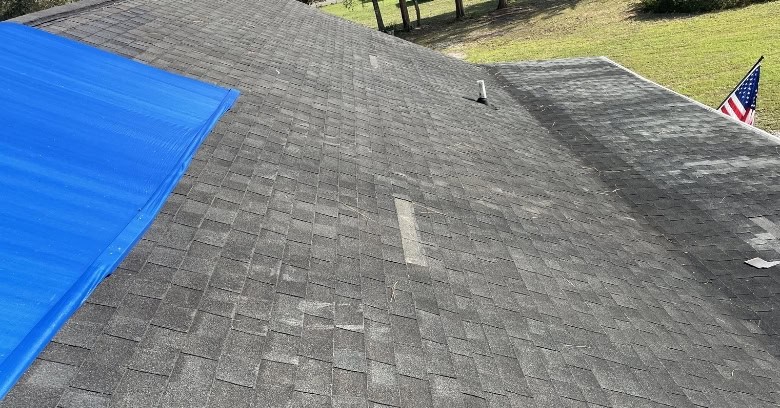
If water is coming in, a properly installed tarp can keep the inside dry until the permanent repair is done. A good one runs over the ridge and is secured with boards along the edges, since a tarp that’s just weighted down tends to blow off. It’s a short-term fix only. Left on through a Florida summer, a tarp traps heat and moisture against the shingles underneath. Call 407-270-1129 and talk through your options.
When repair isn’t the honest answer
A single failed detail on a healthy roof deserves a repair. The question changes when shingles are brittle and bare across the whole roof, or water keeps finding new ways in. On an old roof, lifting one shingle to reach a nail can crack the ones around it, and a small repair grows. If that’s where your roof is, you’ll hear it before any work starts, with photos to show why. The choice is still yours, and a modest repair to buy time is a fair thing to ask for. Our roof replacement in Clermont page explains what replacement involves.
Storm damage and insurance
If a storm caused the damage, you file your own claim with your insurance company and pay your deductible. APC Roofing documents the damage with photos, gives you a written estimate and works with your adjuster.
How it works
- Book your free inspection. Call 407-270-1129 or request a free estimate online, and tell us what you’re seeing inside.
- Get a clear, honest assessment and estimate. You’ll get photos of the leak source, a plain explanation and a written estimate.
- Your roof gets fixed and the site gets cleaned up. The crew repairs the detail that failed, checks the ones next to it and cleans up before leaving.
A small roof leak can soak insulation and soften the deck for months before it shows on the ceiling. Catching it early is usually the difference between a repair and a bigger job.
Roof repair questions from Clermont homeowners
How do I know if my roof can be repaired?
If the damage is in one area and the rest of the roof is still flexible and holding its granules, a repair usually makes sense. The inspection photos will show you.
Do you repair tile and metal roofs too?
Yes. APC Roofing repairs shingle, tile, metal and flat roofs.
Will my repair match the rest of the roof?
Close, but rarely perfect on day one, because the old shingles have faded. The match improves as the new shingles weather.
Is the roof inspection free?
Yes. The inspection and estimate are free, with no obligation.
Book roof repair in Clermont, FL
Call 407-270-1129 to schedule your free roof inspection, or request one online. For leaks you’re still trying to pin down, see our roof leak repair page.
You’ll know what failed, what it took to fix it and that the ceiling is going to stay dry the next time a storm rolls through.