
There’s a bucket under a ceiling tile in your building, and it’s been there longer than you’d like to admit. Someone patched the roof last year, the leak stopped for a few months, and now it’s back after the latest afternoon storm. You need commercial roof repair in Orlando that actually ends the problem, and you’d like to know you’re not paying for the same repair twice.
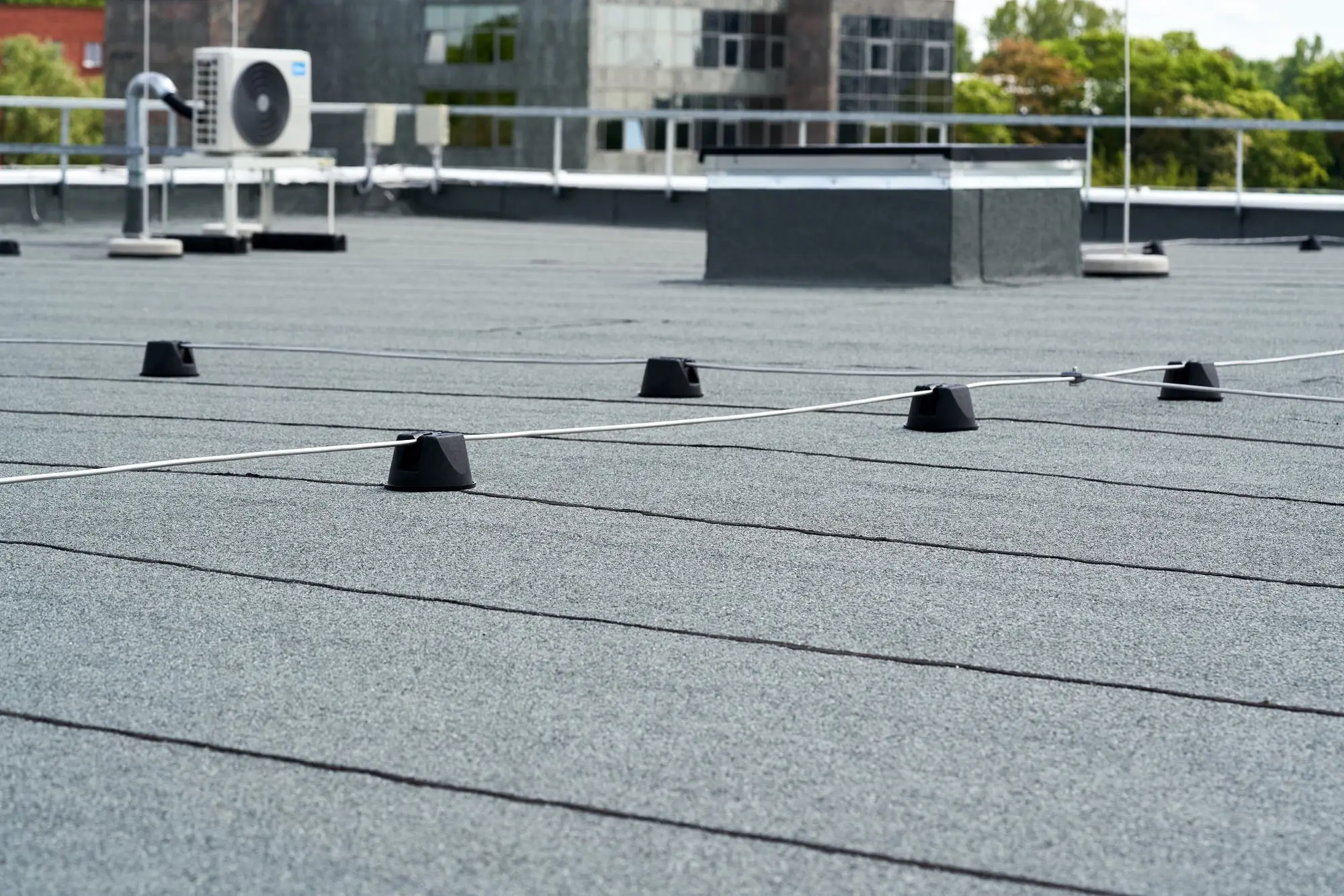
On a commercial roof, the drip you see inside is rarely right under the hole. Water gets in at a seam or a flashing, runs along the deck or through the insulation, and comes out wherever it finds an opening. A repair that only covers the spot above the bucket is a guess, and you deserve better than a guess.
APC Roofing is GAF Certified, licensed in Florida (CCC1337030) and insured, and we work on commercial buildings across the greater Orlando area from our base in Clermont. Your inspection is free. Call 407-270-1129 to set it up.
How a commercial roof leak gets traced
A good repair starts by finding where the water enters, not where it lands. That means looking at the roof from both sides:
- From inside: where the stains are, how far they’ve spread, and any spots on the deck that look wet, rusted or sagging.
- On the roof: seams, flashing at walls and parapets, curbs around rooftop units, pipe penetrations, drains and scuppers, and the edge metal along the perimeter.
- Drainage: where water ponds after rain, and whether drains and scuppers are partly blocked.
Then the question is how much water has gotten in. If the insulation under a flat roof is soaked, patching the surface traps that moisture, and the membrane blisters and fails early. Knowing what’s wet underneath tells you whether a repair will hold.
Where commercial roofs in Central Florida usually leak
The Florida sun and summer storms find the same weak points on building after building.
Seams and laps. On TPO, seams are heat-welded. On EPDM, they’re taped or glued. Sun and movement work them loose over time, especially at corners and around penetrations.
Flashing around rooftop units and walls. HVAC curbs, vent stacks and parapet walls all need flashing that moves with the building. Sealant dries out in the heat, and a small gap there lets a lot of water in.
Drains and scuppers. Leaves, gravel and debris block drains, water ponds, and standing water speeds up wear on the membrane around it.
Perimeter edge metal. Hurricane-season wind pulls hardest at a roof’s edges and corners. Loose edge metal lets wind get under the membrane.
Metal panel fasteners. On metal roofs, the rubber washers under exposed screws dry out, and screws back out as the panels heat and cool every day.
Commercial roof repair in Orlando by roof type
Each system gets repaired its own way, with materials made for that system.
- TPO: damaged areas are cleaned and new TPO is heat-welded over them.
- EPDM: patches and seam repairs use EPDM-compatible tapes and primers.
- Built-up and modified bitumen: blisters, splits and worn spots are cut out and rebuilt in layers.
- Metal panels: worn fasteners are replaced, laps are resealed and damaged panels are swapped out. Our metal roof repair page has more.
- Shingle roofs on commercial buildings: damaged shingles, flashing and pipe boots are replaced, the same way they would be on a home but to the code requirements for that building.
If your building has a flat roof, our flat roof repair page covers ponding and membrane problems in more depth.
After a storm
After a hurricane or a strong summer storm, have the roof checked even if nothing is leaking yet. Wind can loosen edge metal or lift seams without an immediate leak. If you file an insurance claim, you file it with your insurer and pay your deductible. We document the damage, provide the estimate and work with your adjuster. More on our storm damage roofing page.
When repair stops making sense
Repairs are the right call on a roof that’s sound overall. When large areas of insulation are wet, the membrane is brittle and cracking across the field, or the roof has needed repairs every few months, more patching is money spent on a roof that’s done. At that point you’ll hear it plainly, with photos, along with your options for a recover or reroof. Our commercial roofing page explains those.
How it works with APC Roofing
- Book your free inspection. Call 407-270-1129 or request your free estimate online.
- Get a clear, honest assessment and estimate. You’ll get photos of the leak source and the roof’s overall condition, plus a written repair estimate.
- The repair gets done and the site gets cleaned up. Work is scheduled around your business and the weather, and the crew cleans up before leaving.
A slow leak over one part of a building can spread through the insulation well beyond the stain you see. Fixing the source early keeps the repair small.
Commercial roof repair questions
Why does my roof keep leaking after it was patched?
Most often the patch covered the spot above the drip instead of the place where water was getting in, or wet insulation was left under the repair. Tracing the leak from both sides of the roof usually solves it.
Can you repair my commercial roof without replacing it?
Often, yes. If the roof is dry and sound overall, targeted repairs to seams, flashing and drains can keep it working for years.
Do you repair shingle roofs on commercial buildings?
Yes. Offices and light-commercial buildings with pitched shingle roofs get the same careful repair work, done to code for that building.
Is ponding water on my flat roof a problem?
Water that’s still sitting there a couple of days after rain wears the membrane faster and adds weight. It usually means a drain is blocked or the roof has settled, and both can be fixed.
Get the leak fixed for good
Call 407-270-1129 to book your free inspection. The goal is a dry building, no more buckets, and a repair you only pay for once.


















