Roof Replacement

Planning Roof Installation on a Home in Sanford Florida?

APC Roofing removes coverings past their service life and fits fresh flashing, membrane and vents throughout.

Dial 407-270-1129 and we will come out and take measurements.


Leaving the Old Covering On – and What We Do Instead

A lot of jurisdictions accept fresh asphalt nailed straight onto a worn surface, and that route avoids stripping anything. Going over the top conceals the deck and its flashing, so the faults of the earlier roof remain.

Asphalt nailed onto asphalt copies each bump it sits on, and warmth caught between the two ages them early. A proper reroof clears each slope down to the boards, which puts any rot where a carpenter can cut it out.

What the Wood Shows: Fixing the Base

When the shingles are gone, every panel and plank can be walked and checked. Spongy areas come out and fresh wood goes in, while sheathing that has worked free gets renailed.

A plank-and-gap deck is common on houses of a certain age, and that kind of deck gets plywood laid over it. Fasteners driven into punky wood do not hold, which is how a new roof starts shedding tabs.

Synthetic Underlayment – the Nail Pattern

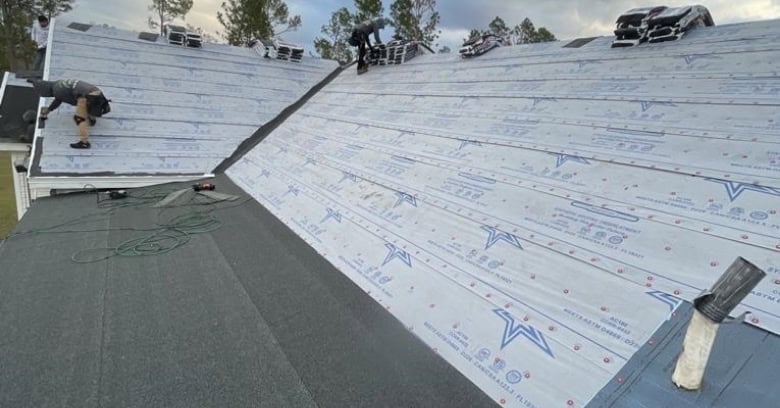
A roll of plastic-based fabric is fastened across the plane, so the structure remains dry when a storm tears something loose above it. Old tar paper split easily and buckled after a rain, whereas the newer product keeps its shape for years.

The upper edge of each run tucks under the next one up, and fastener spacing follows the maker's printed guide. What the covering rests on is worth asking about, because identical-looking roofs can part ways under the shingles.

Ice and Water Membrane: Sealed Around the Nails

A rubber-and-asphalt layer sticks directly to the sheathing, and it flexes as the wood swells and shrinks. The compound seals around the shank of every roofing nail, so moisture that gets under a shingle has no path into the house.

At the colder end of our territory, the protection is taken higher up the plane, as frozen gutters send trapped meltwater upward. A sealed deck, with tape over each joint, is sometimes specified, and that keeps water out after high winds take tabs off.

The Edge Metal: Laid Before or After

Light-gauge flashing is nailed along the bottom line and the slanted ends, so water drops free instead of curling back under. At the eave, the metal is tucked beneath the underlayment, while up the rakes the order is reversed.

A lot of older homes went up with shingles simply hanging over the wood, and water has been soaking the trim behind the gutter for years. A new roof is the time to add formed metal on every side, and damaged lumber beneath it is repaired.

The Starter Strip: Built for Wind

Along the eave goes a product made for that spot, with a tar band near its lip, and its outer border overhangs the drip metal slightly. A homemade version made from reversed stock puts the sticky line out of position, so a strong blow can peel up the lowest row.

A painted guide on every shingle shows where fasteners go, because only there does each hit pass through both plies. A slanting or deep-set head slices the mat, and the shingle around it can then rip loose in a storm.

Airflow Under the Deck: What Trapped Heat Costs

The underside of the roof wants a draft that rises from the soffits to the peak, with the inlet and outlet openings in proportion. When the lower vents are painted shut or packed with insulation, the attic goes hungry, which makes a roof fan suck air from the living space.

A well-ventilated underside holds the plywood near outdoor temperature, so the tabs keep their oils longer. At the colder end of our territory, a vented attic prevents house warmth from thawing the snowpack, so ice ridges rarely build along the gutters.

Exhaust Fan Lines: Routed Outdoors

Builders often left bathroom vents dumping under the sheathing, and the vapor they move condenses overhead. Stained decking and rusted nail tips reveal the damp, so the material eventually weakens from the attic side.

With the sheathing exposed, the pipes from the fans are easy to trace, so a proper outlet with a damper can be set for each. Any connection that has pulled loose is fastened back in place, and an insulated sleeve keeps condensation from dripping down.

Step Flashing at the Walls – and the Kickout at the Bottom

An angled plate goes in with every row that stops against the house, with the exterior finish lapping over the upright half. Metal that served the previous roof is pitted and already nailed through, so everything is thrown out and replaced.

The bottom end of a wall run gets a kickout that throws water clear, since otherwise the stream slips inside the cavity. Builders skipped the part on lots of older houses, and the damage shows up as swollen, stained boards beside the roofline.

Chimney Flashing – Old Brick, New Metal

On a masonry flue, an apron wraps the downhill face and stepped pieces climb both flanks, and counterflashing seated in a cut joint overlaps them. A wide chimney calls for a cricket on the uphill end, so rain divides and flows past instead of pooling.

A stack that went without a peaked diverter can get one while the old layers are off, because nothing covers the wood in that area. Brick that flakes or mortar that crumbles up top is masonry work, since the counterflashing holds only as well as what surrounds it.

Skylight Units: What Changes With the Roof

A purpose-built trim package from the maker wraps every curb, and the parts overlap the adjoining courses like shingles. A tired unit with condensation between the panes is replaced while everything is apart, since pulling it next year means tearing into sound work.

Owners who dislike a light well can have it taken away, and the gap is filled with rafters and plywood. Streaks down the shaft on cold nights are often condensation, which traces to the living space rather than a fault outside.

Valley Linings: Open or Closed-Cut

A trough formed by adjoining planes collects both flows, so it is reconstructed with the rest of the job. An adhesive membrane covers the entire run, and then either sheet metal or shingles are laid over it.

An open channel shows bare steel between neat margins, while closed-cut work tucks tabs from one side over the center, trimmed straight on the other. Picking between them comes down to the covering and the climate, and both perform when installed as specified.

Roof Penetrations: Sealed by Laps, Not Caulk

A fresh flashing unit goes on every drain riser, and the louvers over the fans are swapped. Mounts and stacks that no longer serve, from dish brackets to disused pipes, are removed, and new decking fills each opening.

Any caulk used at a collar plays a minor part, while the flange lapped under the upper courses keeps the rain out. Silicone and lead versions resist ultraviolet light better than ordinary neoprene, so they pair well with a covering that will be there for decades.

The Flatter Parts: Membrane, Not Shingles

Many a sunroom, carport or rear room is topped almost horizontally, and asphalt was often nailed across it regardless. Shingled courses only work when water drains off fast, and at a low angle it pools and wicks back beneath the edges.

Modified bitumen or a single-ply sheet can take over that section during the replacement, and it tucks under the shingled plane above. A transition piece joins the flat part to the shingles, as water hesitates where the grade eases.

What Goes on Top – What the House Can Carry

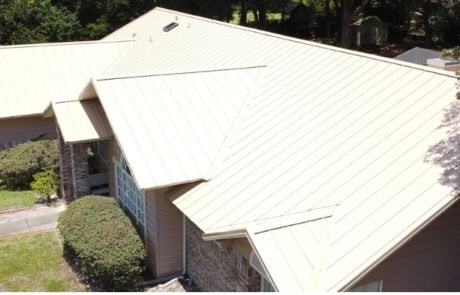
The pitch rules certain products out, because each system names a minimum slope. A laminated shingle serves the great majority of houses, standing seam metal is prized for wind resistance, and tile only makes sense where the building was designed to take it.

How the roof looks from the street matters too, and paler shades keep the attic a little cooler. We say which we would use on your house and why, and you decide.

Specifications That Vary: Fasteners and Toughness

At the colder end of our territory, hail shapes much of the plan, so impact-rated shingles are often the pick. The grade reflects a laboratory drop of steel balls on sample pieces, so it tells you about toughness, not about what any storm will do.

At the coastal end of our territory, the design answers to gale-force wind, so the product must carry a strong uplift rating. Every piece gets the extra nails the maker specifies, while the rakes and eaves are sealed down with cement.

Hips and Ridges: Exhaust Along the Crest

The apex and every outside corner are covered with factory-bent shingles, as regular field material creased that hard falls apart. Along a ridge that exhausts air, the decking is cut away on each side, and the vent is fastened across the gap and capped.

Foam or plastic plugs seal the ends where the peak meets a gable, and driven rain stays outside. The gap in the deck matches the maker's stated width, as a cut too wide leaks while one too narrow barely breathes.

The Ground Around the House: Gutters and Grass

Plantings and outdoor seating close to the walls do better under tarps, and the air conditioner and low windows need boards in front. A roll-off container beside the house catches what comes down, with mats beneath its wheels to save the pavement.

The gutters gather granules and scraps as the old layers come off, and a full run spills over in the next heavy rain. Nails left in the yard catch tires, mowers and paws, so a thorough sweep after the job is sensible.

Step by Step: Stripped, Repaired, Rebuilt

Removal moves across the roof in stretches, which limits how much wood a passing shower can reach. Any rotten panels are replaced, and the membrane and underlayment go down on top, with the rake metal and starter set once the sheets are down.

New courses go on working uphill, and caps and vents close off the highest line. The factory adhesive lines set as the sun heats the new shingles, and until then a strong gust can lift a loose tab.

What Happens Below – Getting Ready Indoors

Every blow on the deck travels down through the studs, and photos or shelves on upper walls can shake loose. Granules and old debris fall through gaps into the attic, so boxes kept up there are worth covering.

Cars do better parked away from the driveway, because a dumpster and material deliveries use that stretch. Pets that dislike racket settle in a far room or elsewhere, while children are kept back from the eaves as shingles fall.

Building Permits: Part of Doing Things Right

Local authorities usually require sign-off for a complete tear-off, and a code inspector examines the result once it is done. Pulling the permit is normally up to the roofer, because that document ties the work to the business doing it.

Treating sign-off as optional is a way of dodging review, and that deserves weight when choosing. An inspection on file reassures whoever buys the house next, and it can smooth a sale when the time comes.

The Life of a Replacement: More Than the Label

Modern laminated shingles are engineered for decades, while standing seam and tile can exceed that on the right house. Real-world results hinge on the edge and flashing details, as well as the storms overhead.

Identical products on neighboring houses can finish a decade apart, since one breathes and the other bakes. An annual look once the heavy weather passes finds trouble early, so the covering has a better chance of lasting its full span.

Clues From the Yard and the Attic – Worth a Closer Look

  • Tabs that have curled at the corners – on every face, not just one.
  • Smooth, shiny areas with nothing left on them, with grit piling up in the gutters.
  • A string of repairs at a different point each time.
  • A ridge that has dropped – visible from the yard.
  • Daylight showing through the boards in more than one place.
  • A covering too stiff to flex, a sign the asphalt has dried out.
  • Green growth pushing under the laps, on top of age-worn material.
  • An old layover now wearing thin, meaning a strip to the deck next time.

How APC Roofing Plans Roof Installation in Sanford Florida – Our Method

We begin by walking every slope, and the attic gets a look from the hatch. The results are set down in a written scope, with each layer, the metal and the ventilation listed.

Pictures are taken of the repaired wood and the flashing before they are buried, so the layers underneath can still be checked.

Roof Installation Near Sanford Florida – Planned, Then Built

Call us at 407-270-1129 and ask for a measurement of every slope.


Gutters and a New Roof: What We Look At

All the rain the shingles shed collects in the troughs, with the drip metal setting where it enters. Sections that sag, leak at the seams or pull from the fascia are noted, since escaping water soaks the trim along the eave.

Removed troughs are put back with a gentle pitch toward the outlets, with fresh fasteners driven into solid wood. At the colder end of our territory, a stopped-up gutter freezes hard and backs water up, so guards or larger leaders can help there.

What a Replacement Does Not Change: Who Handles What

A rafter that has cracked or a ridge that sags is a job for structural carpenters, so the repair is made before the new layers go on. A thin blanket of attic insulation stays thin under a fresh roof, which leaves rooms that were hard to heat just as hard.

Wiring trouble spotted near the rafters belongs to an electrician, and it is marked as such. You know in advance what the replacement fixes, and just as clearly what it does not.

To plan Roof Installation in Sanford Florida, phone APC Roofing at 407-270-1129. We take measurements and set the work down on paper, and each recommendation comes with its reasons.

Frank Smith

Verified

★★★★★
Our experience with APC roofing began with an introduction and quote by Lucio. He came to our home, explained the process and immediately went on the roof to access the damage. As we began to inquire further about what to expect Lu got us in contact with Adrian. Now Adrian became an invaluable partner in very honestly and sincerely letting us know what APC could and couldn’t do to repair or replace our damaged roof. Hurricane Milton left us scrambling to come up with thousands to meet our deductible. Patiently and empathetically Adrian dispelled our apprehension about working with a contractor or being left incomplete and in need of legal help to resolve any disputes. He gave us his assurance that he would oversee the entire project. I have to admit that he kept his word. Even when we thought there would be a last minute hiccup with financing he put me in-touch with Lucy and she did not give up until we got the information and terms I wanted. This was a truly great team from start to…

Mike Price

Verified

★★★★★
Everything went smooth on schedule nice clean job would recommend to anyone Mike Price was a great guy to work with

Tom Lewis

Verified

★★★★★
This company does fantastic work from start to finish. I couldn’t be more pleased and will refer anyone I know to APC Roofing!
★★★★★
APC Roofing recently installed a beautiful new roof on our home. Our experience, from the first visit by Lance, the APC salesman through to the finished product, was absolutely great. Their crew arrived in the morning and prepared the site, covering everything around the house so no damage would be done. They finished the job by late afternoon. The crew was polite, worked quickly, and all surrounding areas were meticulously cleaned. From the salesmen, to the hard-working roofing crew, to the team in the office, I couldn't be more satisfied. My sincere thanks to you all.

Elsa Kate Nichols

Verified

★★★★★
They were very helpful in working through and explaining the insurance process beforehand. The crew arrived earlier in the day both days than promised and worked hard. The roof and details are beautiful and everyone, from the gentleman delivering the trash trailer to the roofers to the manager, treated our property with respect and care protecting plants and cleaning up nicely.