The storm passed, and now there’s water coming through the ceiling. Maybe a tree limb punched through the roof, or the wind peeled back a whole section of shingles. You’re moving furniture, setting out buckets and wondering who to call first and what this is going to turn into.
Take a breath. Emergency roof repair happens in two stages: getting the water stopped, then making a permanent repair that’s done right. Mixing up the two is how some families end up living under temporary cover for months. This page walks through both, so you know what’s happening and what to ask.
APC Roofing has handled storm damage repair since 2017 across Central Florida, the Daytona Beach area, the greater Kansas City area and Springfield, Missouri. We’re GAF Certified, licensed and insured. Call 866-995-0704 to get your roof inspected.
What to do first
Your safety comes before the roof. Stay off it, especially when it’s wet or dark, and keep clear of any sagging ceiling or downed lines. Then:
- Move furniture, electronics and anything valuable away from the leak
- Catch dripping water and soak up what’s on the floor
- Take photos and video of the damage inside and out, from the ground
- Call your insurance company to report the damage if you plan to file a claim
Those photos matter. They show what the damage looked like before anyone touched it.
Temporary protection buys time
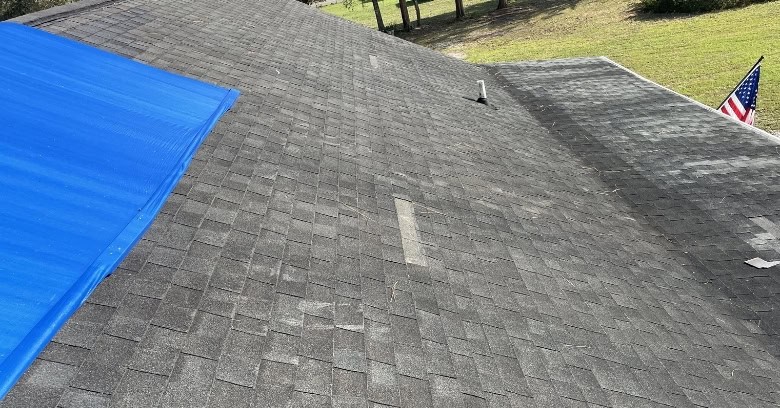
When a roof is opened up by wind or a falling tree, the first job is keeping more water out. Temporary covering or boarding over an opening buys the time needed to plan the permanent repair properly, in daylight, with the right materials.
It’s a stopgap, not the fix. Temporary covers break down in the sun and can work loose in wind, and they tend to fail during the next storm. Every week under temporary cover is also a week the wet material underneath isn’t drying out. Treat it as a deadline you’ve been given, not a problem you’ve solved.
The real damage is often under the surface
Sudden damage almost always reaches farther than the hole you can see. Before anyone writes a final price, enough of the roof has to be opened to see how far the water traveled. That can mean swollen or soft decking, soaked insulation, rusted fasteners and wet underlayment well past the point of impact.
On a sloped roof, water runs along the underside of the decking and drips off at the first thing in its way, so the ceiling stain can be far from the actual opening. On a flat roof, water spreads sideways under the membrane. A price written from the driveway, without anyone looking underneath, is a price that’s likely to change.
Dry it before it’s closed up
This is the step that gets skipped when everyone’s in a hurry, and it’s the one that decides whether the repair lasts. Wet material sealed under a new roof doesn’t dry. It rots, and mold can grow where nobody sees it.
The right order is to remove what’s soaked through, dry what can be saved and confirm it’s dry with a moisture meter before rebuilding. Interior repairs like drywall, insulation and paint follow the roof, and they’re usually a separate job from the roofing work.
How insurance fits in
Insurance claims move on their own timeline, often weeks or months, while your home needs decisions now. If you decide to file a claim, you file it yourself and you pay your own deductible. APC can document the damage with photos, provide an estimate and work with your adjuster.
A few tips help. Keep the bill for emergency protection separate from the estimate for the permanent repair, since policies often treat them differently. Photograph everything before it’s covered or removed. If more damage turns up once the roof is opened, photos taken during the work help document it for your adjuster. Be cautious of anyone who asks you to sign over control of your claim, or who offers to waive your deductible.
Repair now, or replace?
An emergency doesn’t automatically mean a new roof, and it doesn’t mean a patch either. A tree through one section of a fairly new roof is a repair. Wind that stripped several slopes off a roof that was already near the end of its life is usually a replacement, and repairing it means paying twice for one outcome.
Four questions settle it. How much life did the roof have left before the storm? How many slopes were damaged? Did the decking stay dry? Is matching material still available? Those can be answered from what’s on the roof, and they should be answered before the repair is written up. Our roof repair page goes deeper on that decision, and our storm damage page covers what wind and hail do to different roofs.
How it works with APC Roofing
- Book your free inspection. Call 866-995-0704 or request a free online estimate.
- Get a clear, honest assessment and estimate. We look at the damage and what’s underneath, take photos and explain whether a repair or replacement makes more sense.
- Get the roof fixed and the site cleaned up. The crew makes the permanent repair and leaves your property clean.
Financing is available through Aqua Finance, Fortifi, Hearth and Home Run Finance if the repair turns out bigger than expected.
Emergency roof repair questions
What should I do if my roof is leaking during a storm?
Stay off the roof. Move belongings away from the leak, catch the water, and take photos. Once the weather clears and it’s safe, have the roof inspected.
Does homeowners insurance cover emergency roof repair?
Many policies cover sudden storm damage, but coverage varies. Check your policy and talk to your insurer. You file the claim and pay your deductible, and APC can provide documentation and an estimate for your adjuster.
A tree fell on my roof. Does the whole roof need replacing?
Not always. If the damage is limited to one section and the rest of the roof is in good shape, a repair is often enough. The inspection will show how far the damage goes.
Do you handle emergency roof repair in my area?
APC serves Central Florida, the Daytona Beach area, the greater Kansas City area and Springfield, Missouri. See emergency roof repair in Greater Orlando or emergency roof repair in the Kansas City area for local details.
From a bad night to a sound roof
A roof opened up by a storm won’t get better on its own, and wet decking gets harder to save with every week it stays wet.
Get it looked at, get a straight answer on what it needs and get it fixed properly the first time. Then you can put the buckets away, have a dry house and stop watching the ceiling every time it rains. Call 866-995-0704 to book your free inspection, or start your estimate online.