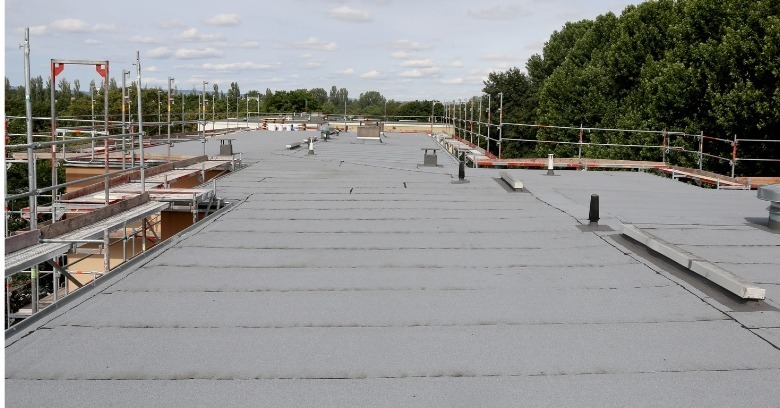
Hoping to find Commercial Roofing Installation in Republic Missouri?
APC Roofing builds and mends the wide, low coverings above places of work, including the drains, curbs and flashings.
Call 913-398-5020 and a roofer will go up top and check every part.
Above a Shop or Office – Some Background
Employees, inventory and equipment are what the membrane protects, so a small opening can interrupt a full day of trade. A large building is usually topped by a broad, nearly level surface, and runoff and uplift are engineered rather than guessed.
Package units, vent stacks and dishes are bolted in place above the ceiling, and each duct, line or support passes through the waterproofing. The business inside shapes the choice of system, so a refrigerated plant is specified unlike a clinic.
Sheet Systems in Wide Use – Names Decoded
Single-ply means one factory-made layer of TPO, PVC or EPDM, modified bitumen comes as polymer-rich asphalt on a roll, and built-up roofing is felt sealed with hot tar several plies deep. The laps on a thermoplastic sheet are fused by a welding machine, whereas a rubber splice depends on primer and tape.
A commercial kitchen pushes greasy vapor up through the exhaust fans, and oily residue softens asphalt and EPDM, so PVC is a common pick for the spot. A stone-covered built-up system is weighty and tough, and the surfacing blocks sun that would dry out the bitumen.
Commercial Steel: Upkeep Notes
Exposed-fastener sheets are secured with screws through the flats, and each shank anchors in the framing below. Sunlight bakes the washers until the rubber splits, and fasteners loosen as the metal moves with temperature.
Standing-seam panels attach with clips tucked under the raised seams, so each pan can creep as the metal grows and shrinks. Rust is often found at overlaps and cut edges, and a restorative coating can add service to sound steel.
Deck Types – What to Check
The way the layers are attached follows from the structure beneath, and reroofing leaves the framing in place. Formed steel grips a screw well, concrete wants adhesive or expansion anchors, and wood or gypsum plank takes nails or purpose-made fasteners.
Old, slow leaks corrode patches of a metal deck, and a weak area gets a new panel before anything goes on top. The underside can be viewed from below where no ceiling blocks the view, and small cuts from the upper side answer the rest.
Attachment Methods: Choosing an Approach
Some commercial sheets go down with plates and screws at the seams, fully adhered systems are glued across the whole underside, and ballasted sheets lie free beneath river rock or concrete pavers. Height, exposure and the deck below guide the selection, and an engineer confirms the framing can carry any added weight.
Screw-down systems flutter between plates when gusts hit, whereas glue keeps a sheet calm only over a dry, clean base. Ballast makes any inspection slow, since the stone or pavers must be carried off to reach the laps.
Gusts and the Membrane: What Codes Expect
Suction peaks at the corners, because swirling eddies form where the air crosses the perimeter. The strips along the sides rank next, and the central field is spared most of the load.
Attachment rows tighten on the approach to corners and edges, as set out in engineering tables for height and wind speed. Skimping on anchors at the outside angle lets the covering pry loose, and pressure underneath can strip a wide section.
The Insulation: More Than Warmth
Polyiso sheets are laid across the deck with joints staggered, and a tough cover board over the stack takes foot traffic. The layer cuts energy use across the building, and tapered stock tilts the finished surface toward the drains.
A saturated panel no longer holds back heat, and trapped water weighs on the structure and corrodes steel. An infrared scan at dusk, backed by cores, outlines the affected zone, and any spoiled patch is replaced, never roofed over.
Outlets on a Big Building – Laying Out the Route
A metal strainer bolts over each interior opening, which keeps litter from entering the pipe. When the grate mats over, rain has nowhere to go, and a ring of ponding widens outward.
A secondary outlet is set slightly above the everyday drain, so a steady spill up high signals a blockage below. An inch of standing water weighs about five pounds per square foot, and water lasting two days suggests a depression or a clogged strainer.
Tracing a Leak: Why Care Pays
The mark on a suspended ceiling shows where moisture landed, but the split in the sheet is often somewhere else entirely. Steel decking guides runoff down the corrugations, and seams in the foam layer offer extra routes.
Up top, the laps, curbs and outlets uphill from the mark are inspected, and electronic leak detection can locate a pinhole. Repairs aimed at the spot directly over the drip tend to miss, and the next downpour sends water through again.
Cabinets and Condensate: Where Care Is Needed
Every heavy machine rests on a curb built up from the deck, and the covering turns up the sides beneath metal counterflashing. Each folded inside corner takes careful work to stay watertight, and a poorly sealed crease admits rain.
When a heating contractor swaps a machine, an adapter curb often goes on unflashed, and water reaches the office below soon enough. A condensate tube emptying onto the sheet keeps a patch constantly damp, and the fix is carrying the flow to a drain.
Pipes, Vents and Conduit – Detail by Detail
A round plumbing stack gets a molded boot clamped at the top, while odd shapes go into a pitch pocket filled with sealant. Over time the compound pulls away and splits, and adding fresh material is ordinary maintenance.
Electrical conduit and gas lines ride on blocks simply set in place, as a stand screwed into the deck punctures the waterproofing. A rubber pad beneath every foot distributes the weight, and the cushion saves the sheet from abrasion as the piping moves.
Openings With Lids – Service Notes
Ultraviolet light leaves acrylic and polycarbonate hazy and weak, and hairline breaks radiate from each fastener. A tired gasket on a skylight admits water, and the covering gets accused of a fault in the glazing.
An access hatch is opened by every trade that climbs up, which wears out the springs, latch and weatherstrip. Smoke vents are life-safety devices that pop open in a fire, so flashing and materials stay clear of the swing path.
Masonry Above the Roofline – What Goes Where
Base flashing carries the membrane up the inside face, a termination bar holds the top margin, and a counterflashing strip sheds water outward. Coping over the crest steers rain to either side, though a cracked seam beneath lets runoff in.
Brick and block that have weathered let water migrate indoors, so the stain that appears gets blamed on the membrane. The coping, the wall and every flashing are reviewed together with the field, and failing mortar is raked out and repointed.
Fascia Metal at the Outer Edge: What to Inspect
The flange is hooked onto a cleat fastened along the eave, and a cover strip of membrane is laid over the upper face. The profile chosen has to be rated for wind at the building's elevation, because a loose run of metal lets gusts pry up the membrane.
Commercial gutters catch far more runoff than a house ever sends, which calls for sturdy hangers and oversized downspouts. Dented or lifting trim counts as a repair item, and fastening down loose runs helps stop the membrane peeling away.
Other Trades Overhead – Keeping Damage Down
Refrigeration mechanics may call on a large store every few weeks, and a path gets a little more scuffed each season. An abandoned screw gets forced through the sheet by a passing boot, and an access panel set down on a corner slices a gash.
Thick rubberized pads trace a safe path to each unit, and the abuse lands on something made to take the wear. A note at the ladder can ask every trade to stay on the protected strips, and screws and scraps can be bagged and taken down.
A Regular Look Up Top – the Routine
A walk-through twice annually suits most commercial coverings, plus an extra check after a severe storm. Routine care lifts and empties each strainer, the seams are traced with a probe, and sealant at pockets and terminations is pressed for give.
Ahead of the stormy months, outlets and perimeter metal get close attention, and the next round, after a hard season, searches for fresh movement. Small problems are noted against a drawing of the building, and repairs can be grouped and timed sensibly.
Keeping Track of a System: Kept for Later Years
A clear drawing pins down the position of each unit, drain and hatch, and the assembly is described from the structure to the membrane. A dated photo log follows each repair, and new moisture findings are added over the years.
Countless older buildings reach new owners with no history attached, and every crew works out the layers again. Documentation stays with the building, and a copy passes to the next manager or buyer.
Fix, Refresh or Rebuild: Reading the Evidence
A sound membrane with a handful of local faults simply gets patched, and a weathered surface that is still dry can take a fresh liquid layer. Big stretches of waterlogged insulation make a new covering the sensible answer, and brittle joints throughout lead the same way, but the calendar alone is no verdict.
Any restoration coating depends on a washed, repaired substrate, while lingering dampness gets bottled up. Taking out just the spoiled areas occasionally works as a halfway measure, where the surrounding membrane still has life left.
Planning a Reroof – Guided by What Lies Beneath
With a recover, the old sheet stays and a new membrane goes over the top, and a separation board is laid in between. Codes permit an overlay on a single existing covering, and the foam underneath must be dry.
Tearing off takes the assembly back to the bare structure, and the exposed deck can be inspected and repaired. A tapered system can be designed to empty the low spots, and crickets set between outlets push runoff aside.
Warning Signs – Deserving a Closer Look
- Rain gushing out of the high overflow, which announces a stalled main outlet.
- A tan mark on acoustic tile that keeps growing, which shows moisture has worked through the insulation.
- Algae streaks on the siding beneath a scupper outlet, which can come from open joints up top.
- Loose screws or gaps along the perimeter trim, which can put the membrane at risk in a storm.
- A ceiling that sags or bows between the joists, which hints at a low area in the structure or a slow drain.
- A skylight bubble with hairline fractures, which may break when a worker leans on the glazing.
- Drops falling onto shelving during a downpour, which often traces back to a lap or a curb.
- A downspout that backs up in heavy rain, which can reflect loose brackets or a jam.
How APC Roofing Approaches Commercial Roofing Installation in Republic Missouri – Our Sequence
Our first stop is every drain, scupper and overflow, and next we go along each lap, curb and edge. When a leak is present, the boards beneath are scanned, because saturation below changes the answer.
Everything we find is written up with photographs and a sketch, and each problem is labeled with a location. Each proposal names a choice: repair, restore or replace, and each reason is spelled out for the owner.
Commercial Roofing Installation Across Republic Missouri – A Clear Picture First
Dial 913-398-5020 and a time is agreed with whoever runs the building.
Business as Usual Downstairs – What Gets Agreed
Power fastening through steel echoes through the space beneath, and adhesive fumes can drift into rooftop air intakes. The facility manager hears in advance when the noisy stage is coming, and outside-air vents next to the work can be sealed for the day.
Torn-off material goes down a chute or on a hoist, and anything valuable underneath can be protected. Water-based adhesives give off far less odor than solvent-based glue, which makes the gentler kind a sensible pick over offices.
Tie-Ins Between Sections – Protecting the Interior
Old layers come off only in amounts that can be closed up by evening, and new insulation and membrane go onto the opened area in the same pass. A temporary tie-in joins the finished work to the existing covering overnight, and the stopgap is lifted at the restart.
The outlook decides how far the tear-off goes, and a threatening sky scales the plan back. A sudden soaking ruins exposed insulation, and drips can fall on whatever sits underneath.
Our Service Area's Range – Market by Market
Hail and the weight of snow matter at the colder end of our territory, so a hard cover board and an engineer's review of the framing are sensible. Wherever we operate, ultraviolet light and heat age the sheet, so a bright, reflective finish reduces solar gain.
The coastal end of our territory demands fastening designed around hurricane gusts, and heavy tropical rain calls for extra overflows. Many adhesives have a minimum application temperature, but a welder copes with cool air far better than with a shower.
Guarding Against Falls: Rules on the Job
A perimeter without a tall parapet leaves an open drop, and anyone near the edge works inside warning lines or clipped to anchors. Skylights look solid yet break under a careless step, so a screen or guardrail at each opening prevents a plunge.
Permanent anchors make later visits by other trades less risky, and a safety gate at the ladder completes the setup. Any missing guard is noted in our findings, since a fall from even a single story can cause serious injury.
When you need Commercial Roofing Installation in Republic Missouri, contact APC Roofing at 913-398-5020. We will cover the surface on foot, from the outlets to the parapets, and written findings follow, with the choice left to you.
Verified

Verified
Verified
Verified