
Your flat roof needs replacing, and every roofer you talk to brings up TPO. Maybe it’s the porch roof on your house, maybe it’s the roof over your shop. Before you sign off on TPO roofing in Republic, MO, you want to know what it is, how it holds up to Missouri weather and whether it’s actually the right fit for your building.
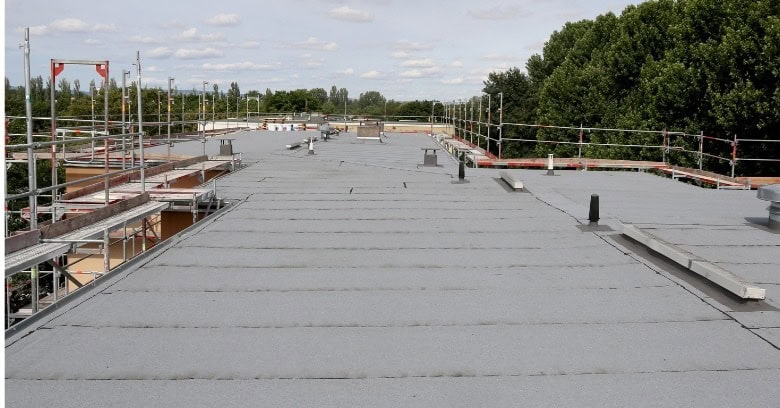
It’s hard to judge a roofing material you’ve never seen up close, and harder still when the bids use terms like “60-mil” and “fully adhered” without explaining them. This page explains them in plain terms, so you can ask good questions and choose with confidence.
APC Roofing installs and repairs TPO on homes and commercial buildings. We’re GAF Certified, licensed and insured, and estimates are free. Call 913-398-5020 to talk through your roof.
What TPO roofing is
TPO stands for thermoplastic polyolefin. It’s a single-ply membrane, meaning one waterproof sheet covers the roof instead of several stacked layers. It comes in wide rolls, and it’s usually white.
The big difference from other flat roof materials is how the seams are made. TPO seams are welded. A hot-air welder melts the edges of two overlapping sheets so they fuse into one piece. A good weld is as strong as the sheet itself, and that matters because seams are where most flat roofs leak.
Why TPO roofing works well in Republic and southwest Missouri
It keeps the roof cooler in summer. A white TPO surface reflects much of the sun that a dark roof would soak up. If there’s a room, shop or office right under the roof, it can feel the difference on a July afternoon, and your air conditioning doesn’t have to work as hard.
Welded seams resist water. Because the seams are fused rather than glued, they hold up well when water sits on the roof for a while after a storm.
It works on homes and businesses. TPO fits a small porch or garage roof as well as a large commercial roof. Our flat roof installation in Republic page covers residential low-slope roofs, and commercial roofing in Republic covers business buildings.
How TPO handles Missouri weather
Hail. Hail is the biggest threat to any flat roof here. Thicker TPO resists punctures better than thinner sheets, and a hard cover board under the membrane helps it shrug off impacts. Ask about both if hail is your main concern.
Cold. TPO gets stiffer in winter. That doesn’t hurt a properly installed roof, but it’s one reason some owners in colder areas prefer EPDM. Welding TPO seams can be done in cool weather, while some adhesives used to bond it down need warmer temperatures to cure.
Heat and sun. The white surface holds up to UV and keeps the membrane cooler, which slows aging. It does get dirty over time, and a dirty roof reflects less, so an occasional gentle cleaning helps.
Choosing a TPO thickness
TPO is sold by thickness in mils, which are thousandths of an inch. The common options are 45, 60 and 80 mil. Thicker membrane costs more, and it gives you more material to resist hail, foot traffic and weathering. For many roofs, 60 mil is a sensible middle choice. If people walk on your roof often or hail is a big concern, ask about 80 mil.
How a TPO roof is installed
- The old roof is removed or prepared. On a tear-off, the deck gets checked and soft or damaged sections are replaced.
- Insulation and cover board go down. Tapered insulation can add slope so water drains instead of ponding.
- The membrane is attached. It’s either mechanically fastened with plates and screws, or fully adhered with adhesive. Edges and corners get extra attention because that’s where wind pulls hardest.
- Seams are welded. Each seam is heat-welded, and a careful installer checks every weld with a probe.
- Flashing and edges are finished. Walls, curbs, pipes and drains get TPO flashing, and metal edge trim is secured at the perimeter.
TPO or EPDM?
Both are good flat roof materials. TPO is white, reflective and welded. EPDM is black rubber with taped or glued seams, and it stays flexible in cold weather. For a roof over living or working space that gets hot in summer, TPO’s reflectivity is a strong argument. For a simple roof where cold-weather flexibility matters more, EPDM can be a good choice. Your estimate should explain which fits your roof and why.
Repairing a TPO roof
TPO can be repaired with a welded patch. On an older roof, the surface first has to be cleaned and prepared so new material will bond to it. Common repairs include re-welding a failed seam, patching a puncture or reflashing around a pipe or curb. If your TPO roof is leaking, our flat roof repair in Republic page covers how leaks are traced.
How it works
- Book your free inspection. Call 913-398-5020 or request a free estimate online. We’ll look at your current roof, its drainage and what’s under it.
- Get a clear, honest assessment and estimate. You’ll get photos, a recommendation on whether TPO fits your roof, the thickness we suggest and a written estimate.
- Your roof gets installed and the site gets cleaned up. The new TPO goes on, the seams are checked and the area is cleaned up.
Financing is available through Aqua Finance, Fortifi, Hearth and Home Run Finance.
TPO roofing questions
Is TPO good for a house?
Yes, on low-slope sections like porches, garages, carports and additions. It isn’t used on steep roofs, where shingles or metal are the right choice.
Can TPO go over my existing roof?
Sometimes, if there’s only one existing roof and it’s dry and solid. If the old roof is wet or there are already two layers, it should come off.
Does TPO need maintenance?
Not much. Keep drains and gutters clear, keep foot traffic down and have the roof checked after major hail storms.
What color does TPO come in?
White is the most common and the most reflective. Gray and tan are also made.
Find out if TPO is right for your roof
Call 913-398-5020 or book your free estimate online. You’ll get a straight answer about whether TPO fits your building, and a roof that stays watertight and keeps the space below cooler in summer.


















