The shingles on your roof are curling at the edges, the gutters are full of granules, and every windy storm seems to leave a few more tabs lying in the yard. You’ve decided it’s time for a new roof, and you’d like installers you can trust to do it right. A good shingle roof installation in Palm Coast is about more than the shingle you pick. Most of what decides how it handles the next hurricane season happens in how it’s put on.
Hiring a roofer can feel like a leap of faith. You won’t see the nails, the underlayment or the starter rows once the job is done. You deserve to know what should be happening up there before you sign anything.
APC Roofing is a GAF Certified contractor, licensed in Florida (CCC1337030) and insured, and we’ve installed roofs since 2017. Your inspection and estimate are free.
Architectural or 3-tab shingles?
Three-tab shingles are the older, flat style, a single layer cut into three tabs. They’re lighter and simpler, and the choices have narrowed as manufacturers have moved away from them.
Architectural shingles, also called laminated or dimensional shingles, are made of two bonded layers. They’re thicker, they give the roof more depth and shadow, and most carry higher wind ratings than 3-tab. That’s why most homeowners here choose them now. Our architectural shingle roofing page goes into more detail.
What makes a shingle roof hold in coastal wind
Palm Coast sits right on the Atlantic, so wind is the main test for a shingle roof here. Hurricane season runs June 1 through November 30, and fall nor’easters bring their own stretch of gusty, rainy days.
Wind-rated shingles. Ask what wind rating the shingle carries and what installation it requires to get that rating.
The nailing. Each shingle has a nailing line, and nails have to land on it, driven flush, not crooked or overdriven. In high-wind areas, manufacturers usually call for more nails per shingle. A shingle nailed too high or too few times is the one that blows off first.
Starter strips at the eaves and rakes. The first row at the roof edge has a sealant strip that locks the edge of the first course down. Edges are where wind gets underneath, so this row matters more than its size suggests.
The seal. Each shingle has a strip of adhesive that the sun softens to bond it to the one below. In Florida heat, that seal sets quickly. Once a shingle’s seal breaks in a storm, it’s much easier to lift next time.
Under the shingles
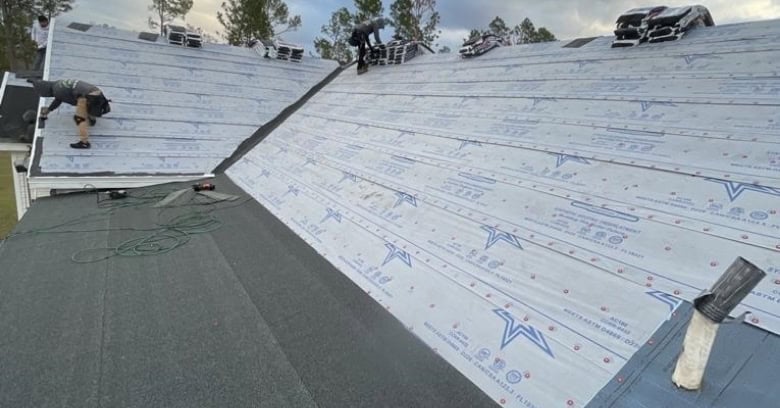
The roof starts with the deck. The old roof comes off, and any soft or rotted plywood is replaced and loose boards re-nailed. Drip edge goes along the edges. Underlayment goes over the whole deck, with self-adhering membrane in valleys, along the eaves and around penetrations, and often across the full roof on Florida homes, so there’s a second line of defense if shingles are ever torn off.
Pipe boots are replaced with new ones, and wall and chimney flashing is installed in the right order with the shingles so water runs over each joint.
Tear off or install over the old shingles?
Laying new shingles over an old layer skips the tear-off, but it hides the deck, adds weight and gives the new shingles a lumpy base that doesn’t seal as well. On most homes, a full tear-off is the better choice, because it’s the only time anyone gets to see and fix the deck.
Color, algae and the Florida sun
Lighter shingle colors reflect more sunlight and can keep the attic a little cooler. Darker colors absorb more heat. Many shingles now come with algae-resistant granules that slow the black streaks so common on humid Florida roofs.
Look at full-size samples or a finished roof in daylight before choosing. Small swatches often look different once they cover a whole house.
How it works
- Book your free inspection. Call 386-259-8425 or request a free online estimate.
- Get a clear, honest assessment and estimate. We inspect the roof and the deck from the attic, help you choose a shingle and color, and give you photos and a written estimate. Financing is available through Aqua Finance, Fortifi, Hearth and Home Run Finance.
- Your new roof goes on and the site gets cleaned up. Many residential projects are finished in a single day, and the crew cleans up before leaving.
An old shingle roof that’s shedding granules and losing tabs won’t get better on its own. Each storm takes a little more, and leaks that reach the deck turn a straightforward replacement into a bigger one.
Shingle roof installation questions from Palm Coast homeowners
How long does a shingle roof installation take?
Many residential shingle roofs are finished in a single day. Larger or steeper roofs, or decks that need a lot of repair, can take longer. You’ll get a realistic timeline with your estimate.
Can new shingles go over my old ones?
Sometimes, but on most homes a tear-off is the better choice. It lets the deck be checked and repaired, and the new shingles lie flat and seal properly.
What shingle color is best for Florida heat?
Lighter colors reflect more sunlight and absorb less heat. Darker colors can look great but run hotter. Pick the color you like, then check it on a full-size sample in daylight.
Is it worth upgrading to architectural shingles?
For most Palm Coast homes, yes. They’re thicker, usually carry higher wind ratings and look more dimensional than 3-tab shingles.
Book your shingle roof installation in Palm Coast
Call 386-259-8425 to book your free inspection, or start online. You’ll end up with a roof that’s nailed and sealed for coastal wind, a dry attic through the next storm season and a clear sense of what you paid for. If you only need a few shingles fixed, see our shingle roof repair page, or browse all our Palm Coast shingle roofing services.