
Searching for Emergency Roofing in Ocala Florida?
APC Roofing takes on anything from a checkup to a full replacement, on asphalt, steel and clay coverings alike.
Dial 407-270-1129, and a roofer comes out to see the house firsthand.
What Keeps a Roof Working: the Working Structure
The surface a passerby notices is only the outer layer, and underlayment, decking and rafters sit beneath the surface. Bent metal covers the gap at a chimney, a pipe or a valley, and water there rarely traces back to worn shingles close by.
Ventilation in the attic ranks as one more working part of the roof, since heat and humidity held there wear down the wood and covering overhead. A drip inside a bedroom can come from any level of the roof, and work confined to the outside can miss the real source.
Everyday Work of a Roof: an Owner's Overview
A sloped covering sheds every storm's water downhill, while nails and seal strips resist the pull of gusts. The trusses and sheathing support the load above, snow included at the colder end of our territory, and intake and exhaust let the attic breathe.
Water is a job for the covering, and wind is a task for the fastening, while what is underneath holds the whole thing steady, out of sight. A problem in one material reads as damage on a different part of the roof, and a lasting fix reaches back to where the fault began.
The Minor Pieces of a Roof: Different Timelines
Most of the slope is designed to hold up for decades, but the flexible seal around a stack splits well before the shingles do. A path opens for water to travel down into the house, and paint bubbles on the ceiling below.
Caulk along a wall joint hardens and pulls away in the heat, and metal flashing rusts at bends and cut ends. Shingles bent into caps split at the seam, as nothing shelters the peak from gusts and glare.
A Walk Around the Property Beforehand: Standing Back and Then Closer
Seen from the sidewalk, the shape of the roof shows dips, sags and wavy planes, and the fascia and gutter runs are visible at the same time. Through binoculars, torn collars, lifted tabs and bare patches come into focus, but a weak spot underfoot tells what optics cannot.
Moving across the planes, a roofer tests every connector and traces every flashing joint, and every course is checked for edges that have come loose. Nobody walks a covering that is wet or too steep, and a ladder at the edge serves as the lookout instead.
The Underside of a Roof: What Owners Can Find
A tide line on a rafter shows where rain has entered, and moisture felt by hand shows the water is still coming through. Light passing through the decking reveals a breach, and the distance from the ridge and gable gets measured so the spot can be found outside.
Rust on the nail shanks comes from moisture in the house, not rain, and a compressed, faded patch nearby points to the same cause. A blocked eave packed with fill, or a bathroom fan venting into the attic, shows up only on an inside look, so a yard-only look passes over faults like that.
A Homeowner's Take-Away: the Basics
The visit produces photographs linked to particular spots on the roof, and a note explains what each picture shows. Parts in fine shape are covered as plainly as parts that are not, and faults are ordered from most to least pressing.
A saved report from an earlier stop gives the next check a baseline, and movement across seasons reads more directly than one day's condition. A roof tracked across each year brings few surprises, and a big repair signals trouble long before the work is urgent.
Maintenance Tasks: What Gets Done
Worn pipe gaskets get swapped out before failure, and aging caulk at skylights gets cut out and redone. Anything the trees drop gets brushed out of the channels, and the gutters get kept running and secured.
A loose piece fastened back promptly stays a minor task, but delay through the wet months lets water get in from below. Moss along a north-facing slope wedges under the laps, and a gentle wash clears the growth, since a pressure washer strips granules.
The Habit Worth Keeping: The Payoff
A trade professional should cover the roof on a yearly basis, set for just after the roughest local weather each season. Catching things early is the whole point of a regular check, and the family hears plainly where the roof stands.
Between checks, a glance from the lawn after a storm is useful, and top-floor rooms are worth checking for fresh stains. A few minutes under the deck with a lamp each season pay off: soft wood, tiny bright spots and soggy insulation surface long before anything reaches the space below.
The Age of a Roof Seen From the Ground: What the Years Bring
Brand-new shingles look dark and consistent across every slope, and around the midpoint the sun-facing plane grows paler sooner than the rest. Near the end, corners curl and granules gather in the gutters, and a repair rarely holds for long at that stage.
An impression formed from outside has real value, but a ladder and a closer look tell the fuller story. A worn-out field is past the point where patching helps, and a good contractor gives that answer plainly, rather than selling another repair.
The Channel at the Bottom: the Basics
Shingles hand off rainfall at the drip edge and no farther, and the gutter picks up the flow at the edge. A channel hung the wrong way holds a pool against the house, and the material there softens over time.
A weak patch there usually traces to a stopped-up drain, not the shingles, and new shingles will not cure a fault of that kind. Gutter fall and downspout placement get checked together, and the drip edge gets looked over where the metal meets the fascia line.
What Ventilation Is For: An Overview
Cooler air should enter through the soffit and rise out at the ridge, and the draft clears warmth and humidity from under the sheathing. Where the opening gets sealed off, the attic runs hot in summer and stays sticky through humid stretches, and the deck and shingles suffer early.
A powered fan with too little inlet area draws cooled air through the ceiling, and one high point pulling toward a nearby high point can choke flow at the soffits. Reroofing with poor airflow left alone carries the fault forward, so the fix belongs in the same job as the new covering.
Roofing That Fits Where You Live: What Shifts From Place to Place
Toward the colder end of our territory, frozen gutters and heavy snow set the priorities, so an adhered barrier goes under the lowest rows. Closest to the ocean, gusts decide how the covering gets anchored, and impact-and-wind-rated shingles and sealed seams get chosen.
In the hail-prone part of our range, at the colder end, a tougher product deserves a look, while sun and heat age coverings everywhere we work. Every material choice answers to the weather at that house, not routine or whatever was used on the last job.
Homes and Businesses: One Steep, One Flat
A sloped covering sheds rain by lap, and the material is commonly shingle, tile or metal panels. Most commercial buildings use a single-ply or built-up membrane, and internal drains and heating units share space on that roof.
Some houses have a gently sloped patch over a back room, and a shingled surface there lets rain linger long enough to work under the courses. A spot like that needs a welded or adhered membrane, laced under the pitched covering above, and another layer of shingles there brings back the same problem.
Tarps and Emergency Covers: What Holds Up
A secured sheet keeps rain out while repairs get scheduled, but nothing gets solved underneath. A sound cover sits over the ridge and gets held down by wood battens screwed through the material, and enough tension keeps gusts from finding any slack.
A sheet cut too small leaves the edges of the opening exposed, because rain travels sideways toward a gap that stops short. Film left in place for months holds heat and humidity against the deck, and whatever sits below begins to suffer.
Vertical Joints on a Roof: the Proper Method
Along a wall, one bent piece of metal goes in under every course, and trim set higher up sheds water past that metal. Every chimney needs an apron at the front and metal carried up across each edge, and a broad stack gets a diverter built into the roof behind.
Tar smeared over a gap gives way as the metal moves, and only a correct rebuild ends things for good. Crumbling mortar lets rain soak into the masonry higher up, and some leaks like that need a mason as well as a roofer.
Getting the Scope in Writing: Items to Expect
A detailed listing names each material going on the roof, and the document says whether the existing roof gets stripped to the deck. The account explains how rotten decking gets handled if any turns up, and the metal, the ventilation and the yard cleanup are each called out.
Bids laid out in full are easy to check against each other, and what one write-up covers and another skips becomes obvious. A roofer who waves off the specifics gives no genuine protection, and memory is a poor record of what got agreed.
What a Re-Roof Involves: Start to Finish
Anything near the eaves that could get damaged gets protected ahead of time, and the existing covering gets removed completely. The bare deck gets checked plane by plane once the old covering is off, and any spongy spot gets swapped for new stock.
Ice barrier, underlayment and new flashing go down across the deck, and the main covering, the ridge line and the vents finish the work. The yard and drive get a magnetic sweep before the crew leaves, and no debris gets left in the gutters.
Beyond the Shingle Roof: Details by Material Type
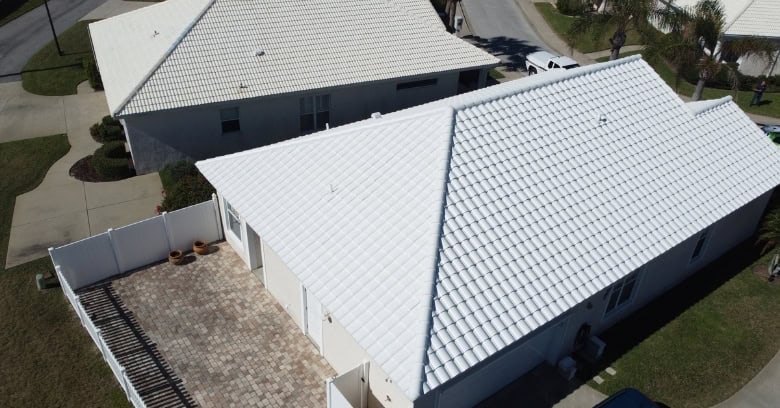
Exposed-fastener metal panels seal at a rubber gasket under every fastener, and a cracked washer gets replaced along with a fresh screw. Tile in our markets gets set by several methods, including mortar, foam adhesive and mechanical clips, and the underlayment handles the water, not the surface material.
Weight placed wrong breaks a piece, and a matching replacement goes in wherever one gives way. On the shallow parts of a roof, lingering water and loose seams are worth watching, and debris gets cleared from drains and scuppers.
Warning Signs Around a House: Caught Early
- Sand-like mineral grains in the gutter runs, from a covering that is no longer new.
- Curled or lifting edges on the courses, most visible on the sunniest slope.
- A hardened gasket at a stack, easy to spot with binoculars.
- Discoloration on a bedroom ceiling, still visible once dry.
- Light glowing between the planks, spotted during a flashlight check.
- Moss packed into the laps, pushing up the lower edges of the shingles.
- A hollow spot in an otherwise even stretch, widening a little each season.
- Dried beads separating at a skylight, easy to spot from the yard.
Emergency Roofing Around Ocala Florida: APC Roofing's Approach
Before a scope gets drawn up, a roofer examines the whole covering and the attic, and the report shows up as photographs and a clear written account. Solid parts get described as directly as weak ones, and the choice of what to do next stays with the homeowner.
Emergency Roofing Around Ocala Florida: a Full Look, Not a Guess
Get in touch at 407-270-1129 to arrange a visit on site.
A Roof's Own History: Best Done Early
Noting when the covering went on, along with the brands used, is worth doing, and adding every inspection report to that folder grows the file. Listing every fix, the place and the scope, takes only a minute, and after several years the weak spots become obvious.
When a house goes up for sale, a buyer's inspector asks about the roof, and a documented account settles the matter later. A second copy of the file, kept somewhere else, is worth having, in case the paper sheets go missing in a move.
What Good Work Looks Like: Quality You Can See
The field reads as straight bands, with crisp cuts where each slope ends, and no nail head shows on the finished surface. The wall joints carry new flashing, tucked to match the way water runs, and any sealant appears sparing and neat.
The soffit vents breathe freely and the ridge vent stays clear, and the gutters return to position, clean and fastened. No nails or scraps get left in the grass or on the drive, and sawdust near a cut line is the most common leftover once the work wraps up.
Anyone comparing options for Emergency Roofing in Ocala Florida does not have to keep guessing about next steps. Contacting APC Roofing at 407-270-1129 moves the scheduling forward. Every visit looks at the roof as a whole, not one spot alone, and no part of the roof goes unchecked.
Verified

Verified
Verified
Verified
Verified


















