
Someone looked at your flat roof and said “you should go with TPO.” Maybe it was a contractor, maybe a neighbor who just had their porch roof redone. Now you’re trying to figure out what TPO actually is, whether it holds up to Kansas City hail and winters, and whether it’s worth paying for over the alternatives.
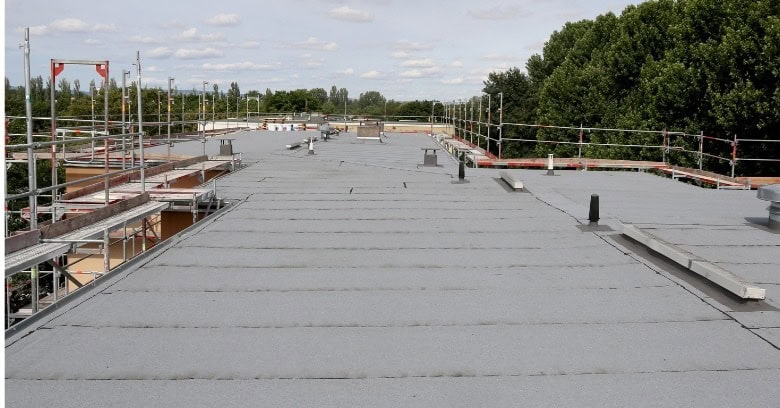
TPO roofing in Lee’s Summit is a good fit for a lot of low-slope roofs, on homes and businesses alike. It isn’t the answer for every roof, and you should know the difference before you sign anything.
APC Roofing is GAF Certified, licensed and insured, and we’ve been in business since 2017. If you’d like someone to look at your roof and give you a straight answer, call 913-398-5020 for a free inspection.
What TPO is
TPO stands for thermoplastic polyolefin. In plain terms, it’s a single-ply roofing membrane: one thick, flexible sheet that covers a flat or low-slope roof in wide rolls. Most TPO is white.
What makes it different is how the seams are joined. The edges of two sheets overlap, and a hot-air welder melts them together into one continuous piece. A well-made welded seam is often as strong as the sheet itself, which matters because seams are where most flat roofs leak.
How TPO handles Lee’s Summit weather
Summer sun. The white surface reflects much of the sunlight that would otherwise heat the roof. On a building or a room directly under a flat roof, that can make the space more comfortable and take some load off the air conditioner in July and August.
Hail. Kansas City-area hailstorms can bruise or puncture any roof membrane. A thicker TPO sheet and a firm cover board underneath give the roof more resistance. After a big storm, it’s worth having a TPO roof checked, because small punctures don’t always leak right away.
Winter. TPO stays reasonably flexible in cold weather, and welded seams don’t rely on adhesives that can struggle in the cold. Snow and ice still sit on any flat roof, so good drainage matters more than the membrane choice.
Wind. Strong thunderstorm gusts pull hardest at roof corners and edges. A TPO roof needs tighter fastening and solid metal edging around the perimeter to stay put.
TPO vs. EPDM and other flat roof options
EPDM is the main alternative. It’s a black rubber membrane that’s been used on flat roofs for decades and stays very flexible in cold weather. Its seams are joined with primer and tape instead of heat. Learn more on our EPDM roofing in Lee’s Summit page.
The short version: TPO is usually white, with heat-welded seams, and it reflects summer sun. EPDM is usually black, with taped seams, and it absorbs heat but stays more flexible in deep cold. Both are proven on Kansas City-area roofs.
Built-up roofing (layers of felt and asphalt, often with gravel) is a third option, mostly on commercial buildings. Each has a place. The right choice depends on your roof’s slope, drainage, structure and how it’s used, and we’ll explain our recommendation instead of handing you a one-size answer.
Where TPO roofing in Lee’s Summit makes sense
On homes, TPO is a common choice for:
- Porch and patio roofs
- Garage and carport roofs
- Additions and sunrooms with low-slope roofs
- Low sections of a larger roof where shingles keep leaking
On businesses, it shows up on offices, retail buildings and warehouses with large flat roofs. If you own or manage a commercial building, see our commercial roofing services in Lee’s Summit.
What goes into a TPO installation
The membrane is the top layer. Under it, there’s usually rigid insulation and sometimes a cover board, laid over the roof deck. On a roof that doesn’t drain well, the insulation can be tapered to create a gentle slope toward the drains or gutters.
The sheet is held down by mechanical fasteners, by adhesive across the whole surface, or a mix of both. Fasteners get closer together at the corners and edges. Then every seam is welded, and each wall, pipe, curb and edge gets its own flashing detail.
That detail work is where a TPO roof succeeds or fails. A bad weld or a skipped corner patch can leak even when the rest of the roof is brand new. For the full install process, see our page on flat roof installation in Lee’s Summit.
Repairing an existing TPO roof
TPO can be repaired by welding a new piece of membrane over a damaged area, as long as the existing sheet is clean and still in good condition. Older TPO that’s gotten dirty or weathered needs careful prep so the patch bonds. If a seam has opened, it can often be re-welded.
When the membrane has shrunk away from the edges, cracked across large areas or has wet insulation under it, replacement is usually the better value. We’ll show you photos and tell you which situation you’re in. If it’s a repair, our flat roof repair team in Lee’s Summit handles it.
How it works with APC Roofing
- Book your free inspection. We check the roof surface, seams, edges and drains, and look for signs of moisture underneath.
- Get a clear, honest assessment and estimate. You’ll get photos, a written estimate and an honest recommendation, TPO or not. Financing is available through Aqua Finance, Fortifi, Hearth and Home Run Finance.
- Your roof gets done and the site gets cleaned up. The crew installs or repairs the roof and cleans up before leaving.
A flat roof that’s already leaking tends to get more expensive the longer it waits, since water spreads through the insulation and into the deck below.
TPO roofing questions
Is TPO good for a residential flat roof?
Yes, on many homes. It’s a common choice for porches, garages and additions in the Lee’s Summit area, especially where summer heat is a concern.
Can TPO be installed in winter?
Often, yes. The seams are heat-welded, so cool weather is less of an issue than it is for adhesive-based systems. Snow, ice and rain on the roof still have to be planned around.
Does hail damage TPO roofs?
Large hail can bruise or puncture TPO, like any membrane. A thicker sheet and a solid cover board help. If your area just had a hailstorm, a free inspection will tell you whether the roof was damaged.
What if my TPO roof was damaged in a storm?
You file the claim with your insurer and pay your deductible. We document the damage, provide a written estimate and work with your adjuster.
Talk to us about TPO
Call 913-398-5020 or request your free estimate online.
When it’s done right, a TPO roof is one you mostly forget about: a cooler room under it in summer, no drips in spring, and confidence that the money went into the right roof for your house or building.


















