You’ve decided it’s time for a new roof. Now the worry shifts. Once the shingles are on, you can’t see whether the work underneath was done right, and you won’t find out until a hailstorm, an ice dam or a hard summer wind tests it. A good roof installation in Kansas City comes down to details that are buried by the end of the day.
You don’t need to become a roofer to judge the work. It helps to know what should happen at each layer, so you can ask good questions and compare bids that look alike on paper.
APC Roofing is a GAF Certified contractor, licensed and insured, and in business since 2017. Inspections and estimates are free, and many residential installs are finished in a single day. Call 913-398-5020 to get started.
What a lasting roof installation in Kansas City looks like
Here’s what goes on, from the wood up, and why each step matters in this climate.
Solid decking
Once the old roof comes off, the plywood or boards underneath get checked. Soft, rotted or delaminated pieces are cut out and replaced. Nails driven into weak wood pull loose, and a strong wind finds them fast. If the old roof was a second layer over a first, this is often where hidden damage shows up.
Ice and water barrier
This sticky, self-sealing membrane goes down first along the eaves, in the valleys and around chimneys and walls. It seals around every nail that goes through it. In a Kansas City winter, when ice dams push water back up under the shingles, this layer is what keeps it out of your house. It runs from the roof edge up past the line of the wall below, since that cold overhang is where ice dams form, and on low slopes it often goes farther.
Underlayment
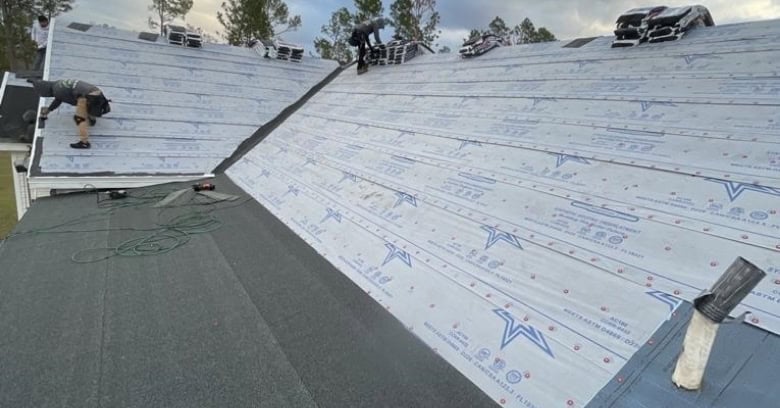
The rest of the deck is covered with synthetic underlayment, lapped so that each row overlaps the one below it, just like the shingles will. It’s a second line of defense when wind drives rain sideways under the shingles.
Drip edge
Metal drip edge runs along the eaves and rakes so water drops cleanly into the gutters instead of curling back onto the fascia. Plenty of older Kansas City homes never had it, and the rotted fascia boards show it.
Starter strip and nailing
A starter row along the edges gives the first course of shingles something to seal to. This is where wind damage usually begins, so the starter and nailing pattern matter here. Shingles go on with the number and placement of nails the manufacturer calls for, which is often more nails in areas that see strong wind.
Flashing
Every place the roof meets a wall, chimney or pipe gets new flashing. Step flashing is woven in with the shingles along walls, and counterflashing is set into chimney mortar joints so water can’t get behind it. Reusing old, rusted flashing to save a few minutes is one of the most common causes of leaks on newer roofs.
Valleys
Valleys carry more water than any other part of the roof. They’re either lined with metal and left open, or the shingles are woven or cut across them. Both work when done right over an ice and water barrier.
Ventilation and ridge caps
Air should come in low at the soffits and leave high at the ridge. That airflow keeps the attic cooler in summer, which helps shingles last, and colder in winter, which helps prevent ice dams. Bathroom and kitchen fans should vent outside, not into the attic. Ridge caps go on last.
Low-slope sections need a different material
If your house has a nearly flat roof over a porch, sunroom or addition, shingles aren’t built for it. Water moves too slowly and works its way under the laps. Those sections get a membrane such as TPO or EPDM tied in with the main roof. Our flat roof installation in Kansas City page explains the options.
Choosing what goes on top
Most Kansas City homes get architectural shingles, and impact-resistant shingles are worth a look if hail is your main concern. See shingle roof installation in Kansas City for details. If you’re thinking about switching to steel, metal roof installation in Kansas City covers that project.
What install day looks like for you
You can stay home, but it’ll be loud. A little prep helps:
- Move cars out of the driveway and garage the night before
- Take down pictures and shelves on walls that share framing with the roof
- Keep pets and kids inside or away from the work area
- Cover anything stored in the attic, since some dust will fall
Many residential roofs are finished in a single day. Larger or steeper roofs, or ones with a lot of decking to replace, take longer, and your estimate will say so. When the work is done, the site gets cleaned up.
How roof installation works with APC Roofing
- Book your free inspection. Call 913-398-5020 or request a free online estimate.
- Get a clear, honest assessment and estimate. We measure every slope, check the decking and ventilation and give you a written estimate with photos. If you’re still deciding whether to replace at all, our roof replacement in Kansas City page can help.
- Your new roof goes on and the site gets cleaned up.
Financing is available through Aqua Finance, Fortifi, Hearth and Home Run Finance.
Roof installation questions from Kansas City homeowners
Can a new roof go over my old shingles?
Sometimes, if there’s only one layer and the decking is sound. A tear-off is usually the better choice, because it’s the only way to see and fix what’s underneath.
Can a roof be installed in cold weather?
Yes, with care. Shingles have a strip that seals in the sun’s heat, and in cold weather that seal can take longer to set. On cold-weather jobs, shingles are sometimes hand-sealed to hold them down until it warms up.
How do I know the hidden layers were done right?
Ask for photos during the install, especially of the decking, ice and water barrier and flashing. A contractor who does the work right shouldn’t mind showing it.
A roof that’s ready for whatever comes next
A new roof with a shortcut underneath often shows up as a leak a winter or two later, at a chimney or along the eaves. Fixing it then means pulling up good shingles to reach the bad layer.
Get it right the first time and you can stop thinking about the roof. Through hail season, ice and summer storms, the house stays dry and the decision feels like a good one. Call 913-398-5020 to book your free inspection.