You’ve decided it’s time for a new roof. Now you’re comparing estimates, and each one lists different materials in words you’ve never had to know: underlayment, ice barrier, drip edge, ridge vent. You want a roof installation in Kansas City that holds up to the next hailstorm and the next hard winter, and you’d like to understand what you’re paying for.
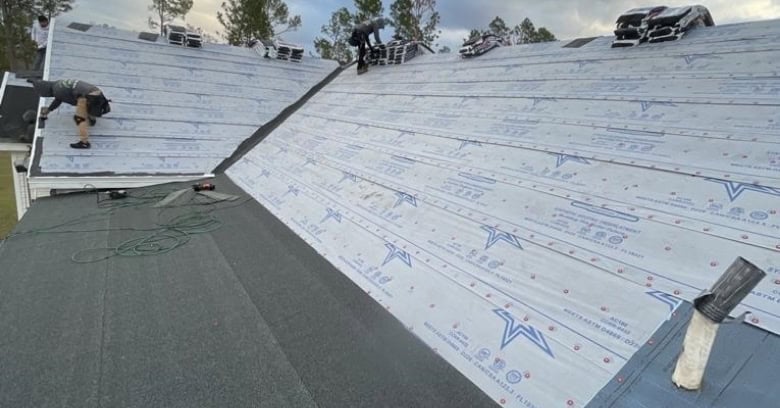
Most of what makes a roof last is hidden under the shingles. Once it’s covered up, you can’t check it. That’s why it helps to know what a good installation includes before the crew shows up.
APC Roofing is GAF Certified, licensed and insured, and has been installing roofs since 2017. Your estimate is free and spells out every layer. Call 913-398-5020 to have your roof measured.
Why a new roof starts with bare wood
A proper roof installation begins with a full tear-off, down to the wood decking. That’s the only way to see the deck and fix it. Boards that have gone soft from old leaks, delaminated plywood and gaps along the edges all get repaired or replaced before anything new goes on. New shingles laid over a bad deck won’t lie flat or hold nails well, and the problems underneath stay hidden until they leak.
Roof installation in Kansas City, layer by layer
Here’s what goes on between the decking and the shingles you see, in roughly the order it’s installed.
Ice and water barrier at the eaves and valleys
This is a self-adhering membrane that sticks directly to the deck and seals around every nail driven through it. In the Kansas City metro it matters most along the lower edge of the roof, where ice dams form in winter, and in the valleys, where water from two slopes meets. Some roofs also get it around chimneys, skylights and other openings.
Drip edge
A metal strip along the eaves and rakes guides water off the edge of the roof and into the gutter, instead of letting it wrap back under the shingles and rot the fascia. At the eave it goes under the underlayment. Along the rakes, it goes over it. Getting that order right keeps water flowing outward.
Underlayment
A synthetic underlayment covers the rest of the deck. It’s a second line of defense if wind ever lifts a shingle, and it keeps the deck dry during installation. Each row overlaps the one below it so water always runs downhill over the seams.
Starter strip
A row of starter shingles goes along the eaves and rakes before the first full course. It fills the gaps at the edge and gives the first row of shingles a sealant line to grab onto. Skipping it is one of the most common reasons edge shingles blow off in a windstorm.
Flashing
New step flashing goes along every wall, with one piece woven in with each course of shingles. Chimneys get new apron, step and counterflashing. Pipes get new boots. Reusing old, rusty flashing to save time is a shortcut that often leads to the first leak on a new roof.
Shingles or other roofing
The finished roof goes on last, nailed in the pattern the manufacturer requires. On most Kansas City homes that’s architectural asphalt shingles, though some homeowners choose metal. Low-slope areas over porches and additions get a membrane made for flat roofs.
Ridge cap and ventilation
The ridge gets cap shingles and, on many roofs, a ridge vent. That vent only works if the attic has enough intake at the eaves, so the soffits get checked too. Good airflow keeps the attic cooler in July and the deck colder in January, which slows ice dams and helps the whole roof age more slowly.
Choosing what goes on top
The right material depends on your home, your budget and how long you plan to stay. Architectural shingles are the most common choice here and come in many colors. Impact-resistant versions are built to take hail better. Metal costs more up front but sheds snow and handles wind well.
You’ll get our recommendation and the reasons for it, and the choice is yours. Learn more on our shingle roof installation and metal roof installation pages.
What installation day looks like
Many residential projects are finished in a single day. The crew protects your landscaping and driveway, tears off the old roof, repairs the deck, and installs the new layers in order. You’ll hear a lot of hammering, so it helps to park outside the garage and keep pets inside.
At the end of the day the crew cleans up the yard and driveway before leaving. Our post on how to prepare your home for a roof installation has a short checklist.
How it works with APC Roofing
- Book your free inspection. Call 913-398-5020 or request a free online estimate.
- Get a clear, honest assessment and estimate. We measure every slope, check the deck from the attic and give you a written estimate that names each layer.
- Get your new roof installed and the site cleaned up. The crew builds the roof in the order above, then clears away the old materials and debris.
Financing is available through Aqua Finance, Fortifi, Hearth and Home Run Finance if you’d like to spread out the cost.
Roof installation questions
Do I really need ice and water barrier in Kansas City?
Ice dams are common here in snowy winters, and the eaves and valleys are where they cause leaks. An ice barrier in those areas is a smart part of any new roof in this climate.
Can new shingles go over my old roof?
It’s sometimes possible, but a tear-off is usually the better choice. It lets the deck be repaired and new flashing and underlayment be installed properly.
Will I need new gutters with a new roof?
Not always. If your gutters are in good shape, they can stay. If they’re sagging or leaking, it’s easier to replace them at the same time, and we can talk through seamless gutters with you.
Is a roof installation different from a roof replacement?
They overlap. Replacement is the decision to take off an old roof. Installation is how the new one is built. If you’re still deciding, start with our roof replacement in Kansas City page.
A roof you don’t have to think about
The parts you never see decide how long the roof lasts. When they’re done right, you get a roof that rides out hail season and winter ice without drama.
Call 913-398-5020 to book your free inspection and get an estimate that lists every layer, or start online.