The flat roof over your garage, back addition or shop has been patched more than once, and there’s water sitting on it two days after every storm. Someone mentioned TPO, someone else said EPDM, and a third person wants to coat it. You want a straight answer on whether TPO roofing in Independence, MO is the right fix for your building, and what it takes to put it on properly.
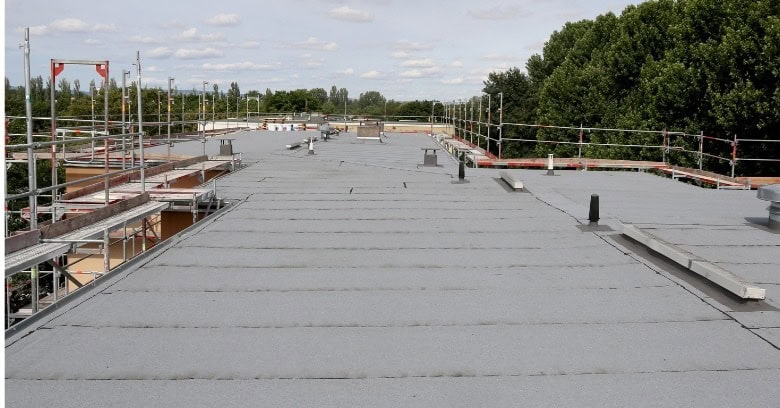
That’s a reasonable thing to want. A flat roof is hard to see, hard to judge from the ground and easy to get wrong, so it helps to understand the options before anyone starts pulling up the old one.
APC Roofing is GAF Certified, licensed and insured, and we’ve been in business since 2017. We repair and install flat and low-slope roofs on homes and light commercial buildings, and your inspection and estimate are free. Call 913-398-5020 to have someone walk the roof.
What a TPO roof is
TPO stands for thermoplastic polyolefin. It’s a single-ply membrane that comes off the truck in wide rolls, most often in white. The sheets are laid over insulation and a cover board, fastened or adhered to the deck, and then the overlapping edges are welded together with hot air. Once the seams are welded, the roof works as one continuous sheet.
That welded seam is the main reason people choose TPO. Seams are where most flat roofs leak, and a heat-welded TPO seam doesn’t rely on glue or tape to stay closed. A roofer can probe every inch of it after welding to check for gaps.
Why TPO roofing works in Independence weather
Independence gets both ends of the weather. Summers are hot and humid, and a dark flat roof soaks up that sun all afternoon. A white TPO surface reflects much of it, which keeps the roof cooler and can make the rooms or shop space underneath more comfortable.
Winters are the other test. Snow piles up on a flat roof, melts during a sunny afternoon and refreezes at night. Water that sits in low spots goes through that freeze-thaw cycle over and over, and it works on any weak seam or soft spot in the deck. Good drainage matters more here than almost anywhere else on the roof.
Then there’s hail. Kansas City area storms can drop hail hard enough to crack an older, brittle membrane or punch through at a seam. A newer membrane over a firm cover board holds up much better than an aging one over soft insulation. After a hailstorm, a flat roof is worth a look even if nothing is dripping yet.
TPO or EPDM for your flat roof?
Both are good single-ply membranes, and both are common on Kansas City area buildings.
TPO is usually white, reflects heat and has hot-air welded seams. EPDM is black synthetic rubber with seams that are joined with primer and tape. EPDM has a long track record and handles cold well, while TPO’s welded seams and reflective surface make it a strong choice for many homes and small commercial roofs.
The right pick depends on your deck, how the roof drains, what’s mounted on it and how the space below is used. You’ll hear our recommendation and the reason for it, and you make the call. If you’re leaning toward rubber, see our page on EPDM roofing in Independence.
What goes into a TPO installation
A TPO roof is only as good as the details around it. Here’s what a proper installation should cover, so you know what to look for in any estimate:
- Slope and drainage. Water needs a path to a drain, scupper or gutter. Low spots that hold water get corrected with tapered insulation or added drainage, not just covered over.
- Insulation and cover board. Wet insulation from the old roof gets replaced. A cover board under the membrane gives it a firm surface and helps against hail and foot traffic.
- Welded and probed seams. Every seam is welded and checked along its full length.
- Walls and curbs. The membrane turns up walls, parapets and around HVAC curbs, with metal termination and counterflashing above it.
- Edge metal. Wind pulls hardest at the corners and edges of a low roof, so the perimeter metal has to be fastened tight.
- Walk pads. If someone services an AC unit on the roof, a path of walk pads keeps boots and tools off the membrane.
Repair, recover or tear-off
Not every tired flat roof needs a new membrane. A puncture, a lifted seam or a failed flashing around a vent can often be fixed. Our flat roof repair page covers that side of things.
When the membrane is brittle, seams are failing across the roof or the insulation underneath is soaked, replacement makes more sense. In some cases a new TPO membrane can go over the existing roof with a board between them. That only works when the old roof is dry and there’s only one layer. Building codes generally limit how many roof layers you can have, and trapping wet insulation under a new membrane just hides the problem. A moisture check during the inspection tells you which route fits.
TPO for homes and small commercial buildings
On homes in Independence, TPO most often goes on porches, garages, additions and flat sections that tie into a pitched shingle roof. That tie-in is a common leak spot, so the membrane needs to run up under the shingles, not sit on top of them.
On small commercial buildings, the whole roof may be flat, with rooftop units, drains and parapet walls to work around. If that’s your situation, our commercial roof repair in Independence page has more.
How it works with APC Roofing
- Book your free inspection. Call 913-398-5020 or request a free online estimate.
- Get a clear, honest assessment and estimate. We check the membrane, seams, drains, edges and flashing, look for wet insulation and give you photos with a written estimate. If a repair will do, that’s what you’ll hear.
- Your roof gets done and the site gets cleaned up. The work is scheduled around dry weather, and the area is cleaned up when it’s finished.
If you’d like to spread out the cost, financing is available through Aqua Finance, Fortifi, Hearth and Home Run Finance.
TPO roofing questions from Independence property owners
Is TPO a good choice for a residential flat roof?
For many homes, yes. It’s common on porches, garages and additions, and the white surface helps in summer. EPDM is also a solid option, and we’ll explain which suits your roof.
Can TPO go right over my old flat roof?
Sometimes. The old roof has to be dry with only one existing layer, and a separator board goes between them. If the insulation is wet, the old roof needs to come off.
Does hail damage TPO?
Large hail can crack or puncture a membrane, especially an older one. A cover board under the membrane helps. After a big storm, have the roof checked even if you don’t see a leak.
What about insurance if a storm damaged my flat roof?
You file the claim with your insurance company and pay your own deductible. We document the damage with photos, give you a written estimate and work with your adjuster. Be wary of anyone who offers to waive or cover your deductible.
Get a straight answer on your flat roof
Water that sits on a flat roof doesn’t stay on top for long. Over a season or two it can soak the insulation and soften the deck, and then a simple repair turns into a bigger job. A quick look now keeps more of your options open.
Call 913-398-5020 to book your free inspection, or start your estimate online. You can also read more about flat roofing in Independence. The goal is a flat roof that drains, stays dry through the next storm and lets you stop checking the ceiling every time it rains.