Shopping for Flat Roof Installation in Deltona Florida?

APC Roofing installs and mends membrane coverings on houses, and on a residence the sheet usually covers a porch or a later addition.

Reach us at 386-356-2111 and a roofer will climb up and give you a plain account.


Runoff in Mind – a Question of Shape

What people call a flat roof is built to fall slightly toward an outlet, and codes commonly ask for at least a quarter inch of drop per foot. On some houses the framing provides the change in height, or tapered foam on the deck can supply the difference where carpentry never did.

On a steep roof a storm drains away in moments, whereas a near-flat surface takes far longer to empty, so minor defects see much more contact with water. A peaked saddle called a cricket parts the flow behind anything rising through the deck, so no pool can build on the uphill side.

Beyond What Shingles Handle: a Rule of the Trade

Asphalt tabs need at least two inches of rise per foot under building codes, and clay or concrete tile needs a steeper plane again. Under the limit, rain blown by wind creeps beneath the overlaps, and wet sheathing starts to rot.

Plenty of homes pair a shingle main roof with a membrane over the addition, with the product decided by the incline of each plane. A sheet covering acts as one sealed skin from edge to edge, so standing rain has no overlap to slip under.

The Main Membrane Types: Names Decoded

TPO and EPDM are single-ply products made in wide factory rolls, and modified bitumen uses polymer-enriched asphalt in smaller strips, and built-up roofing builds felt and tar in plies under stone. A light membrane asks little of porch and garage framing, and every join can be probed with a tool.

TPO is a plastic membrane usually made in white, and EPDM is a rubber sheet in black. The framing, the drains and the equipment above guide the selection, and we say what we recommend and why, and the homeowner chooses.

Joins Between Rolls: Care at Every Edge

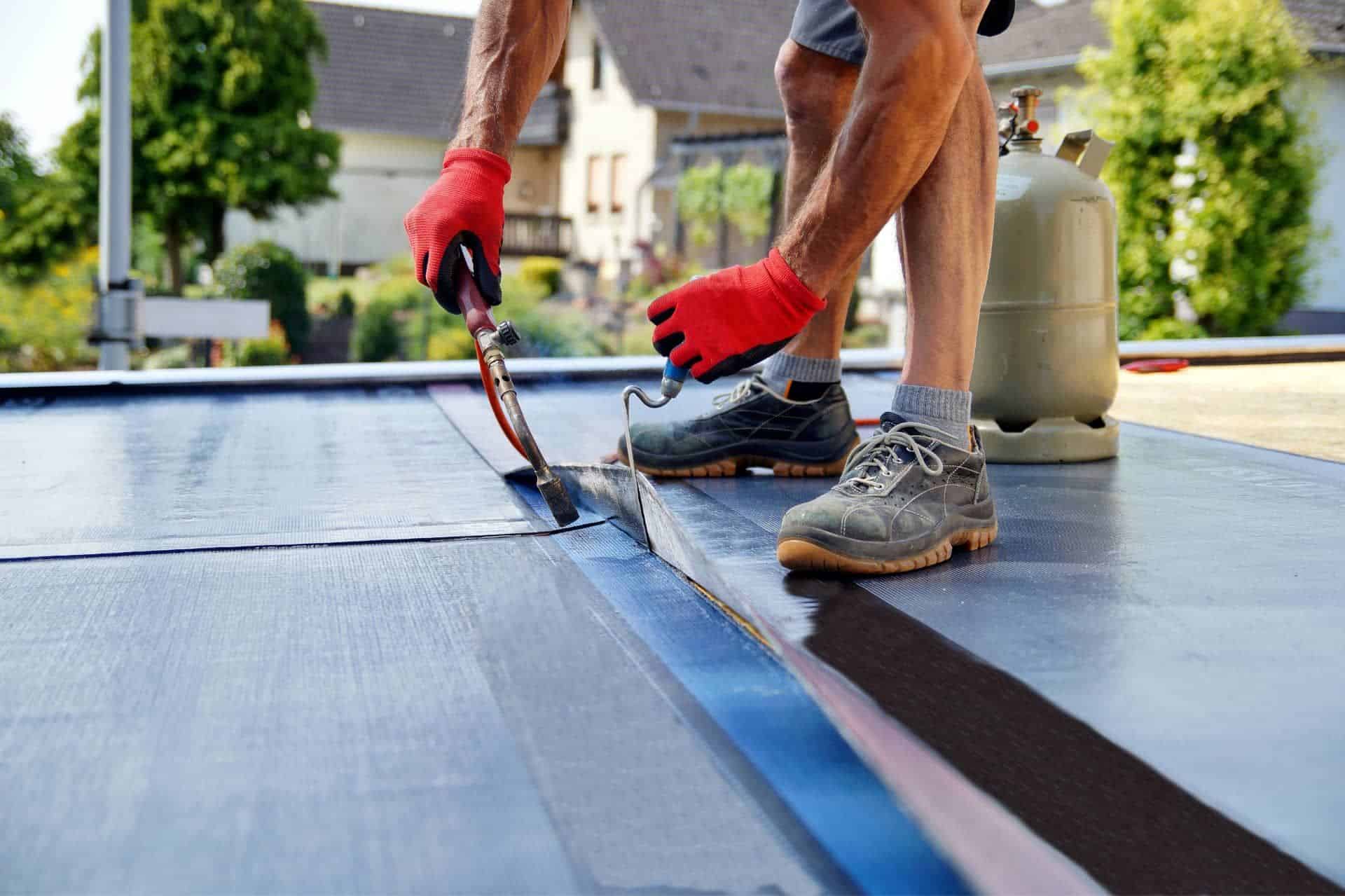
Across the open expanse, a membrane almost never fails, and the meeting lines between widths are where defects gather. On TPO, a hot-air welder melts the seams into one piece, and a dull hooked probe traced along the joint shows any gap.

Each EPDM lap is sealed with primer and tape, so a dusty or damp surface at installation undermines the grip. Weathered rubber joins commonly peel back at a corner, and a fresh cover strip across the gap restores the barrier.

Color Choices: Felt Indoors

A reflective TPO membrane throws back much of the solar heat, so the space below needs less cooling. EPDM in black takes in radiant energy, and the structure underneath stores warmth. A bright surface helps a lot in the hot parts of our service area, and the effect is smaller at the colder end of our territory.

Sheet Thickness: Suiting the Job

A mil, one thousandth of an inch, is the unit for membranes, and 45 and 60 are common on residential porches, and heavier rolls exist for hard service. A denser covering tolerates a dropped wrench far better, and the additional body holds up longer against sunlight. From the yard, a slim grade and a heavy grade look alike, so the proposal spells out the mil figure.

The Hidden Stack: Foam and Structure

Directly under the membrane, many roofs have a cover board, and a course of rigid insulation follows, and the deck at the base is usually plywood on a porch. Polyiso foam slows heat flow in both directions, and more thickness means a higher R-value. Drenched insulation quits performing and gets heavy, and trapped dampness under a sealed membrane has no way out. An electronic meter, an infrared camera or a test cut shows how far the problem spread, because the covering can look intact the whole time.

Joining the Shingles – a Mixed Detail

The membrane is carried up the steeper plane and under the asphalt, so water coming down ends up on the membrane. No part of the sheet's top edge faces the sky, and a sealant bead carries none of the job.

When the membrane is run on the bottom course, water slides beneath the lip, and a hard storm drives moisture into the framing. Wet drywall where the porch ceiling meets the house often leads back to a reversed junction, and the proper repair redoes the detail from the eave up.

Metal Trim – Held Tight

Uplift from gusts concentrates at the corners and the perimeter of a low roof, and a single gap can balloon the membrane and tear the sheet free. Bent metal grips the sheet all along the outside, and a drip lip turns runoff down into the gutter.

Where the membrane ends against a wall, a termination bar fixes the top in place, and a bead of sealant along the upper side keeps water from running behind, and counterflashing overhead shades the joint from rain. A kinked piece of trim or a backed-out nail is a repair job, because a reset is minor next to replacing a torn-away membrane.

Parapets and Copings – Masonry or Framing

The membrane turns up the inner face as base flashing, and counterflashing set higher overlaps the turned-up edge. Copings line the top of the parapet, with an inward slope that keeps rain off the exterior.

Where crest joints open up, rain runs down within the wall, and the stain may appear well below the opening. Masonry with open mortar lines also calls for repointing, and framed construction under stucco needs sealed corners and a tight top.

Drainage Hardware – Clear and Working

An inside outlet, a scupper or an edge gutter carries water off a low roof, and a clog at any opening backs water up. The interior drain rests in a shallow sump beneath a dome-shaped strainer, and a pipe takes the flow down through the house to the yard or a storm line.

The overflow scupper is mounted higher than the main outlet, and code requires another way out where parapets could trap water. On a maintenance visit, strainers and gutter throats get cleared of debris, and a loose dome gets fixed back over the drain.

Standing Pools: the Long View

Rain found on a membrane two full days after a storm is a defect in a roofer's eyes, and the source is a sunken deck or a stopped outlet. Days underwater wear out the sheet faster, and sediment and algae settle on the wet surface. Rain a few inches deep weighs enough to bow the framing slightly, so the dip deepens with every downpour.

A new membrane alone does not cure a roof that ponds, and the answer is tapered insulation, a cricket or an extra drain. The framing and the routes open to new piping decide the remedy, and a level laid across the low area confirms the plan.

Holes in the Field: Caught Early

A slim sheet can be nicked the week after installation, and a dropped screw or a dragged ladder foot is enough. At the colder end of our territory, big hailstones can split a brittle sheet, and broken limbs can slash a surface wherever trees overhang.

A small slit found quickly is handled with a patch, but a wet season of leaking waterlogs the insulation below. Pinholes are located by a slow walk over the full field, because a quick look from the ladder skips tiny punctures.

Paths to the Equipment: Guarding a Busy Strip

A membrane is made to keep out rain, not to carry people, and each trip out to the air conditioner on the roof leaves a little wear on the surface. Dense pads are welded or glued along the approach to the units, and the strips take the abrasion in place of the membrane. Where mechanical gear sits up top, the scope includes traffic protection, and heating and cooling crews are asked to keep to the marked lane.

Decking Up Top – Built to Come Apart

Pedestal-set pavers hold patio furniture clear of the membrane, and rain runs underneath to the outlets. Filled planters require a check on what the structure can bear, because wet earth weighs far more than dry earth.

Pavers come up individually without tools, so the membrane below can be reached without tearing anything out.

What Rises From the Deck – Flashing Every Protrusion

A vent pipe takes a molded boot of matching membrane, and a stainless clamp tightens the collar around the stack. Skylights and units are mounted on curbs framed up from the deck, and the membrane climbs each side beneath a metal cap. Brackets or bundled cables of odd shape go into a pitch pocket, which is a little dam of poured sealant.

With age the fill shrinks away and cracks, and a top-up is ordinary maintenance.

Local Repair or Full Replacement: How the Call Is Made

Leaks on a membrane generally come from one limited area, and a matching piece set over the gap closes the membrane properly. A TPO overlay is welded with hot air and checked with a probe, and on EPDM the cover is primed, taped and cut with rounded corners.

Replacement is the better choice once many seams are failing, or the membrane has hardened and split, or wide areas of insulation are saturated. We give a straight recommendation, and photographs and readings support the verdict.

Add a Layer or Start Clean: the Deciding Factors

A new membrane can go over an old roof with a separator board between, and code allows the method only where one covering is in place. An overlay only works over dry insulation, because moisture closed in continues to rot the wood below.

A tear-off takes all old material off the deck, and soft spots can be mended and given proper fall, and a roof with two coverings must be stripped by code. The route follows the meter readings and how many layers are there, and the findings are written up before any decision.

The Toll of the Years – Stretching the Useful Span

Ultraviolet light, daily heat swings and pooled rain break down a membrane gradually, and technicians walking to units scuff paths across the field. A yearly round of strainer clearing and pocket refills extends the working span, and quick patches over small cuts spare the insulation.

Clues Worth Heeding: What to Notice

  • A widening brown mark on the ceiling under the flat section, proof that rain has reached past the insulation.
  • A steady flow from the secondary scupper in a storm, usually because the main outlet is stopped.
  • Trim sitting loose after a blustery day, where the membrane can begin to peel.
  • A green film at the edge of the roof, which reveals runoff that never clears.
  • A drooping line above the porch from outside, an indication that pooled water is bending the deck.
  • Raised blisters spotted from a window over the membrane, brought on by trapped moisture or a failed bond.
  • Dark streaks on a wall below a parapet, commonly caused by open coping joints.
  • A wet stripe on the porch ceiling next to the house, which usually means the tie-in needs rebuilding.

How APC Roofing Works Through Flat Roof Installation in Deltona Florida – the Sequence Up Top

Our first check is the drainage, from each outlet to every low spot, and every lap is probed from one end to the other next. Afterward, the edge metal, parapets, curbs and pitch pockets are examined, and during an active leak, meter readings and a core cut test the insulation.

The report handed over is written and illustrated with photographs, and each component gets a plain verdict. Where mending makes sense, mending is what we suggest, and a membrane at the end of service is called out frankly.

Flat Roof Installation for Homes in Deltona Florida: Careful Membrane Work

Reach us at 386-356-2111 and we will set a time to come out.


Roof Coatings: Suitable and Unsuitable

Rolled or sprayed fluid can go over an existing membrane, and the liquid dries into one unbroken skin. A coat over a sound membrane adds reflectance and some years, but on a leaking roof the layer just paints over trouble.

Silicone keeps performing under ponding, but acrylic softens where puddles linger. Prep work beforehand is the larger share of the effort, because a layer over dust or chalky residue peels away. We tell you directly when a coating is a sensible choice, and when the membrane below needs more than a fresh surface.

Timing a Membrane Job: Why the Calendar Shifts

EPDM primer and tape bond only to a dry surface, and low temperatures slow the adhesive's grab. TPO welding with hot air handles brisk mornings well, but rain halts every kind of membrane installation.

A small patch fits a brief dry spell, whereas a full replacement needs several settled days. Any area opened during installation is sealed watertight before the crew leaves, so the interior stays safe overnight.

For help with Flat Roof Installation in Deltona Florida, call APC Roofing at 386-356-2111. A roofer checks the membrane, the drains and the perimeter, and the findings arrive in writing with the decision left to you.


Elaine Lee

Verified

★★★★★
I couldn’t be more pleased with the work done by APC Roofing. From start To finish, They were very professional, reliable, Incredibly efficient. The team Showed up on time, communicated clearly throughout the process, and completed the job exactly as promised. The quality of their work is outstanding. My roof looks great, and I feel confident, knowing it was done by such a skilled and trustworthy crew. They cleaned up everything throughly after the job was done, leaving no mess behind. It’s not often you come across a company that combines craftsmanship, integrity, and top-notch Customer Service, but this roofing company nailed it. I highly recommend them to anyone needing roofing work. They truly went above and beyond I’m grateful and thankful for Mike helping me through this process.

Glenn MacKinnon

Verified

★★★★★
APC Roofing did a great job replacing our roof damaged by Hurricane Helene. Our initial contact was with Anthony Fontan, sales rep/roofing expert who helped us successfully navigate the insurance claim and all actions necessary to have our roof replaced quickly. Anthony coordinated temporary repairs on the day after the hurricane. He always provided timely responses to our questions. Work to replace the roof started on schedule and was finished in two days. Site cleanup was well done and the end result exceeded our expectations. We would not hesitate to recommend APC to replace your roof. Make sure to ask for Anthony Fontan

bill lewin

Verified

★★★★★
Anthony was a great advisor and kept us informed during the process. I recommend APC and Anthony. Great job

Michael May

Verified

★★★★★
APC roofing installed a metal roof on my house. I'm highly pleased with communication, workmanship and crew. A real easy experience. The roof looks perfect and should last a lifetime.. Alan kept me posted through all the phases of process and made many options available. Want a quality roof and caring service ask for Alan.

Katty garcia

Verified

★★★★★
Good job!