
Your roof has been patched twice in three years, and now there’s a new stain on the bedroom ceiling. Or a spring hailstorm came through, the adjuster is booked for next week, and you’ve heard “full roof” from one person and “you’re fine” from another. You’re weighing a roof replacement in Blue Springs, MO, and before you sign anything you want to know whether it’s really time.
That hesitation is healthy. A new roof is one of the biggest bills a house can hand you, the damage is hard to judge from the yard, and after every storm there are crews in the neighborhood who won’t be around if something goes wrong next year. You deserve a clear answer, with photos, from people who’ll still pick up the phone.
APC Roofing has been in business since 2017. We’re GAF Certified, licensed and insured, and your inspection and estimate are free. Call 913-398-5020 and we’ll come take a look.
Signs your roof needs replacing, not another repair
Some problems are local. A lifted shingle, a cracked pipe boot or flashing pulled loose at the chimney gets fixed, and the roof keeps going. Replacement starts to make more sense when the wear shows up everywhere:
- Shingles curling or cupping across most of the roof, not just one corner
- Bare spots where the granules have washed off, and grit piling up where the downspouts empty
- Leaks that come back after each repair, in a new spot every time
- A soft feel underfoot or a visible dip in a slope, which points to the deck underneath
- Daylight through the attic boards in more than one place
- Shingles that snap when they’re lifted instead of bending
- A roof that was already laid over an older layer, so there’s nothing left to cover
One of these on its own isn’t a verdict. Several together usually are.
What Kansas City weather does to a Blue Springs roof
Hail does the most damage around here. Spring and early-summer storms across the Kansas City area can knock the granules off asphalt shingles and bruise the mat underneath. You often can’t see it from the ground, but it speeds up aging. A roof that has taken a few hard hail seasons can wear out years ahead of a neighbor’s roof the same age.
Wind is the second problem. Straight-line gusts break the seal strips that hold shingles flat, and a shingle that has been folded back once tends to lift again in the next storm.
Winter adds its own wear. Snow melts on the warmer upper roof, refreezes at the colder eaves and can build ice dams that push water back under the shingles. Freeze-thaw cycles slowly open the small gaps around chimneys, vents and pipe boots. Summer heat then bakes the whole surface again.
Repair or replace: how the decision gets made
We walk the roof, check the attic from inside and photograph what we find. Then we go through the photos with you. If the damage is in one area and the rest of the roof has life left, you’ll hear that a roof repair is the better use of your money. If the damage covers several slopes or the shingles are near the end, we’ll show you why another patch would just delay the bigger bill.
You make the call either way. Our part is making sure you’re deciding with real information.
What a full roof replacement in Blue Springs includes
A proper replacement takes the old roof off down to the wood deck. You can’t fix what you can’t see, and once the deck is open, soft or rotted sheathing can be replaced and loose boards refastened so the new nails have something solid to grip.
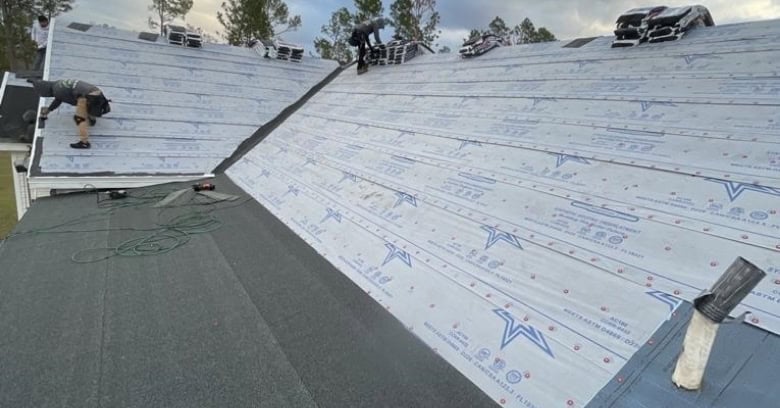
The new roof then goes on in layers. Underlayment covers the deck, a self-sealing ice and water barrier goes along the eaves and in the valleys, and new drip edge, flashing and pipe boots go in before the shingles or metal panels and the ridge caps. Our roof installation page walks through each of those layers and why it matters here.
Many residential projects are finished in a single day, and the site gets cleaned up before the crew leaves.
A note on layovers
Some roofers offer to put new shingles right over the old ones. It’s faster, but it buries the deck and the old flashing, adds weight and leaves the new shingles sitting on a lumpy surface. If someone offers you a layover, ask what happens to any damaged wood underneath. In most cases the answer is nothing.
Choosing materials for your new roof
Most homes in the area get architectural asphalt shingles. They’re thicker than the older flat 3-tab style and hold up better in wind. If hail is your biggest worry, ask about impact-resistant shingles. They’re rated by how well samples hold up when steel balls are dropped on them in a lab, which is a good sign of toughness but no promise against every storm. Our shingle roofing page compares the options.
Metal is the other common choice, including standing seam and stone-coated steel, for homeowners who plan to stay a long time. We’ll tell you what we’d put on your house and why. The final choice is yours.
Insurance, storm damage and paying for the roof
If hail or wind caused the damage, your homeowner’s policy may cover some of the replacement. You file the claim with your insurance company and you pay your own deductible. We document the damage with photos, give you a detailed estimate and work with your adjuster so nothing on the roof gets missed. Be wary of anyone who offers to waive or cover your deductible. Our insurance roof claims page explains how the process usually goes.
If the replacement isn’t storm-related, or you’d like to spread the cost out, financing is available through Aqua Finance, Fortifi, Hearth and Home Run Finance.
How it works with APC Roofing
- Book your free inspection. Call 913-398-5020 or request a free online estimate.
- Get a clear, honest assessment and estimate. You’ll see photos of your roof and get a written estimate that spells out the materials and the work.
- Get your new roof and a clean site. The old roof comes off, the new one goes on, and the property is cleaned up when the work is done.
Roof replacement questions from Blue Springs homeowners
How long does a roof replacement take?
Many residential projects are finished in a single day. Large or steep roofs, metal roofs and jobs with a lot of deck repair can take longer, and weather can move the start date. You’ll know the plan before work begins.
Do I need to be home while the roof is replaced?
Not necessarily, but someone should be reachable. It gets loud inside, so take pictures down from upstairs walls, cover anything stored in the attic and move cars out of the driveway.
Will insurance pay for a new roof after a hailstorm?
That’s between you and your insurer, and it comes down to your policy and what the adjuster finds. Our part is documenting the damage and giving you an estimate based on what’s actually on the roof.
Can you replace just one section of the roof?
Sometimes. If the damage is limited to one slope and matching shingles are still made, a section can be redone. If the whole roof is aging, replacing one slope usually means paying for the rest soon after.
Get a straight answer about your roof
Waiting on a worn roof rarely saves money. A slow leak can soak insulation and stain drywall for months before you see it, and then the repair includes the inside of your house too.
Have it checked while you still have choices. Then you can head into the next storm season with a sound roof, a dry house and no surprises on the bill. Call 913-398-5020 to book your free inspection, or start your estimate online.


















