
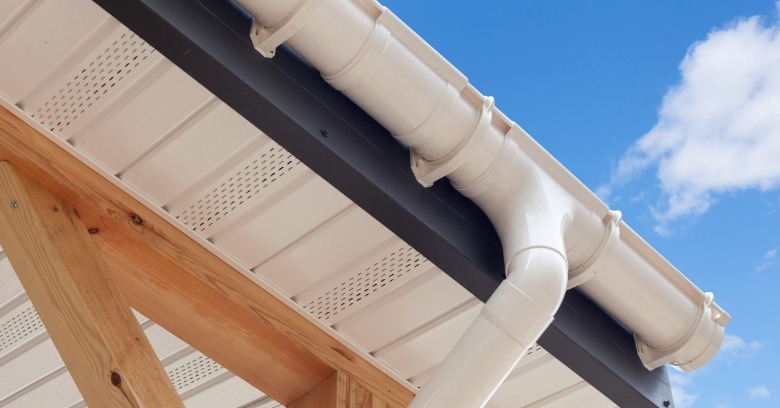
In need of Rain Gutters in Aurora Colorado?
APC Roofing measures, builds, and services gutter and downspout systems on Aurora Colorado residences.
Dial 720-902-6940 to talk it through.
A Good Rain Gutters Estimate Begins With the Roof Area – Not a Price Sheet
Nearly every overflowing gutter and downspout run that comes out for replacement in Aurora Colorado failed for one reason: it was never sized for the roof it serves. The trough is a drain with a workload, and that load comes from a pair of figures: the area of roof it serves, and the heaviest burst that roof will ever take.
The rainfall number surprises people. No one sizes a gutter from the annual rainfall total. The sizing tables – the same tables commercial roof drainage is designed on – are keyed to peak short-duration intensity. A downspout never fails because of a wet year. It overflows inside the few minutes a heavy shower hangs over the roof.
That difference shows up plainly across the map we cover. One market on our list takes better than fifty inches a year; the dry end of the map logs under twenty. Common sense says the markets that see less rain can get away with less gutter. It does not work that way. The intensity of a single hard cell is much closer across those markets than a rainfall map implies.
The Two Measurements That Determine What You Pay for Rain Gutters in Aurora Colorado
First comes the width of the gutter itself. The two profiles worth arguing about on most rooflines are five-inch and six-inch. Moving up a size is not a styling choice: the larger profile moves on the order of fifty percent more water than the smaller one. On a compact, shallow roof that headroom is spare capacity. On a wide, steeply pitched roof emptying into one run, the extra size is what stands between coping and failing.
The second figure is outlet size. This is the number that nobody thinks to ask about, and it is the one that fails. A two-by-three downspout – the one on most older houses – will take about six hundred square feet of roof. Move up to a 3x4 downspout and the capacity roughly doubles, to twelve hundred square feet or so. A four-inch round carries a comparable load. That is not marketing, and it is one of the cheapest upgrades on the job.
Put the two figures side by side and the math is straightforward. Total up the area of roof feeding each length of gutter, and only then divide by what each downspout can take. If the answer says three outlets are needed and there is one on the house, no amount of cleaning will make that run behave. That is an engineering shortfall, not a matter of neglect.
Fall, Outlets, and Run Length
A run of gutter is not hung flat, and a good one never looks sloped. The number the trade works to is close to a quarter of an inch per ten feet of length. Installers differ anywhere from an eighth to a half inch in ten feet, but the logic is the same: enough fall to shift the water, not so much that the roofline looks crooked.
Hang it flat and water sits in the low spots. A run that holds water is the start of the failure: it keeps sediment in place, it sits against the joints, and it adds weight in the worst possible place. Pitch it too hard and the run looks wrong from the curb while water shoots past the drop when it really rains.
Length is as important as the pitch. Somewhere beyond forty feet, the fix is a second outlet, not more profile. Water in a long run with one drop arrives at the bottom faster than it can be cleared, and the spill starts at the lowest point of the lip – typically over the front step, which is how most people find out.
What Holds It Up, and Why It Moves
Hanger spacing is one of the few things a homeowner can see from the ground. Hangers want to be two to three feet on center at most. Up north in the territory we cover, closer is correct – eighteen inches or thereabouts – because snow and ice build up above the rim and sit there for weeks, where rainwater is gone in minutes.
The second thing that is rarely mentioned is thermal movement. A long aluminum run lengthens and pulls back as the weather turns. Across a hundred-foot length from the coldest morning to the hottest afternoon, the travel is more than an inch. Every bit of it has to go somewhere. A run with no allowance buckles, opens its seams, or tears its own brackets out over a few seasons. None of that is a fault in the material. This is a decision nobody made at install.
Where the Roof Edge Meets the Gutter
This is a fault that everybody blames on a leaking gutter but has another cause entirely. Moisture turns up on the fascia board, or runs down the wall in behind the trough, while nothing in the gutter is wrong. The reason is the edge detail.
A drip edge is an L-profile strip that kicks runoff away from the roof edge. Where no apron backs it up, it can still let water wick back onto the fascia by surface tension. A gutter apron flashing is a deeper piece that runs past the deck and turns down inside the gutter. It seals the gap that the water had found. On a steep roof moving water in a hurry, it is a decisive difference.
The roof above the gutter changes the joint. Asphalt shingle is the least trouble. Concrete or clay tile is thicker and heavier, and the apron profile has to be worked in before the tile is set. Standing seam drops its whole snow load at once instead of letting it melt away, and that is why holding the snow above the eave belongs in the gutter discussion and not only a roofing one. Shallow and flat sections behave differently once more. APC Roofing handles every one of those, which is why the detail is drawn rather than guessed.
Ice at the Eave
Where our winters bite, this is the seasonal question. It also happens to be the one most often turned on its head.
A ridge of ice at the eave has nothing to do with the gutter itself. The cause is warmth finding its way into the roof from the living space below. The heat that gets through softens and melts the snow higher up the slope; that water flows down to the edge of the roof, which has no heat under it, and turns back to ice. Let that repeat for several days and a ridge of ice builds, holding water back where it cannot drain.
The gutter is not the cause, but the run is not blameless. A trough already frozen gives that meltwater nowhere to go, and makes the backup worse. What we tell people, when someone asks whether new gutters will end the ice problem, is no. The fix is insulation and stopping the air leaks. What we can do is clear the water away so it does no further damage when the weather turns. Anyone who sells you gutters as the answer to ice damming is pointing you at the wrong repair.
What the Last Few Feet Decide
A perfectly sized system emptying against the wall has simply relocated the problem instead of solving it. It has swept water off a large area of roof, funneled it into one discharge, and put that stream at the worst spot on the property.
This is one of the few points where the code itself puts a number on it. On soils known to be expansive or collapsible, water off the roof must be carried at least five feet clear of the foundation walls, or to an approved drain. Look at what the code keys on: what is under the house, not what falls on it.
That single point is the reason that the driest place we work is exactly the market where how far the water is taken matters most. Ground that swells when it gets wet and shrinks again when it dries works a foundation loose one season after another. The water doing that does not have to be plentiful. It simply needs to be delivered time after time beside one wall. An outlet with no extension does that reliably.
Another number in the code applies to every house, not only the difficult ones: the finished ground level has to fall half a foot inside the first ten feet measured out from the wall. That is the surface the downspout hands its water to. The best-built run delivering water to a reverse slope is fighting a losing battle. The ground gets checked on the same visit – they are the same job.
What Actually Fills a Gutter
What lands up there does not all behave alike, and that is why the standard twice-a-year advice is a starting point rather than an answer. In practice, three things fill a gutter.
- The heavy stuff – whole leaves, twigs, and seed pods. It comes in a seasonal burst, tends to float, and lifts out easily. This is what everybody pictures when a gutter is called blocked.
- Fine debris – litter from conifers and flowering trees. Here is the one that causes trouble. It passes straight through the majority of guards, settles in the low spots, and compacts into sludge that will not wash through.
- Roof grit – the granules that wash off an asphalt shingle roof for the roof's whole service life. A little of it is normal. A marked increase in what collects at the outlet is worth telling us about, because that is a signal from the roof itself rather than a maintenance one.
Covers and screens are part of the answer, not a cure. They cut down how often the run needs clearing, which is worth having. In return they restrict the opening for the water, and when the rain comes down hard a portion sheets past. The small stuff still works its way in. Whether the trade is a good one for you depends on what is growing above the roof, which is why we walk the property first rather than guess.
Extensions, Splash Blocks, and Buried Lines
You have three common methods to move the water away from a wall, and they are not equal. A concrete splash block is the least expensive and takes water the shortest way. It kills the force of the water coming down and scatters it, but it takes it only a foot or two. Where the ground slopes the wrong way that runoff ends up right where it started to where it started.
A downspout extension is the middle choice. It costs little, it moves out of the way, and it carries discharge several feet clear of the house. The drawback is that you can see it, and anything in the way gets knocked off and is never reconnected. We turn up more detached extensions than we ever do failed troughs.
A buried line is the answer that holds up when the ground demands it: a sealed pipe led out to a discharge point well away from the building. None of it shows, it stays connected, and it outlives the run feeding it. The trade-off is that it can clog and nothing on the surface says so, which is the reason a cleanout is put in at the outset and not added after the fact.
Fascia, Rafter Tails, and What We Find
A gutter is hung off something, and what it hangs from is usually the fascia board or the rafter tails behind it. Where a run has been spilling over or tracking down the back over time, the board has usually gone soft by the time the old gutter comes down.
We would rather flag it before anything begins than uncover it with the old run already down. A bracket fixed into a rotten board holds a little while and then pulls out, usually when the gutter is full – which is exactly when it matters. Where rot has taken hold, we point it out, take you to it, and price it as separate work so nothing is buried in a total.
Drainage on Low-Slope and Commercial Work
Not every roof we are asked about sheds at an eave. Flat and near-flat roofs behave differently: drainage happens through openings in a parapet, drains in the field, or a built fall rather than off an open edge. The questions to answer are the same, but the failures are easier to miss and a good deal less forgiving.
On a pitched roof a gutter that is blocked spills over and it is obvious. Where the pitch is nearly nothing a drain that has blocked backs water up on the membrane, and that standing water puts real weight on the structure well before it is spotted. APC Roofing works on both, meaning a mixed roof gets one drainage plan instead of two separate outfits pointing at each other over the junction.
What Wind and Hail Do to a Gutter
Weather damage to the roof itself is obvious. The gutters underneath come last, if anybody checks at all. The order should be reversed for a couple of reasons.
Worth knowing – a run is frequently the best evidence of what came through. Impact marks in the metal tell you the size of the hailstones and where they came from. That is documentation a claim can be built on when the roof itself is harder to read from the ground.
Another point worth making – a gutter pushed out of line gives no sign. It looks right from the ground, and it drains well enough in ordinary rain. It comes to light in the next heavy burst, which might be a season later – potentially past the window for a claim. An inspection straight after runs to a fraction of the repair that follows.
Signs It Is Time to Call About Rain Gutters
You do not need a ladder to catch the common ones. Take a slow lap of the building just after heavy rain, as that is when a gutter shows what it can do.
- Water pouring over the front lip when it rains hard – too small, clogged, or wrongly hung.
- The trough pulling away from the house – bracket failure, commonly after ice or a debris load.
- Paint lifting on the fascia though the gutter itself is not leaking – a drip edge or apron issue, nothing to do with size.
- Eroded ground or a splash pattern below a drop – the water is not being taken far enough.
- Water pooling beside the wall hours after the rain stops – a grading problem as much as a drainage one.
- A length that dips in the middle – water standing where it should not be, and it does not improve on its own.
The Spots That Overwhelm a Correctly Sized Run
The area figure by itself does not settle it, since roofs do not hand the water over evenly. A roof valley brings two slopes together and delivers all of it into a short length of trough. That short length may be handling many times the flow of the lengths on either side, even though it is the same profile.
This explains why a run can overflow in exactly one place in every storm while every other run stays perfectly dry. The answer is rarely a larger trough. It is a second drop placed at or very near the point where the flow lands, so the flow leaves right where it lands instead of running down the length of a gutter that was never sized for it.
Higher roofs create the same problem in a different form. An upper drop emptying onto a lower slope is very common, and it is often the wrong arrangement. It puts the whole upper roof at one place of the lower covering, which wears the surface and then overloads the gutter that lower roof drains into. Taking the upper downspout straight to the ground solves both problems at once.
How to Compare Two Estimates
If you are holding two competing estimates and one is lower, the price gap is hardly ever margin. It is very nearly always a difference in materials and sizes that neither estimate spells out clearly.
An estimate worth reading should state the profile size and what it is made of, the number and size of downspouts, which hangers and how often, what happens at the roof edge and whether it is priced in, and where the water finishes up once it leaves the downspout. That is the whole list. If an estimate is silent on any of them, that is where the difference lies.
All five appear on the estimate because that is the work. A price per foot with none of that behind it is a bare number, not a specification you can compare.
How Long the Work Takes, and What Gets in the Way
A typical house job wraps up inside a day, two where the house is large or awkward. The gutter is formed on site from a coil of metal, cut to the length needed, which is precisely the reason no joint is needed anywhere in between. The corners, the drops, and the end caps are joints, and those are where the work has to be done properly.
Weather governs timing more than anybody would choose. The job calls for a dry spell – sealants need to cure and nobody ought to be on a wet edge. We would sooner push a date than rush it in poor weather and watch it fail early.
Getting to the work changes the day. A tight passage down the side, mature landscaping under the eaves, single-story additions, and a neighbor's fence all affect the sequence. We check that when we measure, not when the truck pulls up.
How APC Roofing Approaches Rain Gutters in Aurora Colorado
The roof gets measured before anything is quoted. Square footage into each length, the roof slope, how long the runs are, and where drops can sensibly discharge – those few numbers tell us what the house needs. All that follows – profile, material, color, guards – is yours to settle with the figures in front of you.
Because the roof and the drainage are both ours, the seam between roof and gutter gets designed rather than inherited. Shingle, tile, metal, low-slope – all of them change how the edge is built. That detail is not something we bolt on later. It happens to be where the job begins.
Repairing or replacing is an honest judgment, and we will say which it is. A properly sized run with a damaged length or a slope problem is worth a repair. A system that was undersized from day one for the area draining into it cannot be repaired into working. Cleaning it more often cannot fix a sizing shortfall.
Arrange Rain Gutters in Aurora Colorado Priced From the Numbers
Phone APC Roofing right away at 720-902-6940 and start with a measurement.
What Sits Under the House Changes the Stakes
The same drainage fault has very different consequences at different addresses, and what settles it is the kind of foundation underneath.
A home on a slab has no basement to flood. What goes wrong shows up slowly: water working under the slab edge, the ground beneath being carried off, and wet spots on the floor into the floor in a room nobody associates with the roof.
A basement hands the water a destination, and it goes there. Moisture coming through the wall, efflorescence on the block, the sump pump cycling almost without stopping, and humidity pulled up into the rooms above – all of those start outside, at an outlet that stops at the foundation.
In both cases the remedy is outside, and it is cheaper than any remedy carried out after the water is in.
Gutter Materials, Briefly
Roll-formed aluminum is what most homes get, and deservedly so: it will not rust, it asks little of the hangers, and it is rolled at the house as one continuous piece. Taking the joints out means fewer places to fail. The trade is that it scratches and it moves as it warms and cools, which the installation has to handle.
Galvanized steel keeps its shape better, which counts in hail country, though the coating is the only thing keeping rust off, so it repays attention. A copper run is the long-life choice and is priced accordingly. Vinyl is cheap to put up and turns brittle as it ages in sun and frost. We are glad to talk through which of those suits your house without pushing the priciest option.
Cleaning, Timing, and What Actually Needs Doing
The twice-a-year figure is what gets repeated, and it is a fair starting point rather than a fixed schedule. How often it really needs doing depends on the trees around the house. A roof under pine is under falling needles most of the year and wants more frequent attention. A house with nothing overhanging may go considerably longer.
The seasonal pattern fits colder places best, and it fits some of our markets badly. Live oaks in the warmer markets on our map hang on to their leaves all winter and drop them in late winter and early spring. Anyone with one of those over the house who books a fall cleaning and stops there is getting the work done at the wrong point in the year and leaving it full for the leaf fall that counts.
What we actually check is not only whether it is clear. Whether the outlets are moving water, joint and end-cap seals, how tight the hangers are, whether the pitch is still right, the condition of the edge flashing, and what becomes of the discharge. That last one is the one that gets overlooked and it is also the one quietly doing the expensive damage.
If you would sooner not keep track of it, that is the service. A gutter looked over at reasonable intervals generally lasts as long as the material will. A run only inspected after the damage is done almost never does.
To move forward with Rain Gutters throughout Aurora Colorado, phone APC Roofing right away at 720-902-6940. We start with the roof measurement and the quote comes from the numbers.
Verified

Verified
Verified
Verified


















