
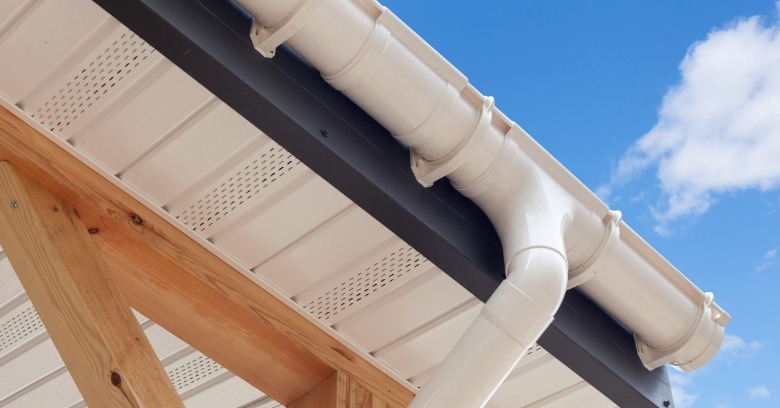
Shopping for Seamless Gutters in Aurora Colorado?
APC Roofing sizes, hangs, and services roof drainage on Aurora Colorado houses.
Call 720-902-6940 to get your roofline looked at.
An Honest Seamless Gutters Job Starts With a Tape Measure – Not a Price Sheet
Most every overwhelmed rainwater system that needs replacing across Aurora Colorado ran out of capacity for the same reason: it was sold by the foot instead of sized against the roof feeding it. A rainwater run is a conveyor carrying a load, and that load is governed by two figures: the square footage above it, and the worst few minutes of rain that roof will ever see.
The second of those surprises people. Nobody sizes a downspout using the annual rainfall total. The standards contractors work from – the ones the sheet-metal trade has used for generations – run on peak short-duration intensity. A trough never fails because of a wet year. It gives up in the ten minutes a summer storm stalls above the street.
That difference carries real weight across the areas we cover. Part of the territory we cover gets more than fifty inches of rain a year; a different market records under twenty inches over the same year. You would think the low-rainfall markets need half the drainage. That is not how it works. The peak burst is far closer between them than the annual totals would suggest.
The Only Two Numbers That Drive What You Pay for Seamless Gutters in Aurora Colorado
The first of them is the width of the gutter itself. The two options you will see on a quote on a house are a five-inch section and a six-inch one. The step up is not cosmetic: the larger profile moves roughly fifty percent more water than the smaller one. On a modest roof with a gentle pitch that headroom is never called on. On a wide, steeply pitched roof dumping into one length, that extra capacity is the difference between a dry wall and a waterfall.
The second is the downspout. This is the number that most quotes leave out, and it is where most of the trouble comes from. A 2x3 outlet – the size on most houses built a while back – drains roughly six hundred square feet. Change up to the larger rectangular downspout and you get close to double, to around twelve hundred. The four-inch round profile sits in similar territory. That is a real doubling, and it costs very little more.
Put those together and it is not hard to work out. Calculate the area of roof that empties into each run, and only then divide by what each downspout can take. If the math says three downspouts are called for and the wall carries a single one, no cleaning routine will stop the overflow. That is a capacity problem, not a maintenance one.
Pitch, Outlets, and the Length of a Run
The gutter itself is never dead level, though it should read as level from the ground. The figure we work from is close to a quarter of an inch for each ten feet of gutter. Practice varies from an eighth to a half inch per ten feet, but the reasoning does not shift: enough slope to keep the water moving, not so much that the roofline looks crooked.
Too little fall and water stands in the trough. Water that sits is how a gutter dies: it traps grit and leaf litter, it works on the seams, and it puts pounds on the brackets in the worst possible place. Too much slope and the line looks wrong from the ground while water overshoots the outlet in a real downpour.
The distance a run covers counts for as much as the slope. Once a length gets past forty feet or so, the answer is another outlet, not a bigger gutter. Water in a long run with one drop comes to the outlet quicker than a single opening can swallow it, and the spill starts wherever the edge has dropped – usually over a door, which is what brings us the call.
What Holds It Up, and Why It Moves
The distance between hangers is one of the few things anyone can inspect from the ground. Supports should be no further apart than two to three feet. In the markets that get real snow, we tighten that up – eighteen inches – because packed snow and ice pile above the rim and stay for weeks, where rain is gone within minutes.
A second detail no quote mentions is how much the metal moves. A run of aluminum moves as the temperature swings. Over a long length from the coldest morning to the hottest afternoon, the travel is more than an inch. It must be designed for. A length with nowhere to move bows, splits a seam, or pulls a screw out over a few seasons. That is not a fault in the material. That is an installation choice that was never made.
Where the Roof Edge Meets the Gutter
Here is a fault worth naming that presents as a leaking gutter but has another cause entirely. Moisture shows on the fascia, or runs down the wall in behind the trough, while the trough itself is sound. The cause is the detail where the roof stops.
The common edge flashing is a bent metal strip that pushes water off the deck. When that strip is the only flashing, it can still let water wick back into the gap behind the trough on surface tension alone. The apron detail is a deeper piece that extends over the edge and into the gutter. It closes the gap the water was using. On a steep roof moving water in a hurry, that detail decides the outcome.
What the gutter hangs beneath changes what the edge detail has to be. A shingle roof is the plain case. A tile roof sits higher and heavier, and the apron has to be worked in before the tile is set. Metal panel roofing lets go of its snow load in a single slide rather than melting it off slowly, and this is why holding the snow above the eave belongs in the gutter discussion and not a roofing one alone. Flat and low-slope sections change the answer again. APC Roofing works with all of those roof types, which is why we raise it.
Freezing Weather and the Cold End of the Roof
Across the northern half of our service area, this is the cold-weather conversation. And it is the one most regularly misread.
The ice at the roof edge has nothing to do with the gutter itself. The cause is warmth passing up through the deck from inside the home. The heat that gets through thaws the snow on the upper roof; the runoff makes its way down to the overhang, where nothing underneath is heated, and refreezes. Go around that cycle across several cold nights and a ridge of ice builds, trapping the next thaw where it cannot drain.
None of it starts in the gutter, though the trough is part of the story. A run packed solid with ice removes the last escape route, and deepens the backup. The straight answer, when the question is put to us whether new gutters will cure the ice, is that they will not. The remedy lives in the attic. What good drainage does is clear the water away before it does a further round of damage as things warm up. A company pitching a gutter job as an ice dam solution has the diagnosis wrong.
The Ground the Downspout Empties Onto
A properly sized gutter emptying at the foot of the wall has simply relocated the problem rather than dealt with it. It has swept water from a large stretch of roof, focused it to one point, and dropped it exactly where you least want it.
Here is one of the rare places where the building code sets an actual figure. Where soils are known to be expansive or collapsible, water off the roof has to be taken not less than five feet clear of the foundation walls, or to an approved drain. Note what triggers that: the ground, not the rain.
That difference is the reason the market with the least rainfall of any we serve happens to be the place where the last five feet matters most. Soil that expands when it gets wet and contracts as it dries out moves a foundation up and down one season after another. The moisture behind it need not amount to much. It simply needs to be repeatedly concentrated in one place. An outlet with no extension does it every single storm.
One more code number applies to every house, not only the difficult ones: the finished ground level has to drop six inches inside the first ten feet away from the foundation. That is the grade your gutters are handing water to. A properly sized run delivering water to a reverse slope is fighting a losing battle. We check the grade when we measure – they are the same job.
What Ends Up in the Trough, and How Often
What lands up there does not all behave alike, and that is why one schedule for every house is a starting point rather than an answer. Roughly speaking, three different loads fill a gutter.
- Coarse material – leaves and woody bits. It drops over a short season, mostly sits on top, and lifts out easily. That is what comes to mind first when a gutter is called blocked.
- Fine material – needles, catkins, winged seeds, and flower drop. This second one is the load that gives trouble. It drops through most screens and guards, settles into the low points, and compacts into sludge that no amount of rain will clear.
- Roof granules – the mineral granules washing off an asphalt roof over the whole of the roof's life. A modest amount is entirely normal. A sudden increase in the sediment at the drop is worth a phone call, because it is a roof signal rather than a maintenance one.
Screens and covers are part of the answer, not a cure. They bring down how often you are up a ladder, which matters. In exchange they leave a narrower entry the water must pass, and in a heavy driving rain part of the flow goes straight past. Needle and seed litter still gets through on most designs. Whether guards are right for your roof comes down to what is growing nearby, which is why we look before recommending rather than guess.
Extensions, Splash Blocks, and Buried Lines
You are left with three workable ways to move the water out to where it does no harm, and they are not equal. A splash block at the base costs the least and does the least. It breaks the force of what comes out of the pipe and disperses it, though it carries it only a foot or two. Where the grade leans toward the wall the runoff ends up right where it started to the foundation wall.
A downspout extension sits between the two. The cost is small, it moves aside when the lawn is cut, and it carries discharge several feet clear of the house. The weakness is that it lies across the ground, and anything underfoot ends up detached and is then forgotten. We come across more loose extensions than we do gutters that leak.
An underground line is the right answer where it is worth doing: a continuous pipe led out to somewhere the water can safely go a long way from the house. It is invisible, it stays connected, and it will still be there when the gutters are not. The cost is that it can fill with silt without any visible sign, which is the reason an access point belongs in the design rather than added later.
The Board Behind the Gutter
A rainwater run has to be carried by something, and that something is the fascia board most of the time or the rafter tails behind the board. Where a run has been spilling over or running down the back for years, the board has usually gone soft by the time the old gutter comes down.
We would sooner say so before anything begins than find it once the crew is on site. A hanger going into decayed board holds a little while and then works free, usually when the gutter is full – which is the moment you are counting on it. Where we find rot, we say so, walk you to it, and price it as separate work so nothing is buried in a total.
Flat Roofs, Commercial Buildings, and Larger Drainage
Not every roof uses a gutter. Flat and low-pitch areas behave differently: the water leaves through scuppers, field drains, or a tapered fall instead of running off an edge. The engineering questions are identical, but the failures are less obvious and far less forgiving.
On a pitched roof a gutter that is blocked spills over in plain sight. Where the pitch is nearly nothing a drain that has blocked leaves the roof ponding, and ponded water weighs tons before anyone sees it. APC Roofing handles both kinds of work, which means a building carrying both gets one drainage plan rather than two trades blaming each other at the joint.
Storm Damage and the Drainage Below It
Damage from wind and hail to the covering itself is plain to see. The gutters come last, when they are checked at all. It should be the other way around for two reasons.
One thing worth knowing – the gutter is usually the most legible record of what actually struck the house. Dents in a metal trough show how big the hailstones were and which way they came. That is documentation that supports a claim when the covering above cannot be assessed from the lawn.
Another point worth making – a gutter pushed out of line does not announce itself. It reads as normal from the curb, and it works through everyday weather. You find out about it during the next serious storm, and that could be a season later – often past the point where anyone would connect the two. An inspection straight after costs nothing like the cost of finding out later.
Reading a Roofline From Below
No climbing is required to pick up most of these. Walk the perimeter after a real downpour, for that is when a run shows you what it is doing.
- Curtains of water spilling over the lip during a burst – a capacity, blockage, or pitch problem.
- A gap opening between the gutter and the fascia – hanger spacing or fasteners, usually after a heavy load.
- Marks running down the board behind the run with nothing wrong inside the gutter – water getting behind, not the run.
- Splash marks and eroded ground below a drop – discharge too close to the wall.
- Water pooling at the base of the house long after the storm passed – a discharge and ground-level problem.
- A run with a belly in it – water sitting where it should not, and it does not improve on its own.
Valleys, Upper Roofs, and Concentrated Flow
Area alone does not tell the whole story, because roofs deliver water unevenly. Any valley brings two slopes together and sends the combined flow onto a few feet of gutter. That one stretch is often taking several times the volume of the lengths on either side, though nothing about it looks different.
This is why a gutter can spill at one spot in every storm while the remainder handles it without trouble. The answer is rarely a bigger gutter. It is another outlet positioned at or close to where the valley discharges, so the flow leaves where it arrives rather than traveling along a trough never sized for that load.
Second-story roofs produce the same effect by another route. An upper drop discharging onto a lower roof is very common, and it is usually the wrong arrangement. It dumps the whole upper roof onto a single spot of the covering below, which wears the surface and then overloads the run serving the lower roof. Running the upper discharge down past the lower roof solves both problems at once.
How to Compare Two Estimates
If you are holding a pair of quotes and one is lower, the price gap is hardly ever one company charging more for the same thing. It is almost always a difference in materials and sizes that no quote actually states.
An estimate worth reading should state the profile size and the metal it is made from, the outlet count and profile, which hangers and how often, how the roof edge is handled and whether it is in the price, and where the discharge from each drop finishes up once it exits the pipe. That is the whole list. If a piece of paper leaves one out, that is where the money went.
We write those down because they are the job. A linear-foot rate with none of that behind it is just a number, not an estimate.
Scheduling, Access, and the Day Itself
Most residential gutter work wraps up inside a day, occasionally two. The run is rolled on site off a coil of stock, cut to fit each run exactly, which is why no joints appear part way along. The corners, the outlets, and the ends are joints, and those are where the sealing has to be right.
Weather governs timing more than anyone would like. The job needs a reasonably dry spell – sealant has to cure and nobody belongs on a wet roof edge. We would rather push a date than work through rain and have you calling us back.
Getting to the work shapes the day. Narrow side passages, established beds below the run, attached structures, and a neighbor's fence all shape how we stage it. We check that on the measuring visit, rather than on the morning of the job.
What You Get When APC Roofing Approaches Seamless Gutters in Aurora Colorado
The roof gets measured before anything is quoted. Square footage into each length, roof pitch, the run lengths, and where outlets can actually land – those four figures tell us what the house needs. All that follows – the visible choices – is yours to settle with the numbers in front of you.
Because the roof above is our work too, the seam between roof and gutter is drawn, not guessed. Asphalt, tile, standing seam, low-slope – every one changes how the flashing and apron are made. None of that is left until later. It happens to be where the job begins.
Fix or replace is a judgment, and we will tell you which. A sound run with a failed section or a bad hang should be repaired. A run that never had the capacity for its roof is not a repair. More frequent clearing does not add capacity.
Book Seamless Gutters in Aurora Colorado From People Who Measure First
Contact APC Roofing right now at 720-902-6940 for an honest look at your roofline.
What Sits Under the House Changes the Stakes
The same undersized run does not do the same damage at different addresses, and what settles it is the kind of foundation underneath.
A house built on a slab leaves water nowhere obvious to gather. The trouble is more hidden: water working under the slab edge, the ground under it washing away, and dampness rising at the wall-floor junction far from where it came in.
A basement or a crawl space hands the water a destination, and it will find it. Water through the wall, salt staining on the block, a sump pump that keeps running far more than it should, and damp air pushed up through the whole house – all of those start outside, at an outlet emptying too near the wall.
Whichever it is the work is outside, and it costs far less than any cure done after the water is already in.
What the Trough Is Made Of
Roll-formed aluminum goes on the large majority of houses, and for good reason: rust is not a concern, it is light enough for the hangers, and it can be rolled on site with no joints along the run. Having fewer joints means fewer places for a leak to start. The trade-off is that it dents easily and it moves with temperature, which the install has to allow for.
A steel gutter is stronger and resists damage, which matters in hail country, but the finish is the one thing holding corrosion off, so it repays attention. A copper system sits at the durable end and it shows. Plastic is inexpensive to install and gets brittle under UV and cold. We will talk you through what makes sense for your roof without a sales pitch.
Keeping a Run Working
The twice-yearly figure is the usual advice, and it is a fair starting point rather than a fixed schedule. How often it really needs doing depends on what is growing over the roof. A roof under pine takes a steady needle drop through much of the year and asks for more frequent attention. A house with no trees close by will go a good deal longer.
The twice-yearly habit was borrowed from colder places, and it does not fit everywhere. The semi-evergreen oaks in the warmer part of our map hold their leaves through winter and shed them as the new growth comes. Anyone with one over the roof who stops at a fall visit is doing the work just before the quiet months and letting it fill again for the real leaf fall.
What we look at is not only whether it is clear. How the drops are running, the seals at joints and caps, hanger tightness, whether the slope has held, the state of the edge flashing, and where the discharge ends up. Ground level is the item that is skipped most often and it is the one quietly running up the bill.
If you would rather not think about it at all, that is what we do. A gutter inspected on a sensible interval tends to last as long as the metal allows. A run only inspected once the damage is visible almost never does.
To get started on Seamless Gutters throughout Aurora Colorado, contact APC Roofing right now at 720-902-6940. We do the measuring first and the quote follows the numbers.
Verified

Verified
Verified
Verified


















