
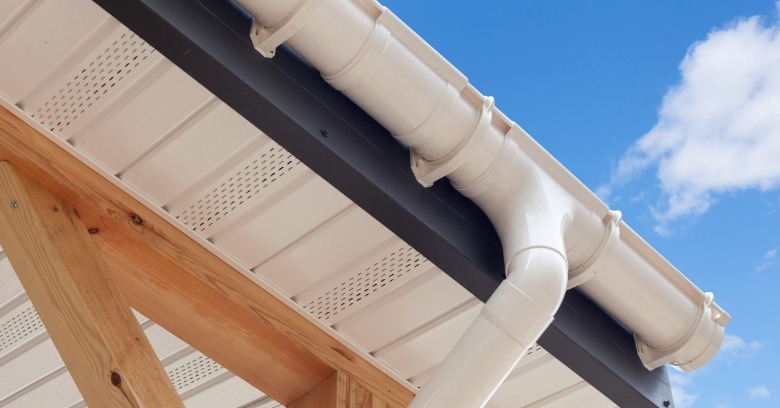
Searching for Gutter Installation in Aurora Colorado?
APC Roofing lays out, puts up, and looks after roof drainage at Aurora Colorado residences.
Call 720-902-6940 for a measured quote rather than a guess.
A Good Gutter Installation Quote Begins With the Roof Area – Not a Catalog
Almost every overflowing gutter run that has to be replaced across Aurora Colorado came up short for one reason: it was never sized against the square footage above it. A rainwater run is a conveyor carrying a load, and what it has to handle is governed by two figures: how much roof drains into it, and the heaviest burst that roof will ever take.
That second number is the one people get wrong. Gutters are not sized against the annual rainfall total. The sizing tables – the same tables commercial roof drainage is designed on – are keyed to how hard it rains in a five-minute burst. A gutter never fails because of a wet year. It gives up in the few minutes a cloudburst sits over the block.
That distinction counts for a great deal in our service area. Part of the territory we cover catches better than fifty inches a year; the drier end of our map logs under twenty. It is easy to assume the markets that see less rain need half the drainage. It does not work that way. The worst five minutes is a great deal closer than the annual totals would suggest.
The Only Two Numbers That Settle What You Pay for Gutter Installation in Aurora Colorado
First comes the size of the trough. The two sections you will see on a quote on a residence are the five-inch K-style and the six-inch. The jump between them is not a styling choice: the six-inch trough carries on the order of fifty percent more water than a five-inch section. On a modest roof with a gentle pitch the extra is a cushion. On a big roof with a steep pitch draining into a single run, the extra size is what stands between coping and failing.
The second figure is how the water gets out. This is the number that most quotes leave out, and it is where the failures start. A 2x3 outlet – the one on the majority of older homes – is rated for about six hundred square feet. Move up to a 3x4 downspout and it takes about twice as much, to something near twelve hundred. The four-inch round profile carries a comparable load. That is not marketing, and the extra cost is minor.
Put the two figures side by side and the calculation is plain. Calculate the roof area that ends up in each run, and next count your outlets. If the arithmetic says you need three downspouts and the house has one, no cleaning routine will fix it. That is a sizing fault, not a housekeeping problem.
Pitch, Outlets, and the Length of a Run
A gutter run is not hung flat, though it should read as level from the ground. The common working figure is roughly a quarter inch for every ten feet of run. Crews differ a little either side of that, but the reasoning does not shift: enough to keep water on the move, subtle enough that nobody notices.
Too little slope and water sits in the low spots. Water that sits is the start of the failure: it traps grit and leaf litter, it sits against the joints, and it loads the hangers in the worst possible place. Overdo the slope and the line looks wrong from the ground while the flow overruns the outlet when the rain comes hard.
Length matters as much as slope does. Once a run pushes much past forty feet, a second outlet is the answer, not more profile. Water in a long single-outlet run gets to the downspout faster than it can be taken away, and the spill starts at whatever point the lip is lowest – frequently over the walkway, which is how the problem announces itself.
What Carries the Load and Why It Shifts
How far apart the hangers sit is one of the few details you can check yourself standing on the lawn. Hangers should sit no more than about two to three feet apart. Up north in the territory we cover, closer spacing is the right call – eighteen inches – because ice and packed snow mound above the rim and linger for weeks, where rainwater is gone in minutes.
The other thing that is rarely mentioned is movement. A run of aluminum moves as the temperature swings. Over a hundred feet of run through a full year of temperature change, the metal moves more than an inch. All of that must be designed for. A length with nowhere to move distorts, splits at the joints, or pulls its brackets loose over a few seasons. It is not a fault in the material. That is a step that got left out.
Drip Edge, Gutter Apron, and the Gap Behind the Trough
There is a failure mode that everybody blames on a leaking gutter but has another cause entirely. A stain appears on the fascia, or runs down the wall behind the trough line, while the trough itself is sound. The problem is the edge detail.
Standard drip edge is a simple L-section that throws water clear of the deck. Where no apron backs it up, runoff can still curl back onto the fascia simply by clinging to the metal. An apron is the longer profile that extends over the edge and into the gutter. It takes away the route that was letting water behind. On a steep roof throwing water hard, the difference is not subtle.
The roof above the gutter changes the joint. An asphalt roof is the least trouble. Tile is thicker and heavier, and the edge detail goes in ahead of the tile rather than after it. A standing-seam roof turns loose a full slope of snow in one movement rather than melting it away gradually, which is why snow retention above the gutter line is a gutter question every bit as much as a roofing one. Low-pitch runs of roof behave differently once more. APC Roofing handles every one of those, which is why we raise it.
Freezing Weather and the Cold End of the Roof
Where our winters bite, this comes up every winter. It is also the one most regularly misread.
The ice at the roof edge starts nowhere near the gutter. It is caused by heat leaking out through the roof from inside the home. That warmth softens and melts the snow up the slope; the water that comes off runs down as far as the cold overhang, which has no heat under it, and freezes on the spot. Run that cycle for several days and you have a ridge of ice, trapping the next thaw further up the slope.
None of it starts in the gutter, though the trough is part of the story. A trough already packed with ice removes the last escape route, and the dam grows faster. The honest answer, when a homeowner asks whether new gutters will end the ice problem, is that they do not. The remedy is in the attic, not at the eave. What we can do is give that water a route out before it does a further round of damage as the thaw sets in. Anyone who sells you gutters as the answer to ice damming is selling you the wrong repair.
Where the Water Goes After It Leaves the Downspout
The best-sized run in the world that dumps hard against the foundation has moved the problem rather than dealt with it. It has gathered water from a large stretch of roof, concentrated it into one stream, and placed it at the worst place available.
This is a rare case where the building code is explicit. On soils known to be expansive or collapsible, the roof water must be carried no less than five feet away from the foundation, or to an approved drain. Mark what the rule turns on: the ground, not the rain.
That distinction explains why the driest market we serve happens to be the place where getting the water away matters more than anywhere. Soil that swells when saturated and pulls back as it dries will lift and drop a foundation year after year. The rain that causes it does not have to be plentiful. It just has to be repeatedly concentrated at one point. A downspout with no extension does that reliably.
A second number in the code applies everywhere, not just on difficult soil: the finished grade has to drop at least six inches over the first ten feet measured out from the wall. That is the grade the discharge lands on. A faultless gutter discharging onto ground that runs the wrong way is beaten before it starts. We check the grade while we are measuring the roof – it is the same problem.
Why Cleaning Schedules Are Not One Size Fits All
Not all debris behaves the same way, and that is why a single cleaning schedule is a starting point rather than an answer. Broadly, three sorts of material collect in a trough.
- Coarse material – big leaves and small branches. It arrives in a rush, mostly sits on top, and clears easily. It is also what everybody pictures when a clogged gutter is mentioned.
- Fine material – needle drop, catkins, and flower litter. That is the load that gives trouble. It drops through most screens and guards, works into the standing water, and turns to a dense mat that rain will not move.
- Granule wash – the mineral granules that wash off an asphalt shingle roof across the roof's service life. A small amount is entirely normal. A sudden increase in what collects at the outlet is worth a call to us, because it is a signal from the roof and not a gutter one.
Guards of any kind are a trade-off, not a solution. They reduce how often you are up a ladder, which counts for something. In trade they leave a narrower entry that water must get through, and during an intense burst water can sheet clean over them. Fine debris still gets underneath. Whether the trade is a good one for you depends entirely on your trees, which is something to look at together rather than guess.
What Goes Under the Downspout
You have three sensible ways to get the discharge out to where it does no harm, and they are not the same. The concrete or plastic splash block is the low-cost option and takes water the shortest way. It softens the fall of the water coming down and spreads it, but it carries it barely a foot or two. Where the ground tilts toward the house the runoff ends up right where it started to the foundation wall.
A hinged or roll-out extension is the middle choice. The cost is small, it lifts out of the way for mowing, and it does move water well away from the wall. The weakness is that it is in plain view, and anything visible ends up detached and is then forgotten. We find more disconnected extensions than we do failed runs.
An underground drain is the answer that holds up when the ground demands it: a sealed pipe run clear to a place the water can go safely at a good distance from the house. It is out of sight, it cannot be kicked loose, and it lasts a great deal longer than the run above. What you take on is that it can silt up without anyone noticing, and that is the reason a cleanout goes in at the start instead of being regretted later.
The Board Behind the Gutter
A length of gutter is fixed to something, and that point of support is normally the fascia or the rafter tails it is nailed to. If a run has been overflowing for any length of time, the board is often soft when we pull the old system away.
We would rather tell you that when we quote than turn it up part way through the job. A bracket fixed into a rotten board lasts a season or two and then pulls out, generally under a heavy load – which is exactly when you are counting on it. Where the wood has rotted, we point it out, show you where, and price the repair separately so the cost is clear.
Flat Roofs and the Drainage They Need
Not every roof drains at a gutter. Low-slope and flat sections drain differently: the water is taken off through openings in a parapet, drains in the field, or a built fall rather than over the roof edge. The engineering questions are no different, but the failures are quieter and much harder to spot early.
On an ordinary sloped roof a blocked run spills over and it is obvious. On a flat or low-slope roof a blocked outlet backs water up on the membrane, and that standing water adds serious weight long before it is noticed. APC Roofing handles both kinds of work, which means a property with a bit of each gets one plan rather than two trades arguing about the junction.
What Severe Weather Does to a Gutter Run
Damage from a severe storm to a roof gets attention. The gutters underneath are dealt with last, if at all. That is the wrong way around for two reasons.
A point worth making – a run is very often the plainest evidence of what actually hit the property. Hail dents in the run are sized and directional. That is a record that supports a claim when the shingle surface cannot be assessed from the lawn.
Another point worth making – a gutter moved by the wind gives no sign. It reads as normal from the ground, and it works in average rain. You find out about it during the next big storm, and that could be a full year later – potentially past any claim deadline. A look while it is fresh is far cheaper than the cost of finding out later.
Signs It Is Time to Call About Gutter Installation
You can stay on the ground to pick up most of these. Walk the outside of the house in the middle of a downpour, for that is when the system shows its hand.
- Water sheeting over the front edge in a storm – a size, blockage, or slope problem.
- The trough pulling away from the house – hangers that have let go, usually after a heavy load.
- Marks running down the board behind the run while the run itself is sound – water getting behind, nothing to do with size.
- A trench, a splash line, or bare soil under a single downspout – extension needed.
- Puddles standing beside the wall well after it stopped raining – grade and discharge together.
- A run that visibly sags – load the hangers were never meant to carry, and it will get worse on its own.
Where a Roof Sends Too Much Water to One Place
Roof area alone only gets you part of the way, given that roofs do not hand the water over evenly. Any valley gathers two planes of roof and puts the entire flow onto a short length of gutter. That one stretch might be carrying several times the water of the rest of the run, though it looks the same.
That is the reason a gutter can overflow at exactly one point every time it rains hard while the rest of the house handles it without trouble. The cure is not usually more profile. It is a drop placed at or very near where the valley lands, so the water leaves where it arrives instead of traveling down a length that was never sized for it.
Roofs above cause the same problem in a different form. An upper drop emptying onto a lower slope is common, and it is regularly a poor arrangement. It puts an entire upper roof onto one point of the roof below, which erodes the covering and then overloads the trough that serves the roof below. Piping the upper discharge down past the lower roof settles both at once.
Reading a Gutter Quote
Once you have a couple of quotes and one is cheaper, the gap is not usually margin. It is very nearly always a difference in what is being installed that neither document puts in writing.
A quote you can trust tells you the profile size and the metal it is made from, the downspout count and size, which hangers and how often, what happens at the roof edge and whether it is in the price, and where the water is taken once it exits the pipe. That is the short list. Where an estimate leaves one out, that is where the gap is.
We write those down because that is the job. A linear-foot rate and nothing spelled out is just a number, not an estimate.
Timing, Access, and How Long the Work Takes
A typical house job wraps up inside a day, occasionally two. The run is rolled on site out of coil stock, cut to length, and that is why no joint is needed between the corners. Corners, drops, and caps are joints even so, and those are the points where the work has to be done properly.
Weather drives the schedule more than anybody would choose. The install needs reasonably dry weather – sealant has to cure and nobody ought to be on a wet ladder. We would sooner move a date than install in the rain and watch it fail early.
Site access counts too. Tight clearance at the side, mature landscaping under the eaves, lower additions, and boundary lines all change the way the work is staged. We check that while we are measuring, not after the crew arrives.
What Happens When APC Roofing Quotes Gutter Installation in Aurora Colorado
The roof gets measured before anything is quoted. Square footage into each length, the slope, the length of each run, and where the downspouts can actually go – those numbers give us a specification. Everything after that – profile, material, color, guards – is a choice you get to make against a known requirement.
Because the roof above is our work too, the seam between roof and gutter is designed, not assumed. Shingle, tile, metal, low-slope – each one changes the way the edge is built. It is not tacked on at the end. It is precisely where the work starts.
Repair against replacement is a decision we make on the evidence, and we will say which one applies. A correctly sized system with one bad length or a hanging fault is a repair. A run that was too small to begin with for the area draining into it cannot be repaired into a working system. More frequent clearing will not change the arithmetic.
Get Gutter Installation in Aurora Colorado With the Roof Measured First
Contact APC Roofing now at 720-902-6940 for a clear look at your roofline.
Slabs, Basements, and Crawl Spaces
The same shortfall in drainage does not do the same damage across different homes, and the deciding factor is the kind of foundation underneath.
A house on a slab has nothing underneath to flood. What goes wrong shows up slowly: runoff finding its way beneath the edge, soil washing away underneath, and dampness rising at the wall-floor junction in a room nobody associates with the roof.
A house with a basement or crawl space gives the water a place to collect, and it takes it. Seepage through the wall, salt staining on the block, a sump pump that keeps running constantly, and wet air pushed up into the living space – those all start at a single downspout that stops at the foundation.
In both cases the work is outside, and it is far cheaper than any cure tried once the water is already inside.
What a Gutter Is Made Of
Roll-formed aluminum is the usual choice, and deservedly so: it will not rust, it is light enough for the hangers, and it can be formed on the driveway as a single continuous run. Taking the joints out means the usual leak points are gone. The downside is that it scratches and it expands and contracts a good deal, which the bracket layout has to allow for.
Coated steel keeps its shape better, which is worth having where hail happens, but the protective layer is the one thing holding corrosion off, so it needs looking after. A copper run is the durable end of the range and it carries a premium. Plastic is inexpensive to install and grows brittle in sun and cold. We will talk you through what makes sense for your roof without a sales pitch.
Keeping a Gutter Working
Two visits a year is the advice everyone gives, and it is a fair place to start and not an answer in itself. How often it really needs doing depends on the trees over the house. A house with pines above it collects fine needle litter for most of the year and needs more attention. A house well clear of trees can go a long time between visits.
The two-visit habit was inherited from colder climates, and it does not suit everywhere. The oaks that stay green in the warmer markets we serve hang on to their leaves all winter and shed them as the new growth comes. A homeowner there who books a fall cleaning and stops there is doing the work just ahead of the quietest months and letting it fill again for the leaf fall that counts.
What gets looked at is more than whether it is clear. How the outlets are flowing, seals at the joints and the ends, whether the brackets have held, the fall along the run, how the apron and drip edge are holding up, and what becomes of the discharge. The discharge is the part most often skipped and it is also the one quietly doing the expensive damage.
If you would rather leave it to somebody else, that is the service. A run that is inspected at sensible intervals usually lasts as long as the metal will. A run only inspected once the damage is visible does not.
For Gutter Installation in Aurora Colorado, dial APC Roofing right away at 720-902-6940. We do the measuring first and price it from what the tape says.
Verified

Verified
Verified
Verified


















