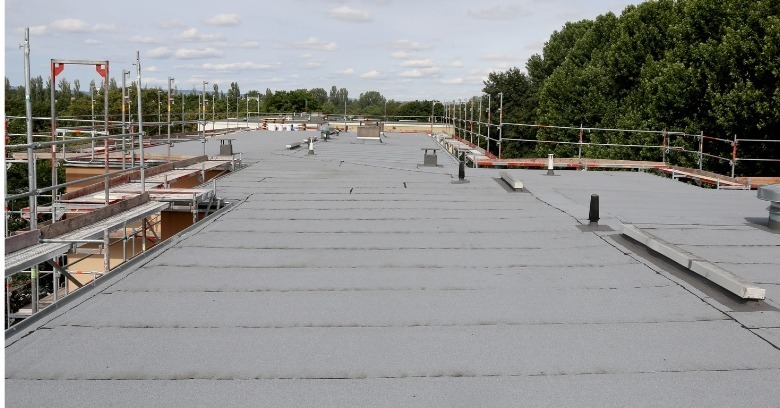
In the market for Commercial Roofing in Hidden Harbour Neighborhood Florida?
APC Roofing replaces and patches membranes on warehouses, shops and offices, taking in the edges, the outlets and every curb.
Phone 407-270-1129 and a roofer will walk the surface and explain the findings.
Above a Shop or Office – Some Background
Customers, goods and running machines fill the space beneath the covering, so a small opening can interrupt a full day of trade. Wide commercial buildings carry a top surface that is nearly flat, so outlet sizes and wind design come from engineering figures.
Air handlers, fans and communications gear sit on the membrane, and each support, line or duct gets careful flashing. The business inside shapes the choice of system, because a bakery and a document archive ask for different things.
Kinds of Low-Slope Covering – Names Decoded
TPO, PVC and EPDM are single-ply products made as one flexible layer, modified bitumen is asphalt blended with polymer and rolled out, and built-up roofing piles felt and tar ply on ply. Thermoplastic seams are welded with heated air, whereas rubber splices rely on primer and adhesive tape.
Fryer exhaust coats the area around a restaurant's fans, and oily residue softens asphalt and EPDM, so the stretch nearby is often PVC. Gravel-surfaced built-up roofing weighs a lot and wears well, because the loose aggregate keeps ultraviolet light off the bitumen.
Metal on Shops and Plants: Upkeep Notes
Some profiles are held down by screws driven through the flat of each sheet, and the purlins below take the grip. The sealing washers age and harden on a hot, sunny surface, and fasteners loosen as the metal moves with temperature.
A standing-seam system uses clips hidden inside raised ribs, and the hardware lets each pan travel. Corrosion gathers where sheets overlap and at trimmed ends, and a retrofit coating can give sound metal more years of service.
Deck Construction – What to Check
Fastening choices depend on the structure below, and reroofing leaves the framing in place. Ribbed steel accepts screws with no trouble, a concrete slab needs glue or anchors set in drilled holes, and wood or gypsum plank uses fasteners rated for the material.
Moisture trapped for years can rust through metal decking, and a weakened section is taken out and replaced before new layers go down. Wherever the interior is exposed, the underside gets a look from a lift, and small cores from above show the rest.
How a Membrane Is Secured: Matching the Choice to the Site
A fastened install uses plates and screws in the overlaps, fully adhered systems are glued across the whole underside, and ballasted sheets stay put under a blanket of stone. Deck type, building height and wind exposure point to the right method, and extra weight is used only where the structure can bear the load.
Screw-down systems flutter between plates when gusts hit, whereas a glued sheet holds steady on a clean, dry substrate. A ballasted layout turns inspection into a slow job, since the stone or pavers must be carried off to reach the laps.
Gusts and the Membrane: Planning the Attachment
Pull is greatest at the outside angles, since air accelerates on rolling over the perimeter. The zone running down each side follows close behind, and the center is loaded far more lightly.
Attachment rows tighten on the approach to corners and edges, and design tables for the height and exposure set the spacing. Where anchoring falls short, the membrane can lift at an outer angle, and the opening grows as each gust gets beneath.
Rigid Foam: Beyond Energy Savings
Polyiso sheets are laid across the deck with joints staggered, and a firm cover board spreads concentrated weight. Insulation reduces the load on air conditioning and furnaces, and tapered units can slope a dead-flat deck to the outlets.
Moisture in polyiso drives the R-value down sharply, and the heavy mass adds weight and rusts a steel deck. Nondestructive meters and cored samples show how far the problem reaches, and any spoiled patch is replaced, never roofed over.
Getting Rain Off – Parts of the System
Each interior sump wears a cast strainer dome, and trash and gravel stop at the bars instead of in the pipe. A clogged grate slows the outflow to a trickle, and a pond spreads across the field.
An overflow scupper sits a little higher than the main drain, so a steady spill up high signals a blockage below. Rain held across a wide area can put tons onto the beams, and a puddle still there two days after a storm indicates a sag or a matted strainer.
Finding the Source of a Drip – Patience Pays
A stained ceiling tile marks only where the drops fell, but the split in the sheet is often somewhere else entirely. Steel decking guides runoff down the corrugations, and joints between boards lead a trickle further still.
Laps, curbs and outlets upslope of the stain are checked by hand, and an electronic scan can pinpoint a hidden leak. Sealing whatever sits above the soggy tile rarely fixes anything, so a fresh ring appears in the next shower.
Cabinets and Condensate: Keeping Water Out
Each large machine stands on a raised curb, and the sheet is carried up the faces and tucked under metal. Each folded inside corner takes careful work to stay watertight, and a small gap lets wind-driven rain into the structure.
Swapping a machine for a newer model tends to add an adapter curb without flashing, so a new leak follows within a season. A trickle from a condensate pipe wears a streak of slime into the membrane, so the flow should be carried to a drain.
Pipes, Vents and Conduit: Handled Case by Case
A round plumbing stack gets a molded boot clamped at the top, while awkward profiles are boxed in a pitch pocket and packed with filler. Sun and seasons shrink the compound until cracks open, and a top-up is standard upkeep.
Electrical conduit and gas lines ride on blocks simply set in place, because a mount fastened through the sheet lets rain in. A walkway-grade pad under each base spreads the load, and the cushion saves the sheet from abrasion as the piping moves.
Skylights, Hatches and Smoke Vents – Service Notes
Ultraviolet light leaves acrylic and polycarbonate hazy and weak, and fractures tend to start at the fastener holes. A shrunken gasket or a separated miter lets water through, and the covering gets accused of a fault in the glazing.
Technicians lift the access hatch many times a year, and constant use loosens hinges and flattens the weatherstrip. Smoke vents are life-safety devices that pop open in a fire, so nothing placed during roofing work may pin the covers down.
Parapets on Commercial Buildings – Getting the Details Right
Base flashing carries the membrane up the inside face, a termination bar clamps the upper end, and counterflashing hangs down to shield the fastened line. Formed metal coping caps the parapet to keep rain off the top, but joints whose sealant has cracked admit runoff beneath.
Weathered brick and block take on water through the faces, and occupants below mistake the damp for a roof leak. Coping, wall and flashing are all looked at in the same inspection, and loose mortar is repointed rather than coated over.
Fascia Metal at the Outer Edge – Wind at the Border
A continuous cleat is fixed along the eave and locks the hem of the flange, and a stripping ply seals the sheet to the horizontal face. Perimeter pieces must carry a wind rating for the building's height, since a bent clip can let a gust peel a whole stretch.
An eave gutter on a big building collects runoff from a vast surface, and the hangers, joints and leaders must be sized generously. Bent or lifted trim belongs on the repair list, since early work protects the covering behind the edge.
Visitors Who Are Not Roofers: Setting Some Ground Rules
Refrigeration and heating crews climb up to the equipment month after month, and a worn lane appears between the hatch and the units. An abandoned screw gets forced through the sheet by a passing boot, and a toolbox dragged across the top tears the surface.
Thick rubberized pads trace a safe path to each unit, so scuffing lands on a sacrificial layer. Managers can require contractors to keep off the unprotected sheet, and cut-offs and fasteners go down with the worker who carried up the parts.
A Regular Look Up Top – the Routine
A walk-through twice annually suits most commercial coverings, and heavy wind is reason for an extra check. Upkeep includes emptying every strainer, the seams are traced with a probe, and sealant at pockets and terminations is pressed for give.
Before the stormy part of the year, attention goes to outlets and perimeter flashing, and a later round looks for anything a punishing season loosened. Minor faults get noted and pinned to a sketch, so repairs can be arranged before a leak starts.
Paperwork Worth Keeping: Knowledge That Lasts
A scaled drawing shows where each unit, drain and hatch sits, and the assembly is described from the structure to the membrane. Dated photographs of each repair go in alongside, and cut samples and infrared findings get appended.
Plenty of older buildings arrive with no history at all, which leaves every new contractor guessing. A roof log stays with the site, and a copy passes to the next manager or buyer.
Choosing the Scope – Matching Work to Condition
A sound membrane with a handful of local faults simply gets patched, while an elderly but dry surface can accept a new liquid system. Big stretches of waterlogged insulation make a new covering the sensible answer, as do laps cracking across the whole field, but the calendar alone is no verdict.
A silicone or acrylic coat demands a clean, mended substrate, while lingering dampness gets bottled up. Removing only the ruined parts can make sense as a middle option, when the surrounding field is still performing.
Routes to a Reroof: What Codes Allow
A recover puts a fresh membrane over the current roof, and a separation board is laid in between. An overlay is allowed by code over no more than a single existing covering, and the foam underneath must be dry.
A tear-off strips everything down to the structure, so rusted or soft decking gets fixed in the open. Fresh tapered boards can give a dead-flat surface some fall, and crickets between drains split the runoff.
Signs Worth Reporting – Reasons to Call
- Splashing from the upper overflow opening, which signals a clogged primary drain.
- A brown ring overhead that widens with each downpour, which indicates water reaching the interior.
- Peeling paint high on the exterior wall, which can trace to a leaking downspout joint.
- Fascia metal that flutters or rattles in a gust, which can hand a gale a lever.
- Standing water in the same place long after a downpour, which can indicate an overloaded deck or a plugged outlet.
- A yellowed, brittle skylight lens, which may give way under a misstep.
- Water trickling down an interior column in a storm, which often traces back to a lap or a curb.
- Water spilling over the lip of an eave gutter, which can mean a clog or an undersized run.
How APC Roofing Carries Out Commercial Roofing in Hidden Harbour Neighborhood Florida – Step by Step
The drains, scuppers and overflows get our attention before anything else, and the laps, curbs and perimeter come next. When a leak is present, the boards beneath are scanned, and the advice waits for the numbers.
A written report, photos and a sketch record what we found, and each fault is marked at the exact spot. The outcome we propose is a repair, a coating or a replacement, and the why is explained in terms you can verify.
Commercial Roofing for Property Owners in Hidden Harbour Neighborhood Florida: Plan the Next Step
Call 407-270-1129 and a time is agreed with whoever runs the building.
Life Under the Job: Practical Arrangements
Screwing into a steel deck rings through the rooms beneath, and glue fumes can travel down through open intakes. Noisy steps are discussed with the manager beforehand, and vents beside the work can be covered while the cement sets.
Waste is sent to the ground through an enclosed chute, and desks and machines under an open section can be shielded. Low-odor adhesives cut down the smell considerably, and the gentle option fits a store that stays open.
Staged Work on a Big Surface – Protecting the Interior
A careful tear-off exposes only what can be dried in before the crew leaves, and fresh foam and sheet cover the bare area without delay. A holding seal ties the completed edge to the untouched field each night, and the extra piece is sliced off the next morning.
The weather report limits the size of each tear-off, and any hint of showers shortens the stretch. A sudden soaking ruins exposed insulation, and drips can fall on whatever sits underneath.
The Weather We Work In: Timing and Materials
The colder end of our territory adds hail and snow load to the list, so a resilient top board and stronger framing are called for. Intense sunshine in every city we cover breaks a membrane down over time, and a white reflective surface cuts the warmth absorbed.
The coastal end of our territory demands fastening designed around hurricane gusts, and tropical storms require ample secondary drainage. Adhesives come with a cold limit printed on the label, while hot-air welding copes with cool days but not with showers.
Fall Protection Up Top: Practical Precautions
A perimeter without a tall parapet leaves an open drop, so warning lines or harnesses tied to anchors are used near the edge. Plastic skylights break under someone who stumbles onto the dome, and a wire screen or a rail around every opening stops a plunge.
Anchor points installed for good serve every trade that follows, and a gate at the ladder top adds protection. Where a screen or warning line is missing, our findings say so, because a fall from a low roof can still be serious.
When you need Commercial Roofing in Hidden Harbour Neighborhood Florida, contact APC Roofing at 407-270-1129. A roofer will inspect the drainage, the seams and the flashings, and a written report follows, with the next step up to you.