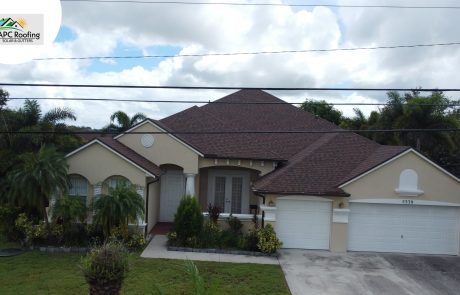
Trying to Find Hail Damage Roof Repair on a Family Home in Kissimmee Florida?
APC Roofing climbs onto the shingles once bad weather has passed through, reading the flashings and the vents along the way.
Call 407-270-1129 to have a roofer come take a look.
How Air Travels Over Shingles: Not Spread Out Evenly
The eaves, the rakes and the ridge carry the heaviest load of any gust, while an open middle section stays comparatively calm. Blowing air reaching under a curled tab pushes on the course set above the tab, so a nail under a shingle ends up doing the whole job alone.
A house corner throws wind into small eddies, and builders space the attachment points closer together at that spot. A row of shingles at that outside edge carries more push than a row set farther out, so extra fasteners there exist for exactly that reason.
A Last Step the Sun Finishes: Not Done at the Factory
A strip of sealant under every shingle grips the course sitting beneath, and a firm hold forms there, doing much of the work, not nails alone. A strong blast can snap a bond without moving the shingle, though nothing shifts out of place in the first hour after.
A broken seal stays quiet for the next windy spell, and moisture finds fasteners a tight course used to shelter. A single shingle off a bond hurts nothing taken alone, though several shingles parted together make a doorway rather than a blemish.
The Rating on a Bundle: Read With Care
In a lab, unused shingles are pinned to a board and every seal is made deliberately, before a controlled gust is brought to bear on the assembly. A roof already carrying a season or two of harsh weather no longer behaves like unweathered asphalt, and a rating drawn from the original goods stops counting once weather sets in.
Fastening outside the marked zone leaves a shingle with a weaker hold, and a course can fail at a wind nobody would call extreme. An aged mat loses flexibility a new mat still carries, and a laboratory rating fits new construction, never an older roof.
Hail Against a Shingle: Under the Surface
Stones grow largest in storms that cross the colder end of our territory, and the size eases as a storm tracks eastward. The force of a hailstone buries granules in the layer set below, and the struck spot goes soft under a thumb.
What stops rain from reaching a deck lies under the topmost grit, and a fault at that depth is never merely cosmetic. A struck area of a shingle runs down faster than a sound area beside a struck spot, and a roof weakens in patches rather than all at once after a wide hailfall.
Hardware That Also Suffers: Easy to Walk Past
A hit the asphalt handles fine dents soft metal beside a struck slope, and a mark left that way keeps the same shape for years. Rubber torn at a pipe penetration sends rain straight past a boot's seal, and the water that follows shows up in a room below. A dented gutter can still carry water as designed, while a crimped downspout carries water over the leading lip without help.
A roofer counts hollows in the flashing the same way a roofer counts marks on a slope, which keeps a whole roof in one set of findings. A storm strong enough to scar the shingles usually leaves a matching toll on the metal, so marked shingles hardly ever stand next to hardware with no marks at all.
What Ends Up in a Downspout: Worth a Second Glance
A mineral coat baked onto a shingle screens the asphalt from direct sun, and a bare patch left exposed hardens and splits within a season. A hard rain washes displaced grains all the way to a gutter, and a handful scooped from that spot says plenty about the roof.
An uncovered patch of shingle weathers far faster than a covered one, so a minor patch grows into a larger fault over time. A drift of grit at a downspout fell from the roof plane overhead, and a roofer can trace the source back to the face above.
Rain That Arrives Sideways: Where Water Is Not Meant to Go
Every overlap in a shingle assembly assumes gravity alone does the moving, and a lateral shove from a strong gust upsets that assumption completely. A turbine housing passes rain through once wind reaches a certain speed, so the deck nearby can darken with no tear anywhere on the slope.
Debris From a Tree – Weighing the Impact
Momentum arriving fast concentrates weight in one tight spot, and the framing bears force the finish alone never reveals. A board can crack even though the covering keeps a normal shape from above, and a roofer finds the break by tapping the deck and by checking from the attic.
Limbs raking a roof leave sweeping lines of exposed asphalt along the way, so the pattern left behind traces how far that motion carried. Reaching a cracked board usually means lifting the shingles above the break, which is why a small hit can turn into a larger job.
Reading the Underside of a Deck: Where the Story Is Plainest
A gleam between the boards signals a gap somewhere in the covering, and the location is clear well before anyone climbs onto the roof. A wet section of decking darkens and rust often follows at fastener tips, and the darkest mark generally sits closest to the actual opening.
Compressed insulation records a history of repeated soaking over time, so that stretch is worth replacing even as the top layer still looks intact. A gable vent can let driven rain reach framing well away from any break in the covering, and the answer in that case is a baffle behind the slats, not a repair to the surface.
Ceilings and Walls: Signs Worth Tracing
A brown ring on the drywall lands downhill of where rain first entered, and the true entry point can lie well uphill of the visible blemish. Blistered coating shows paint pushed away from behind by trapped moisture, which is why nobody should judge a covering by what shows up below.
Water reaching a ceiling fan is reason enough to cut power to that circuit, because live wiring beside standing water is the greater danger. Dampness at the top of a wall adjacent to a chimney can run down inside the chase, and step flashing along that run gets looked at as well.
The Metal Details on a Roof – What Pulls Free
The assembly at a wall junction depends on staying tucked beneath the shingle layers while nailed in place at once, and one weak point undermines the protection for the entire span. Uplift at a gable can twist a strip of edge metal out of line, so the section above starts to go the same way once that piece lets go.
Ridge caps sit in the roughest airflow on a roof and can still come away as a unit, and the seam stays unsealed the entire distance the instant that connection fails. A raised end on a vent lets rain slip in under the baffle, and the mess found below often spreads well past the point of entry.
Glass Placed Into the Roof – What a Storm Finds
A raised curb holds a skylight's glazing clear of the shingles nearby, so runoff gets sent aside long before reaching the seam. The outside glass of a unit can break while the inside layer holds, so the entire assembly gets replaced together.
Debris striking a plastic dome can leave a pattern that spreads with heat, so a hairline flaw rarely stays hairline for long in bright weather. A misted panel between two layers of glass is beyond ordinary cleaning, and no amount of daylight cures a fault hidden from view.
When the Rate Climbs Too High: What Overflows and Why
A short, heavy burst can deliver more water than a gutter section was built to carry, and the surplus pours over the front lip instead of down a downspout. Leaves and grit washed off a roof can choke the drain opening at the point of collection, and dampness trapped that way can seep in wherever the metal meets the trim.
What Bridges the Gap: What Stays On
A sheet fastened over an opening can keep rooms dry while a proper fix waits, because anything temporary is meant to come off once real repairs begin. A covering battened along every edge stays firm without further help, and every nail for that task goes through solid wood, never through the covering alone.
Anything simply sitting on top can leave with the next hard blow, so the damage from a failure can extend beyond the first weak point. Putting fasteners through good material creates problems nobody had before, so a roofer plans exactly where every screw for that cover lands.
Keeping Everything in Order: a Simple Trail
Photographs are taken of the whole house while conditions still match what a storm left behind, and every face of the house gets included in that record. Each damaged spot gets a number attached in ordinary figures, because a mark's true size is hard to judge without a reference point.
Conditions keep changing what a later look would actually find, and marks seen now may look different again next week. What gets requested for review comes across precisely as the paperwork shows, and the record describes the roof, and nothing beyond the roof.
A Line of Unmarked Rigs: Take a Moment First
Unfamiliar trucks can move street by street once skies have cleared, and only some of that traffic stays in the area for long. Paperwork handed over on a driveway still counts as a real contract, and there is always time to think before committing to anything.
A roofer with a nearby yard is easy to track down if a question comes up, so a concern that comes up afterward has somewhere to go. An offer that expires while a truck sits in the driveway is not a real offer, and sleeping on a choice like that is simply good sense.
Weakness That Compounds: Back Again
A roof that lost some grip once needs less wind the next time to lose more, and less force is required with each fresh round of damage. Where a course folded over once, the mat carries a break along that fold, and water can find that same flaw on a future occasion.
Once framing has taken on water before, a fresh leak follows the same open path, which is how a small fault can grow into a much more sizable one. Sheathing soaked more than once loses grip on the fasteners driven into the wood, and new material fastened there in that state will not hold securely either.
Things Worth Checking After a Storm: Inside and Out
- Corners of shingles curled or torn loose, obvious from across a street.
- A dimpled fascia cover or downspout, with a shape that holds for a long time afterward.
- Grit banked up at a drain outlet, more than a covering normally sheds.
- Daylight showing between roof boards overhead, with an attic lamp switched off.
- A spreading mark on drywall upstairs, in a bedroom or a hallway.
- Peeling near the top of a wall, drying out between storms.
- Glass in a skylight chipped or broken, or daylight showing where the unit meets the roof.
- A downspout crushed or pulled loose from a bracket, visible from the yard below.
The Way APC Roofing Works on Hail Damage Roof Repair in Kissimmee Florida: From the Call to the Finish
An inspection begins outside, along the lawn and the drive, before anyone climbs, and dented gutters or downspouts get photographed up close from below. Up top, each accessible plane gets covered end to end, while the underside of the deck gets a separate look from below.
Findings come back in writing, with photographs attached to every item, and every finding stays tied to a specific spot on the roof. A recommendation comes with the reasoning laid out step by step, and the choice of what to do next belongs entirely to the homeowner.
Hail Damage Roof Repair for a House in Kissimmee Florida: Getting a House Sound Again
Call us at 407-270-1129 to arrange a visit.
Snow on a Roof – Ready for Tougher Conditions
At the colder end of our territory, a big accumulation rests on the structure for days, which strains the wood beneath more than fresh powder would. A frozen edge at the gutter line can trap runoff on the slope higher up, which the membrane at that edge is meant to guard against.
Wind at the colder end of our territory packs snow into valleys and around chimneys, so the load across the framing ends up uneven rather than balanced. A built-up mass sliding loose can crush a porch set beneath the eave, and hangers can bend under strain from a sudden release like that.
A Harder Environment Near the Shoreline: Fatigue Builds in Hardware
Storms at the coastal end of our territory can keep blowing through long stretches of the day, and gutters and flashing there can corrode faster given the salt in the air. A drawn-out shove can flex every shingle tab thousands of times over a day, which is exactly why hardware spacing matters more in that harder-hit zone.
Wet blown against an elevation can work into window heads and trim, and interior cavities can stain as readily as ceilings do when that happens. Codes at the coastal end of our territory call for more fasteners per shingle, so nothing gets put back with less holding power than the original had.
A Fix That Blends In – What Stands Out Up Close
A newly made batch rarely lines up in shade with an aged covering nearby, which holds true across every manufacturer's lineup. Replacement shingles near a driveway can catch the eye of anyone passing, though a season or two eases some of that mismatch.
An older style no longer sold gets replaced with something comparable, so a gap in tone or texture remains even with careful selection. A slope covered in individual patches tends to read as pieced-together rather than one continuous surface, and redoing the whole side is a suggestion worth considering, not a requirement.
Signs of Careful Work: What to Notice
A mended section sits down without any visible ridges, and the reveal of each course matches the courses nearby. Each flashing piece laps the piece set lower on the slope, and caulk never ends up as the thing actually keeping water out.
Nails land at the spot the next row of shingles covers completely, and nothing sits crooked or cuts through the mat underneath. A snapshot taken soon after a repair is worth saving for the future, as that record gives anyone looking later something firm to compare against.
If Hail Damage Roof Repair is what brought you here after rough weather in Kissimmee Florida, contact APC Roofing at 407-270-1129 and a roofer will come out and look the covering over. What the weather left behind gets examined closely and photographed, and what happens next gets explained in plain language.
Verified

Verified
Verified
Verified
Verified