
You know your house needs new rain gutters, and now you’re choosing between sizes, styles and downspout setups you’ve never had to think about. Rain gutters in the Missouri Ozarks have to handle hard spring storms, heavy leaf fall and winter ice, so those choices matter more than they look.
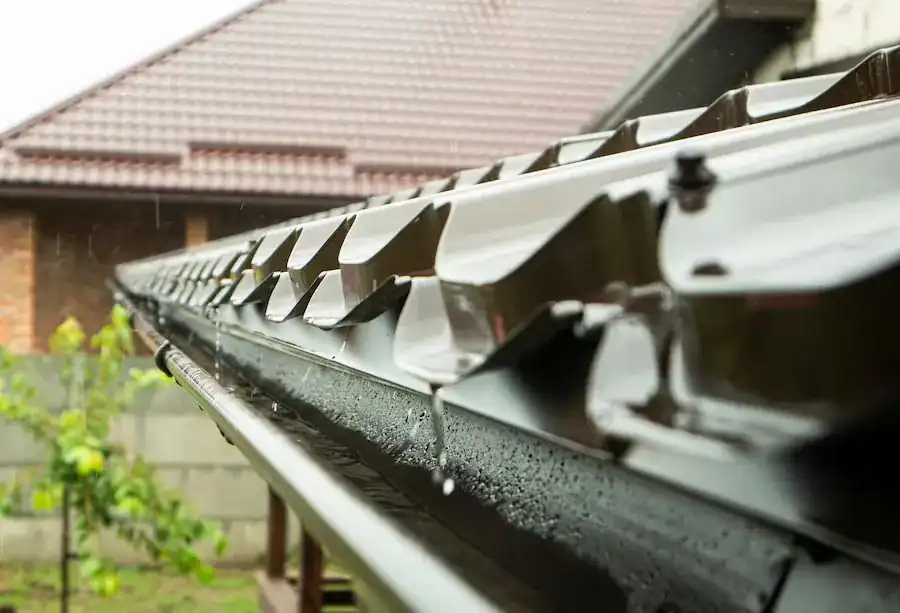
Nobody wants to pay for gutters twice. The good news is that the right system for your home comes down to a few things that can be measured, not guessed.
APC Roofing installs rain gutters across southwest Missouri, on their own or with a new roof. We’re GAF Certified, licensed and insured, and your estimate is free. Call 913-398-5020.
Rain gutters in the Missouri Ozarks: why they matter
Your roof sheds every drop that falls on it, and without gutters, that water drops straight off the eaves. It splashes mud onto siding, soaks the soil next to the foundation and wears trenches in the ground below. Over time, that can mean a damp basement or crawl space, rotted trim and settling around the house.
Ozarks homes have a few extra problems to plan for. Hardwood trees fill gutters with leaves and seeds every fall. Sloped lots make it tricky to get water away from the house without washing out the yard. Spring storms can dump a lot of rain fast. And winter ice adds weight that loose or flimsy gutters can’t carry.
Gutter size: 5-inch or 6-inch
Most homes use either 5-inch or 6-inch gutters, measured across the top. A 6-inch gutter holds and moves noticeably more water than a 5-inch one.
A 5-inch gutter is fine for many homes with modest roof sections and moderate pitch. A 6-inch gutter is worth considering if:
- Your roof has large sections draining to one gutter
- The roof is steep, so water comes off fast
- A valley or upper roof sends extra water to one spot
- Your current gutters overflow even when they’re clean
The right size comes from measuring each roof section and its pitch, not from a rule of thumb.
Gutter style: K-style or half-round
K-style gutters have a flat back and a decorative front that looks a bit like crown molding. They’re the most common style on homes, hold more water than a half-round gutter of the same width, and fasten easily to a flat fascia board.
Half-round gutters are a simple semicircle. They suit some older and traditional homes and drain cleanly, but for the same width they carry less water and need a different style of hanger.
Most Ozarks homes end up with K-style for its capacity. If the look of half-round matters to you, it’s worth talking through.
Materials
Aluminum is the most common gutter material. It doesn’t rust, it’s light, and it comes in many colors to match your trim. Steel is heavier and stronger, which helps with ice and falling limbs, but it can rust once the coating is scratched. Copper is a premium choice found on some high-end and historic homes. It weathers to a brown and then green patina over time.
We’ll talk through what fits your home and budget when we give you your estimate.
Downspouts: size, number and placement
Downspouts are where many gutter systems fall short. A gutter can only empty as fast as its downspouts drain. Standard downspouts are 2×3 inches. Larger 3×4-inch downspouts move much more water and clog less easily, which helps on wooded lots where twigs and seeds collect.
Placement matters just as much. Long gutter runs often need a downspout at each end. Each downspout should be placed where the water can be carried away from the foundation, and on a sloped lot that means thinking about which way the ground falls.
Where the water goes after the downspout
The last few feet decide whether your gutters protect your foundation. A downspout that empties right at the wall puts the water right back where you didn’t want it. Extensions, splash blocks or a buried drain line can carry water away from the house to ground that slopes away. On hilly Ozarks lots, it also helps to avoid dumping water where it will cut a channel through the yard or freeze on a walkway.
For the full process, see gutter installation in the Ozarks. For one-piece runs with no joints along the length, see seamless gutters. For an overview of all your options, visit our Ozarks gutters page.
How it works with APC Roofing
- Book your free estimate. Call 913-398-5020 or request a free estimate online.
- Get a clear, honest assessment and estimate. Your roof sections are measured, downspout locations planned and the fascia checked, and you get a written estimate.
- Get the work done and the site cleaned up. Your new rain gutters go up, and the crew cleans up before leaving.
Rain gutter questions
Do I need gutters if my house has a big overhang?
An overhang keeps some water off the walls, but it doesn’t keep water away from the foundation. If you have a basement, a crawl space or a sloped lot, gutters are still worth having.
Should my gutters match my trim?
Most people match the gutters to the fascia or trim so they blend in. Some prefer a contrasting color. Either works.
Why do my gutters overflow at one corner?
Often a valley above is pouring a concentrated stream into that spot, or the downspout there is too small or clogged. A larger downspout or a different gutter size at that corner usually fixes it.
How do I keep leaves out of my gutters?
Regular cleaning, especially after fall, does the most good. Larger downspouts also help debris pass through instead of clogging.
Rain gutters you can stop worrying about
Choose the right size, style and downspouts and you get a system that handles spring downpours, carries water away from your foundation and holds up under winter ice. Call 913-398-5020 to book your free rain gutter estimate. Trust matters.


















