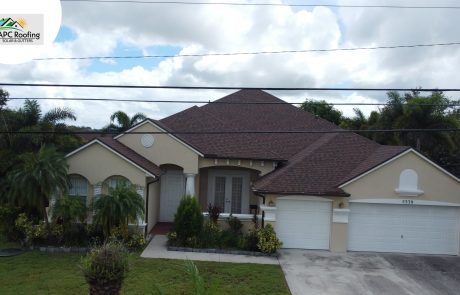
Researching Tile Roofing for a Property in Orlando Florida?
APC Roofing works on earthenware and cement coverings, new and old, whether the job is a single slipped piece or an entire slope reset.
Dial 407-270-1129 and a roofer who knows tile will explain what is going on overhead.
The Parts Above the Ceiling: A Plain Guide
The visible pieces take the weather and send most rain toward the gutters, while a sheet laid over the decking is what actually stops a leak. Strong gusts force some moisture through the gaps between courses, so the layer beneath has to guide that seepage out at the eave edge.
A cracked piece of tile does not by itself put a stain on a ceiling, because the underlayment below is generally still whole. Once past the underlayment, water often follows the decking downhill before it falls, so the mark it leaves can sit well away from the opening.
Choosing Between Materials: Points of Contrast
A clay piece starts as earth pressed to a profile and baked, and the color runs all the way through the body. Years of sun leave a slope of this kind looking much as it did, and a well-made piece absorbs very little rain.
Concrete is pressed from sand, cement and water, then cured instead of fired, and on many brands the color is a thin coat on the face. Constant sun slowly bleaches the brightest side, and any chipped edge shows up gray against the weathered front. Swapping in one unit leaves an obvious bright patch, and the difference narrows over many seasons.
Cement-based pieces take in more rain than fired clay, and toward the colder end of our territory, moisture taken in swells as it freezes. Over many seasons that cycle can spall the outer skin, so products carry a grade for how they stand up to that exposure.
Shapes You Will See – Style Meets Function
Mission-style barrel work lays separate pans and covers in alternating rows, and the look goes back to old Spanish colonial buildings. The S profile merges the hollow and the crown into one molded form, and many recent houses wear this version.
The flat kind sits nearly level on the deck and resembles slate or thick shake, while water steps down from course to course. Wavy patterns keep whatever falls from nearby trees, while smoother surfaces let the wind clear most of the debris.
The Structural Question – Switching Coverings
Per square foot, standard tile carries several times the pounds of shingles, and a house built under tile had its rafters sized for that from the start. A move up from a lighter covering adds weight the house was never meant to carry, and a sagging ridge line can be the result.
A structural engineer should review the rafters, spans and bearing walls before any such conversion, and strengthening is sometimes part of the answer. Some manufacturers offer a lighter concrete tile, and a house that could not hold full-thickness pieces may still manage that option.
Anchoring the Roof – Rules and Practice
Nails or screws driven through the head are a standard hold, and battens across the slope carry the courses on many jobs. Elsewhere a two-part foam bonds each tile to the underlayment, while mortar holds the entire field on still others. Nose clips supply added restraint on certain products, while local code and the manufacturer decide which mix is permitted.
Wind pulls hardest at the eaves, rakes, hips and ridges, so the perimeter carries a denser pattern of attachment. At the coastal end of our territory, building rules written for hurricanes demand more hold-down, so adhesive coverage and screw spacing are engineered to comply. A repair has to work with whatever holds the neighboring courses, since forcing loose a glued unit tends to break the ones next to it.
The Underlayment – Heat and Sunlight
Old roofs mostly carry asphalt felt, frequently doubled, but modern jobs often get a synthetic or a self-adhered bitumen roll. The pocket under the covering stays warm for months and wears on the underlayment, and a membrane of the wrong kind dries out years ahead of schedule.
The units overhead keep daylight off the material under them, but a hole ends that protection and the uncovered spot deteriorates rapidly. A dry ceiling below a missing piece is no reason to put off the replacement, since water passing a weathered membrane soaks into the plywood.
A New Sheet Under Old Tile – Matching Replacements
On a big project the pieces often come off one at a time and are stacked nearby, and weak spots in the sheathing are repaired. Next comes new underlayment, rolled out from eave to ridge, and the salvaged tile goes back on top. Nothing about the outside of the house seems to change, while the part that keeps rain out starts its life over.
A portion of the tile breaks on the way down or back up, and older material fails at a higher rate. Each new piece has to sit flush with its neighbors, and a profile still being made means a perfect match. Where nobody sells the old style any more, reclaimed tile or a close lookalike is used, and weathered and new pieces rarely look the same at first.
Breakage on the Slopes: Trees and Hail
Somebody's shoe accounts for a large number of the fractures, and the one on the roof was frequently installing a dish or cleaning a gutter. The top of a ladder set against the edge cracks the lowest units, and a standoff bracket that bears on the wall avoids that.
A dead branch landing on the roof shatters everything under it, so keeping trees clear of the house removes most of that risk. At the colder end of our territory, severe hail punches through clay and concrete, though pea-sized pellets usually do nothing.
Tile Underfoot – Planning a Path
Where a unit sits on the course beneath, it can take a person's weight, while the center has no backing and fractures under a shoe. With a curved profile, feet go in the low pan and stay off the hump, while boards laid over the covering take the traffic.
From above, a unit trodden on in the wrong spot can look intact, so breakage builds up on a roof without anyone knowing. Anyone putting equipment on tile should arrange the approach with a roofer beforehand, and tile beneath every bracket gets removed and put back properly.
In the Valleys – Litter and Overflow
Where adjoining slopes meet, a single fold gathers rain from both, and on tile a sheet-metal channel runs down it. The trimming on each side fixes how much of the bottom shows, and a gap left too slim overflows in a heavy downpour.
Many shortened pieces at the edge are too small to keep a nail hole, so foam, clips or wire ties hold them in place. Debris lodged in the valley holds the runoff back, and some of that water travels sideways beneath the pieces.
The Capping: Signs of Age
The joints at the peak and the outside corners are covered with shaped trim, and on many homes it is set in mortar. Old bedding splits as the roof warms and cools, so the pieces loosen and crumbs wash down the slope.
Many newer roofs mechanically fasten the trim to a raised support rail, and a flexible closure or foam seals the gap beneath. Some of those materials are made to let air pass for attic ventilation, while their shape still keeps rain and insects from getting in.
Chimney and Wall Junctions: Wide Channels
A vertical surface rising from a slope gets an angle of sheet steel turned up its face, and an overlapping counterflashing keeps weather from getting behind its upper edge. A tile roof needs a broad pan there, finished with a raised rim, and the adjoining tile ends short so rain has room to drain.
Caulk used as a shortcut loses its grip after a few summers, so the same spot takes on water again. A durable repair removes the pieces nearby and reshapes or replaces the metal, and the underlayment along that edge is redone while it is open.
Things That Pass Through – Mounts and Skylights
The underlayment is joined to a base flashing around every plumbing riser, and a malleable lead cover is shaped down over the tile. A standard neoprene boot cannot follow the rise and fall of a rolled piece, and rain gets under its flange.
Skylights, attic vents and solar mounts each need flashing made for a tile shape, and anything drilled through a piece without it becomes a leak.
At the Bottom Edge – Setting the Angle
At the gutter, each curved piece leaves an open mouth beneath it, which lets in birds, wasps and wind-blown rain until something fills the hollow. A closure made for the purpose is installed along the fascia, and weep slots in it allow trapped water to drain.
Eave pieces have nothing below them to angle them up, so a riser strip props them up. A flat front row holds water instead of shedding it, and a visible droop shows from the driveway.
Built-In Cooling – Trouble Spots
On battens or through their own curve, many coverings sit up off the wood, so moving air runs beneath the courses. The draft strips heat away before it travels downward, and the sheet below is spared much of it.
Across a long summer, air conditioning tends to run less, while thick material slows the warmth moving through it. Leaves packed at the eave or mortar filling the ridge can shut the airflow off, and the pieces then hold heat against the deck.
Growth and Stains: Upkeep Choices
Newer concrete sometimes shows a powdery white film called efflorescence, and it fades on its own with rain. Moss packed into the overlaps holds rain where it should drain, and at the colder end of our territory freezing slowly flakes the surface.
Pressure washing strips the color coat from concrete, and it drives water in beneath the courses. A cleaner made for roofs, rinsed off gently, removes growth more safely, while clearing the valleys and gutters by hand keeps drainage open.
Things to Watch For: Before Damage Spreads
- One unit sits lower than its neighbors, which points to a broken fastener or a failed bond.
- An empty space interrupts the pattern of tile, and the exposed sheet begins to degrade in sunlight.
- Chunks of tile collect along the driveway or walk, and the break they came from may be out of sight.
- Mortar pieces sit in the grass below a ridge, as the old bedding up top gives way.
- A brown ring spreads on a ceiling below the roof, though the leak itself may start far from that spot.
- A wall next to the chimney has swollen drywall, which points to the flashing at that joint.
- Lichen and moss crowd the shaded side of the house, so drainage on that slope may be slowing.
- The line along the bottom edge dips or waves when seen from the yard, and a missing riser or rotten fascia may lie behind it.
How APC Roofing Takes On Tile Roofing in Orlando Florida: Our Method
The opening step is walking every slope, and the material, the shape and the way the pieces are set are identified. Valleys, ridges, wall junctions and the eave are then looked at closely, and pieces are lifted in places where the underlayment has to be seen. The attic is checked from inside for water marks and weak boards, because discolored plywood shows the path of any leak.
Any problem is photographed, with measurements taken of the extent. What was seen is set out in a written report, and the reasoning behind each suggestion is spelled out. Where the sheet under the pieces is sound and only pieces are broken, the answer is a repair, and a spent underlayment is identified plainly. The owner has the final word, and deferring the work is a valid choice.
Tile Roofing in Orlando Florida – Looked at Closely
Call 407-270-1129 to ask about a visit.
Mending or Relaying – Reading the Condition
A cracked piece, a loose cap or a leaking wall joint is usually a contained problem, so the effort is confined to that area. The condition of the underlayment determines whether a relay is needed, while the look of the pieces tells very little.
When the waterproofing is spent across one side of the house, the pieces there are relaid, while the sound slopes are not disturbed. Underlayment installed in a single job generally gives out at about the same point, so the untouched parts may need the same work before long.
Tile Over the Years – Upkeep Matters
Clay of high quality can hold up for a century or longer, and concrete holds up for many decades, as a rule not quite as long. Underlayment gives out well before the pieces do, and its condition usually sets when major work comes due.
A roof checked regularly and kept clear of debris gets its full span, whereas neglect lets a single gap ruin the sheet early. A stated age is a rough guide, not a pledge, as grade, hold-down and flashing detail all change it.
Getting the Basics Right – Code and Maker Rules
Tile sheds rain through overlapping courses, not sealed joints, which means the angle has to be sufficient for water to run off. Where the pitch is modest, a stronger underlayment system is required, and beneath the stated minimum another material belongs.
Every board under the tile needs to be firm, so damaged sheets are swapped out while everything is exposed. Clean gutters matter to the covering above them, because an overflowing trough can send water under the eave pieces.
To look into Tile Roofing in Orlando Florida, dial APC Roofing at 407-270-1129. The slopes are walked and the findings are put in writing, and what happens next is up to you.
Verified

Verified
Verified
Verified
Verified